If you are a developer or business leader choosing which model to integrate into your application, you need clear, practical insights.
In 2025, two models dominated the conversation: Google's Gemini 2.0 Pro and OpenAI's o3. This article provides a practical, step-by-step comparison of these models, discussing real-world use cases, integration challenges, pricing, and performance. It also explains where Wonderchat, which makes the AI model a setting, fits next to these two models.
Table of Contents
Model Overview and Capabilities, 3.1 Multimodal Processing
3.2 Reasoning and Context Windows
Introduction
When selecting an AI model for your applications, the decision goes beyond raw performance metrics. Integration ease, developer support, pricing, and ecosystem compatibility are equally critical. Gemini 2.0 Pro and OpenAI’s o3 each offer unique benefits, and this guide is designed to help you determine the right fit based on your technical requirements and business goals.
Key Considerations for AI Model Integration
Before diving into the technical details, ask yourself:
What types of data will your app process?
Do you need advanced multimodal capabilities (e.g., processing images and audio alongside text) or is a text-centric model sufficient?How critical is real-time performance?
Evaluate the speed of inference and latency in delivering responses.What is your budget for both development and ongoing operations?
Pricing and operational costs vary considerably.Which ecosystem do you already rely on?
Integration with existing cloud or productivity tools can save development time.How complex are your required tasks?
Some applications need deep reasoning and coding assistance, while others benefit from rapid, broad responses.
Answering these questions is a first step in helping you determine whether Gemini 2.0 Pro or OpenAI o3 is best for your need.
Model Overview and Capabilities
3.1 Multimodal Processing
Whether you’re developing an enterprise chatbot, a product recommendation engine, or a complex AI agent knowledge base assistant for your website, understanding these models’ strengths and limitations is essential.
Gemini 2.0 Pro:
Strength: Natively handles text, images, audio, and video, making it highly versatile if your app requires the interpretation of multiple data types without extra preprocessing.
Use Case Example: A mobile app offering real-time assistance via image recognition (such as identifying products or scanning documents) alongside textual queries.
OpenAI o3:
Strength: Excels in advanced text processing and logical reasoning with its enhanced chain-of-thought mechanism. Although it supports multimodal tasks, it often requires extra steps to preprocess non-text data.
Use Case Example: A technical support chatbot or coding assistant that relies on deep, logically structured responses.
3.2 Reasoning and Context Windows
Gemini 2.0 Pro:
Strength: Features an expansive context window that is ideal for handling lengthy inputs, whether it’s for detailed document analysis, long conversations, or complex planning tasks.
Integration Tip: Use Gemini’s large context window if your system involves summarizing extensive reports or handling multi-turn conversations.
OpenAI o3:
Strength: Utilizes a chain-of-thought reasoning process that allows for step-by-step problem solving, making it effective for tasks requiring deep analysis and logical deductions.
Integration Tip: Choose o3 for applications where reliable logical reasoning is essential, such as advanced analytics or coding support.
Performance in Real-World Applications
Performance in a controlled test environment can differ from production use. Here’s what you can expect:
Gemini 2.0 Pro:
Speed: Optimized for low latency, crucial for real-time interactions in consumer-facing apps.
Stability: Benefits from integration with Google’s reliable infrastructure, ensuring consistent performance across devices.
Practical Insight: Ideal for high-volume applications where rapid responses and energy efficiency are key.
OpenAI o3:
Speed: Although its inference may be slightly slower due to intensive reasoning, o3 consistently delivers highly accurate and logically coherent responses.
Stability: Well-suited for enterprise-level applications where the depth of analysis and precision outweigh the need for ultra-fast responses.
Practical Insight: Best for specialized applications where the quality of reasoning is paramount.
Integration and API Support
Gemini 2.0 Pro:
API Integration:
Easily integrates via Google Cloud’s Vertex AI with comprehensive documentation, sample code, and SDKs available in multiple programming languages.
Practical Tip: If your infrastructure already uses Google services, integration is nearly plug-and-play.
Developer Tools:Reliable monitoring, quota management, and fine-tuning tools simplify development.
OpenAI o3:
API Integration:Offers extensive API endpoints with reliable error handling and scalability features.
Practical Tip: Ideal for applications that require detailed logging and debugging support for complex tasks.
Developer Tools:
Extensive libraries, plugin support, and enterprise-grade security features enable efficient custom development.
Wonderchat makes the AI model a setting, with models from OpenAI, Anthropic, Google and DeepSeek depending on your plan, so there is no integration code to write. With Wonderchat, the plan includes the AI models, so you do not manage each provider's API keys.
Cost, Pricing, and Operational Efficiency
Gemini 2.0 Pro:
Pricing Model: See Google's pricing page for current Gemini prices.
Operational Costs:
Lower inference costs and energy consumption make it suitable for high-volume, consumer-focused apps.
Budget Tip:
If your app requires broad, real-time interactions, Gemini’s cost efficiency is a significant advantage.
OpenAI o3:
Pricing Model:
Generally positioned at a premium, particularly for enterprise applications that demand advanced reasoning capabilities.
Operational Costs:
Higher inference costs are justified by the model’s superior performance in deep analytical tasks.
Budget Tip:
For applications where accuracy and detailed analysis are paramount, the investment in o3 can yield higher quality outputs.
Developer Experience and Ecosystem Impact
Gemini 2.0 Pro:
Ease of Use:
Particularly attractive for developers within the Google ecosystem, offering native integrations with services like Google Docs, Sheets, and Gmail.
Community and Support:
Strong support channels and an active developer community facilitate streamlined integration and maintenance.
Practical Benefit:
Ideal for businesses that want to deploy quickly with minimal customization overhead.
OpenAI o3:
Ease of Use:
Designed for complex, high-stakes projects requiring deep reasoning.
Community and Support:
A vibrant ecosystem with detailed documentation and active community forums aids in iterative development.
Practical Benefit:
Excellent for specialized applications requiring precise multi-step logical processing.
Practical Use Cases and Recommendations
When to Choose Gemini 2.0 Pro:
Consumer Apps: Real-time chatbots and virtual assistants where rapid response is critical.
Multimodal Applications: Projects that require integrated processing of text, images, audio, or video.
Google Ecosystem: Businesses already using Google Cloud or Workspace will benefit from integration.
High-Volume Interactions: Cost-effective for applications with large user bases.
When to Choose OpenAI o3:
Enterprise Solutions: Tools requiring deep reasoning, such as coding assistants or analytical platforms.
Complex Problem-Solving: Applications that need extensive logical processing and multi-step analysis.
Customization Needs: Projects that demand highly tailored API control and detailed debugging.
Quality-Focused Applications: Scenarios where accuracy and logical depth are prioritized over response speed.
Where Wonderchat Fits
For businesses that want an answering agent built on their own content without building from scratch, Wonderchat is one option. Wonderchat answers from your own content and makes the AI model a setting, with models from OpenAI, Anthropic, Google and DeepSeek depending on your plan. With Wonderchat, you can:
Build Custom AI Agents: Create agents powered by your own knowledge base (website links, PDFs, or text documents), and most teams are live the same day.
Integration: Add the agent to your website with the chat widget, and to Slack, WhatsApp and every other channel on every plan.
Model Flexibility: Change the AI model in the settings as your needs evolve, with models from OpenAI, Anthropic, Google and DeepSeek depending on your plan.
Customer Support: Get answers at any hour to the repeat questions your content already covers, with a handover to a person, transcript attached, when it cannot answer.
Analytics: See how the agent is doing in the analytics dashboard, from the Basic plan.
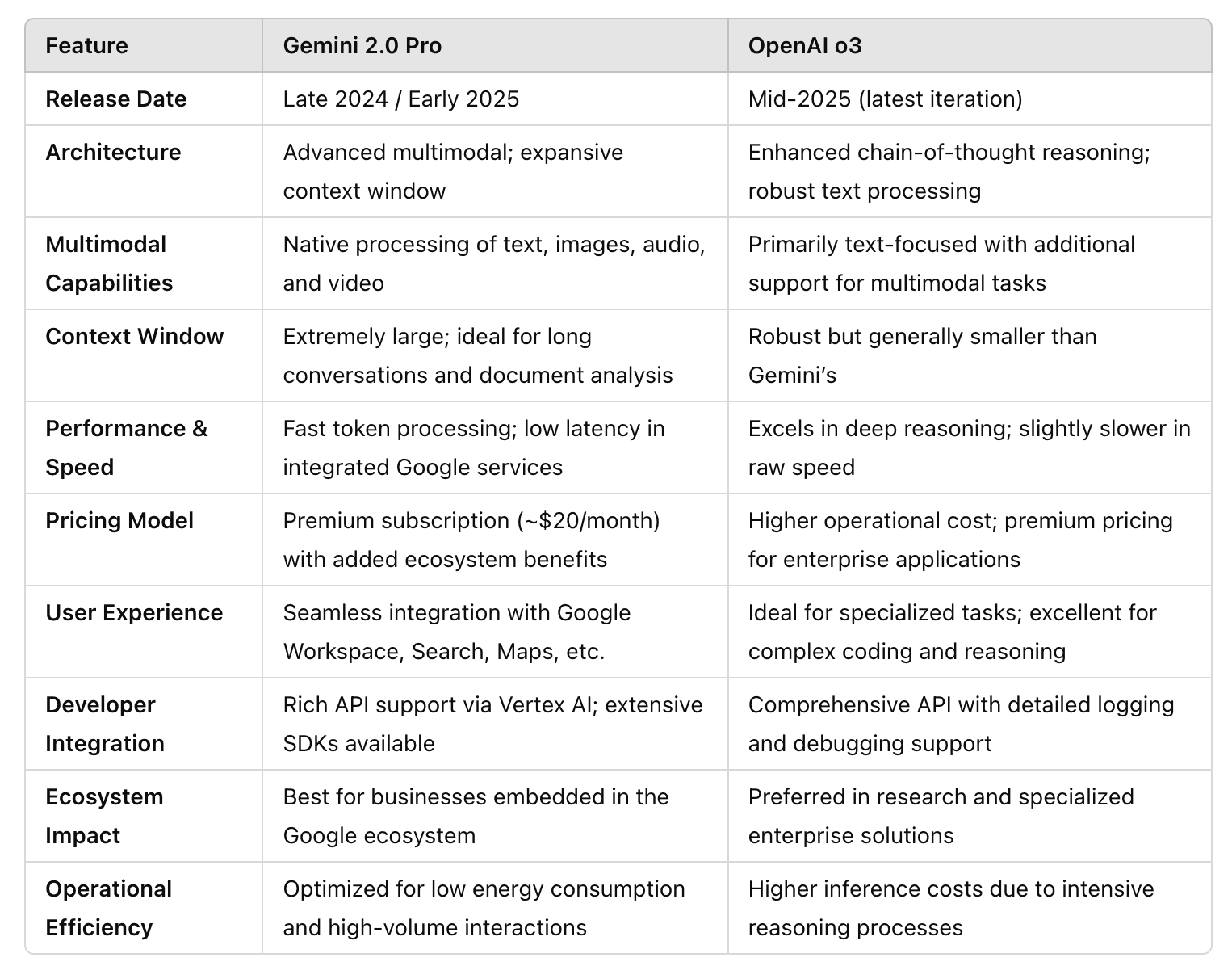
Detailed Comparison Table
Conclusion and Recommendations
Choosing between Gemini 2.0 Pro and OpenAI o3 ultimately depends on your specific application needs:
Gemini 2.0 Pro is ideal for developers seeking a versatile, fast, and cost-efficient solution that integrates with Google’s ecosystem. It’s particularly well-suited for consumer apps, multimodal tasks, and high-volume real-time interactions.
OpenAI o3 shines in enterprise applications that demand deep reasoning, complex problem-solving, and highly customized integration, making it the go-to model for specialized applications where precision is paramount.
For those ready to set up an answering agent, Wonderchat is one place to start. Wonderchat makes the AI model a setting, with models from OpenAI, Anthropic, Google and DeepSeek depending on your plan.