
Summary
The best multilingual chatbot depends on the situation: Wonderchat for cited answers over an existing help desk, Zendesk AI for teams already on Zendesk, Ada for messaging, email, and voice programs, Tidio Lyro for smaller ecommerce teams. A language count says little about retrieval quality, mid-chat switching, or human handoff.
Fin, Ada, Chatbase, and Microsoft can work across the customer’s language and the source language, but their retrieval and fallback rules differ.
Human handoff is only multilingual when the receiving queue can continue in the customer’s language.
Wonderchat can answer from connected knowledge and hand off work to an existing support stack, although it currently publishes less language-by-language detail than several enterprise suites. For a small B2B team with a help center in a few languages, Wonderchat answers only from your docs, shows the source on every reply, and says so when it can't find the answer.
A multilingual AI chatbot detects the language of a customer’s message, finds the right information, and answers in that language, even when the help center is written in another one.
Detection guides the language path, generation shapes the reply, and retrieval decides whether that reply uses the right facts.
A help center written in English answering a question asked in Spanish is a retrieval problem, not a translation problem. When retrieval selects the wrong English passage, the agent can return the wrong policy in fluent Spanish.
Wonderchat reviewed official product, help, documentation, and pricing pages for all ten platforms included in this guide on September 1, 2026. Instead of ranking language totals, Wonderchat checked how each platform detects language, retrieves across languages, writes the reply, and hands unresolved work to a person.
Those findings shaped the guide below, beginning with the three capabilities that have to work before any platform earns its multilingual label.
3 Capabilities of a Multilingual AI Chatbot
A multilingual answer depends on three separate steps, and each can fail even when the other two work.
Detect the language. The agent must identify the language from the message, browser settings, customer profile, or a direct choice. Short replies, product names, and code-switching can send the conversation down the wrong language path.
Generate the reply. The answer must use the customer’s language while keeping product names, policy terms, dates, currencies, links, and the right level of formality. A fluent reply can still change the meaning of a refund rule.
Retrieve the source. The system must find the passage that answers the question, even when the source uses another language or different wording. Semantic search and retrieval perform this work before the reply is written.
When Wonderchat compared the ten platforms, language generation was easy to find in vendor documentation, whereas retrieval rules required much more digging. That gap made cross-language retrieval the hardest part of the comparison because the agent has to find the right source before it can write a supported answer.
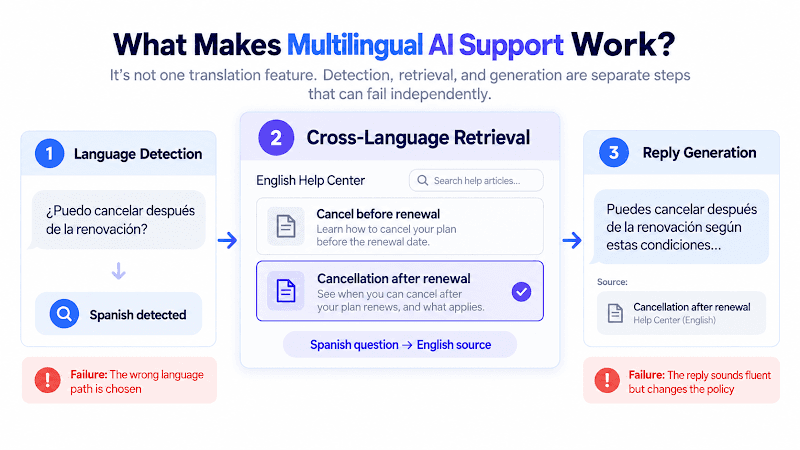
Multilingual support depends on detecting the language, retrieving the right source, and generating a faithful reply. Retrieval is where a fluent answer can begin with the wrong facts.
Why Cross-Language Retrieval Is the Hard Part
Imagine a customer asks in Spanish whether a subscription can be canceled after renewal. The English help center has one article about renewals and another about cancellations. A system that matches only familiar words may retrieve the general cancellation page, then turn the wrong policy into polished Spanish.
The translation worked. The answer didn’t.
Cross-language retrieval has to match meaning across languages before the model writes anything. It also needs a safe fallback when the source is missing, outdated, or tied to another region. That fallback may be a clarifying question, a refusal, or a handoff to a person who can continue in the same language.
When Wonderchat first opened the vendor pages, it expected language counts to make the comparison simple, but the setup rules changed that view.
Fin searches the customer’s language first and, when Real-time translation is enabled, searches only one chosen fallback language if nothing relevant appears. Content in any other language is not used as a fallback.
Ada follows a different order. When same-language articles exist, the agent uses only those articles, and when they do not, it falls back to English. Multilingual Knowledge is off by default for new agents, so they begin by producing non-English replies from English content.
Microsoft supports language-agnostic queries across supported files, although SharePoint, OneDrive, and connector sources have separate limits.
These rules reveal more about real coverage than the language total, and they are what to ask each vendor to show in a trial.
10 Multilingual AI Chatbot Platforms Compared
In the comparison table, Wonderchat separated what each vendor publicly documents from what still needs to be tested. Cross-language retrieval means finding the right source when the question and source use different languages, but a documented method doesn't prove every answer will be correct.
Platform | Published language coverage | Language detection | Cross-language retrieval | Human handoff in-language | Pricing model |
Wonderchat (Best for source-cited support over an existing stack) | 40+ languages | Replies in the user’s language; widget copy needs separate language setup | Answers from connected sources; cross-language matching needs testing with real content | Live chat, email, or tickets synced to Zendesk or Freshdesk on Basic and up; the receiving team must cover the language | Plans billed in AI replies, not seats; the widget in several languages and chatlog translation start on Scale |
SiteGPT (Best for a no-code website agent) | 95 languages | Automatic detection | Documents answers in another language from English content; test conflicting and regional policies | The full transcript passes to SiteGPT chat or connected tools; language continuity depends on staffing | Starter is $39 monthly with annual billing or $59 month to month; message use changes with the model |
CustomGPT.ai (Best for large content collections and API use) | 93 on its language page; its FAQ says 92 | Uses the language of the request; test mid-chat switching | Documents an example using Arabic content, a German question, and a Japanese answer; broader accuracy still needs testing | No native live-agent handoff path is clearly documented | Standard is $99 per month for 1,000 queries; Premium is $499 for 5,000 |
Chatbase (Best for model choice and helpdesk integrations) | 95+ for AI answers; Help Desk translation supports 44 | Automatic for AI answers and incoming Help Desk messages | Documents training in one language and answering in another; the fallback order is not stated | Creates tickets in nine supported helpdesks; customer messages can be translated, while agent replies need AI Compose translation | Hobby starts at $32 per month with annual billing for 700 credits; Help Desk features start on Standard at $120 per month with annual billing |
Fin, formerly Intercom (Best for a mature AI layer on its own inbox or another helpdesk) | Publishes a language list with regional variants, but no total | Automatic, but detected once per conversation | Searches same-language content first, then one chosen fallback language when Real-time translation is enabled | AI Inbox Translation can translate customer messages and teammate replies; some regional variants are excluded | $0.99 per billable outcome; seats apply when used with its inbox suite |
Zendesk AI (Best for teams already using Zendesk) | 80 AI-agent languages; automatic translation covers a smaller set | Switches from customer input, with native-script limits for some languages | Default-language translation is documented; cross-language retrieval is not clearly separated | Agent Workspace keeps context and can route by group or skill; continuity depends on staffing and translation setup | Included with Suite and Support allowances; Suite Team is $55 per agent monthly with annual billing, with tiered resolution usage |
Ada (Best for messaging, email, and voice programs) | 60 for messaging and email; voice supports a smaller published list | Automatic and can switch during a conversation | Uses same-language articles first, then English knowledge when no matching article exists | Handoff messages can be localized; the connected desk and human queue must support the language | Quote-only, with conversation-based and some resolution-based contracts |
Tidio Lyro (Best for ecommerce and smaller support teams) | 48 Lyro languages | Automatic within the languages enabled for the account | Processes sources in their original language; the cross-language fallback order is not fully documented | Online chats pass their history to an agent, while offline requests can become tickets; handoff messages can be translated | Starts at $32.50 per month for 50 Lyro conversations |
Microsoft Copilot Studio (Best for Microsoft-centered custom deployments) | Lists vary by feature and release stage | Browser locale by default; mid-chat switching needs generative orchestration or custom setup | Supports language-agnostic queries across supported files; SharePoint, OneDrive, and connector sources have separate limits | Full-context handoff needs Dynamics 365 Omnichannel or another engagement hub | $200 per month pay-as-you-go |
IBM watsonx Assistant (Best for separate, controlled language deployments) | 13 dedicated language models, plus a universal model | Usually one language per assistant or a translation webhook | Recommends same-language search collections for language-specific assistants | Web and phone can connect to people, but language-specific assistants and queues need separate setup | Lite is free for 1,000 monthly active users and 10,000 messages; Plus lists $148 per instance and $14.85 per 100 active users |
Language coverage and prices were checked on September 1, 2026. Counts may include regional variants, and coverage can change by channel or feature. Vendor documentation describes product behavior rather than independently verified accuracy.
What Multilingual AI Chatbot Language Counts Leave Out
Once the claims sat in one table, the totals stopped looking directly comparable. Ada’s 60 applies to messaging and email while voice uses a smaller list, Chatbase separates 95+ AI-answer languages from 44 Help Desk translation languages, and Zendesk’s 80 AI-agent languages do not all receive the same automatic translation support.
The first filter should be the exact language and channel a team needs, followed by a live retrieval and handoff test. A platform may support Spanish chat but not Spanish voice, translate the final reply without finding the right source, or pass a transcript to a queue without anyone available to continue in Spanish.
Wonderchat answers from the content you connect and shows the source on every reply, so a wrong match is visible in the citation rather than hidden in fluent text. It fits teams that want cited answers from their own content while keeping Zendesk or Freshdesk. Wonderchat supports 40+ languages, although Ada, Fin, Zendesk, and Tidio publish clearer language-by-language lists and channel rules.
Wonderchat prices by AI replies rather than by language. Teams can run a separate agent for each language, and the widget in several languages starts on the Scale plan.
What the EU AI Act Requires for Multilingual AI Chatbots
Article 50 of the EU AI Act has applied since August 2, 2026. Providers must design AI systems that interact directly with people so users are told they are speaking with AI from the start of the first interaction, unless that fact is already obvious. The notice must also be clear, distinct, and accessible.
Article 50 does not give every user a general right to a live agent. Even so, a human path remains an important control for low-confidence answers, billing disputes, security issues, and languages the support team cannot serve. Consumer law, sector rules, or the company’s own risk policy may create further duties, so the final setup still needs legal review.
For multilingual support, show the disclosure in the language used to begin the conversation and make sure it remains clear when the customer switches languages.
How to Evaluate a Multilingual AI Customer Support Platform
Run one small pilot before comparing language totals. Start with three to five languages that already appear in support tickets, then use the same approved sources and the same questions in each one.
Ask every vendor these five questions.
What happens when the question and source use different languages? Ask for a live English-document, Spanish-question test instead of a slide about translation.
How does the agent handle code-switching and short messages? Try a sentence that mixes two languages, a two-word reply, a misspelling, and a product name that looks like a normal word.
Which language wins when policies conflict? Give the agent an old French refund page and a current English policy, then check which date and region it follows.
Can the human queue continue in the detected language? Confirm that the transcript, detected language, summary, and customer fields reach the right team during and after business hours.
Can results be reviewed by language? Request language-level unanswered questions, handoffs, repeat contacts, citations, and customer feedback instead of one blended accuracy score.
The third and fifth questions are uncomfortable for many products, including Wonderchat. They are still the questions that expose whether multilingual support works after a clean demo.
For implementation, prepare current FAQs, product docs, policies, and resolved tickets before setup. If the pilot uses Wonderchat, the multilingual setup guide explains when to use separate agents for each language, one multilingual agent, or script overrides for fixed widget text.
Whichever setup you choose, test formal and informal wording, regional terms such as Canadian French or Brazilian Portuguese, and a language the human team does not speak.
Test Cross-Language Retrieval Before You Buy
Do not begin with a clean translation demo because almost every platform will pass it. Use one current English policy and one older article that looks relevant but contains the wrong rule, then ask the same question in Spanish.
The agent should retrieve the current passage, cite it, and preserve every date, limit, and regional term. When the sources cannot support an answer, it should stop and send the full conversation to the right human queue.
In Wonderchat, you can connect the support sources your team trusts, inspect the citation behind each answer, and configure handoff through live chat, email, Zendesk, or Freshdesk. Wonderchat cannot fix a missing policy or staff a multilingual queue for you, which is why the pilot should test both retrieval and the human path.
Build an AI Customer Service Agent and run the test yourself, or book a demo and bring one cross-language question your current setup gets wrong.
FAQs About Multilingual AI Chatbot
What are multilingual chatbots?
Multilingual chatbots are automated conversation systems that detect or receive a user’s language, find relevant information, and answer in that language. A support-grade system also preserves policy meaning, handles language changes, and sends unresolved work to a human team that can continue the conversation.
Is ChatGPT multilingual?
Yes. OpenAI lists 59 supported ChatGPT interface languages and says its models can understand and generate text across many languages. That is not the same as a support agent that retrieves approved company content, follows support policy, and hands off unresolved work.
How to build a multilingual chatbot?
Choose three to five languages from real ticket data, connect approved content, set detection and fallback rules, and test the same intents in every language with native speakers. Include code-switching, spelling errors, outdated policies, and a handoff to a queue that can continue in the customer’s language.
Are AI chatbots illegal?
No, AI chatbots are not illegal. In the EU, Article 50 generally requires people to be told when they are interacting with AI from August 2, 2026, unless it is obvious. Article 50 does not itself create a universal right to live-agent support, while other laws may add duties.

