Summary
Enterprise-grade AI needs SSO, role-based access, audit logs, controlled knowledge, human handoff, and a deployment model that passes security review.
Commercial models vary as much as the products, from seats and conversations to actions, resolutions, credits, and six-figure custom contracts.
The right choice depends on your stack and risk. Zendesk and Salesforce reward existing customers, Rasa gives developers more deployment control, and Crisp has the strongest EU data location in this list.
Wonderchat Enterprise brings source-cited answers, access controls, and human handoff into the support systems your team already uses.
Enterprise-grade is not a larger message limit with single sign-on (SSO) added to the plan.
The platform must control who can access each source, record who changed the agent, keep customer data in an approved region, and pass the full conversation to a person when AI should stop.
Executives are already pushing the timetable. Gartner found that 91% of customer service leaders faced executive pressure to implement AI in 2026.
I compared the best enterprise AI customer service platforms on the controls that still have to work after the demo ends.
10 Leading Enterprise AI Customer Service Platforms
This list covers ready-made support agents, full customer service suites, and developer platforms.
I checked official product, security, help, and pricing pages on August 26, 2026. A high ranking here does not mean one platform fits every enterprise.
The useful question is what your team must own. Keeping Zendesk or Freshdesk leads to an agent that sits above the current queue, and native CRM actions, voice, EU-only storage, or customer-controlled infrastructure lead to very different shortlists.
Here are the 10 platforms I would compare first, along with the enterprise setup each one suits best.
1. Wonderchat
Best for: Enterprise teams that need checkable answers from complex content while keeping their current support stack.

Wonderchat lets you build an AI Agent on the company content your support team already trusts. It can crawl an entire public or private website, stay within one directory, or use selected pages. You can also connect SharePoint, Google Drive, help centers, past tickets, and files such as PDF, DOCX, PPT, CSV, JSON, and TXT.
Each answer can cite the passage behind it. When the first search produces a weak match, multi-pass retrieval can search again before the agent replies. Confidence scoring and fallback detection stop unsupported answers, while corrections and gap analysis show where your content needs work.
Zendesk and Freshdesk can remain the system of record. Unresolved requests move into the human queue with the transcript, customer details, and handover-form answers attached.
Enterprise teams can also connect Okta, Azure AD, or Google Workspace through SAML or OAuth and control who can view, edit, or publish each agent.
Key Strengths
Choice of OpenAI, Claude, Gemini, DeepSeek, Llama, and Perplexity models
Azure-hosted model options for enterprise governance requirements
Conditional workflows that branch, call external APIs, and route by customer response
Deployment across web, WhatsApp, SMS, Slack, Microsoft Teams, and voice
Shared dashboards for conversation trends, feedback, knowledge gaps, and exported reports
Multilingual answers from the same approved content in more than 40 languages
Limitations
Adds an AI layer instead of replacing a full helpdesk or contact center
Legacy and custom systems may require API or workflow development
No published self-hosted or air-gapped deployment option
“Response quality was very accurate, little training needed. It is worth the price for my corporation, but individual consumers may find it pricey.”
Bring one complex knowledge set and your current support stack to a Wonderchat demo!
2. Zendesk AI Agents
Best for: Support operations already built around Zendesk ticketing, knowledge, routing, and Agent Workspace.

Zendesk AI Agents keep automation, tickets, human agents, and reporting inside one service suite. External knowledge connectors and Action Builder extend the agent beyond Zendesk, while escalation flows can collect fields and route work before a person takes over.
Agent Workspace keeps the conversation, ticket fields, routing state, and human reply in the same operating layer.
Key Strengths
Knowledge connectors for Confluence, SharePoint, Google Drive, authenticated websites, CSV, and Markdown
Search rules that limit which sources each procedure or use case can access
Action flows with branching, loops, custom code, error handling, and external MCP tools
Built-in QA that reviews interactions and identifies failing procedures
Contained and Verified Resolution tiers, with an LLM checking completed conversations
Limitations
Messaging, email, and voice require separate channel setups, while voice remains in early access
Connecting too many knowledge sources can reduce accuracy and increase response time
Seat fees, automated resolutions, and action credits can all affect the final cost
“We're using Zendesk AI currently but we're running out of Automated Resolutions at an alarming rate and are struggling to justify the cost. A majority of the chats we're being charged for are super simple questions that the AI gives a quick reply and a link to a relevant KP article and rarely any followup questions.”
Zendesk overage can be billed automatically, although eligible accounts can pause AI at the allowance limit.
3. Fin
Best for: Teams that want a mature support agent on Intercom or another supported helpdesk.

Fin uses support content, Procedures, rules, and secure data connectors to answer questions or finish multi-step work. Simulations let teams test Procedures before launch, and escalation can route a customer to a teammate or workflow.
It can run with Intercom or a supported external helpdesk, which gives buyers a choice between a full Intercom move and an AI layer over the current queue.
Key Strengths
Multi-turn simulations with defined success criteria and pass-or-fail results
Procedures with branching logic, code snippets, event triggers, and secure data connectors
Deployment across web, mobile, email, phone, WhatsApp, SMS, Slack, Facebook, and Instagram
Automation reporting that separates Fin’s involvement rate from its resolution rate
One outcome charge per conversation, with usage reminders and hard spending limits
Limitations
An Assumed Resolution can be billed without the customer confirming that the answer worked
A configured Procedure handoff is billable, while a standard human request or frustration-based escalation is not
External-helpdesk deployments have minimum commitments, while full Intercom deployments add seat costs
“Fin does not seem to be reading the messages sent by the human agent after a ticket was escalated so that it can learn from it. Fin goes rouge sometimes even with very clear escalation guidance and I have to just send a ‘Hi’ quickly to stop Fin and then read the full conversation to get the context.”
Salesforce signed an agreement to acquire Fin on June 15, 2026, with closing expected in Q4 FY27. Enterprise buyers should ask how the roadmap and contract will change after closing.
4. Salesforce Agentforce
Best for: Salesforce customers that need AI to read and update CRM records through governed actions.

Agentforce connects agents to Salesforce data, Flow, MuleSoft, and business actions. That makes it useful when support work includes checking an order, changing a record, or starting another process inside Customer 360.
Digital Wallet shows consumption, while the buyer chooses conversation pricing, action-based Flex Credits, or an employee license that still needs Flex Credits.
Key Strengths
Data 360 grounding with RAG, unified customer records, real-time data, and zero-copy access
Einstein Trust Layer controls for PII masking, toxicity detection, and zero data retention
Salesforce permissions that restrict which records, fields, topics, and approved actions an agent can use
Testing Center with generated test cases, multi-turn simulations, and LLM-as-a-judge evaluation
Audit and feedback trails covering prompts, masked data, safety scores, actions, and user feedback
Limitations
Administrators remain responsible for least-privilege access, action limits, and agent guardrails
Advanced monitoring may depend on Data 360, Salesforce Shield, or Security Center
Conversation charges, Flex Credits, licenses, and add-ons make forecasting more involved
“I then woke up to the Flex Credit warning email that we were at 100% utilization. We had used 2.1 million credits. I immediately opened a Salesforce Support case and while I was working with the support team to understand what happened, we had used 4.1 million credits on the second day.”
Agentforce pricing lists $2 per conversation whether it resolves or not. Flex Credits cost $500 per 100,000 credits, with standard actions using 20 credits and voice actions using 30.
5. Ada
Best for: Global enterprises running one support program across messaging, email, social, and voice.

Ada uses one Unified Reasoning Engine across channels. Playbooks set multi-step procedures, Coaching changes future behavior, and Simulations test updates before they reach customers. Its Knowledge Hub and APIs connect content and business systems.
The same customer context, policies, and safeguards can run across voice, messaging, email, social, and 60 languages instead of being rebuilt for each channel.
Key Strengths
Up to 1,000 stored test cases and 3,000 simulation runs per day
Multi-turn testing across web chat, email, and voice, with full transcripts and evaluation reasons
Voice simulations that test speech recognition, response delay, DTMF input, SMS, and call recordings
Linked Playbooks that reuse shared steps such as authentication and eligibility checks
Change sets that let teams draft, test, approve, release, and reverse agent changes
Limitations
Dashboard simulations use the published configuration, while staged testing requires MCP change sets
Standard simulation results use pass-or-fail evaluation rather than weighted scoring
Only five handoffs can remain active at the same time
“Pricing is a big one ... security updates from Ada would be nice. It would be nice if users were less stuck ... in a playbook process.”
Ada offers conversation-based pricing and a resolution-based option for specific enterprise needs. Ask for the outcome definition and three-year volume model in the same quote.
6. Forethought
Best for: Large support teams that want resolution, triage, agent help, QA, and knowledge improvement in one system.

Forethought combines Solve, Triage, Assist, Discover, and QA agents. Autoflows can take action through APIs, and the platform lists more than 70 helpdesk, CRM, knowledge, contact-center, and API integrations.
Team covers chat and mobile. Professional adds email, voice, and Slack, while Enterprise adds the Solve API, governance controls, and deeper knowledge-gap tools.
Key Strengths
Browser Agent can click, type, and complete work in legacy systems without APIs
Triage classifies intent, sentiment, language, urgency, and spam before routing
Agent QA scores every interaction instead of relying on a small manual sample
Discover drafts knowledge articles and Autoflows from gaps found in real conversations
Multi-brand management supports up to 20 brands with separate agents, workflows, and personalities
Limitations
No public unit price, included outcome allowance, or minimum commitment
Discover, Analytics API, and expanded multi-brand controls may require higher tiers or add-ons
QA is limited to one rubric on Team, five on Professional, and 20 on Enterprise
“There is a lot of data within the insights which is great, but at times it can be difficult to distill down in to actionable insights. The knowledge gap suggestions are useful, but at times encompass too much which means they aren't so useful.”
The practical entry point is about 20,000 tickets a year and 2,000 per month. Its pricing page combines platform access with outcome-based charges, so confirm the minimum, required channels, and overage terms before the proof of value.
7. Decagon
Best for: High-volume enterprises that need AI to complete complex actions across several systems.

Decagon turns support rules into Agent Operating Procedures, or AOPs. CX teams can edit the logic in natural language, while engineers control integrations, guardrails, and versions. Duet finds gaps and proposes tested AOP changes.
Its security layer includes SSO, role-based access, short-lived tokens, encrypted data, tamper-protected audit logs, and zero-day retention with AI model providers.
Key Strengths
AOPs combine entry conditions, conditional blocks, API tools, calculations, and customer metadata
Message Replays test individual answers, while Simulations test complete conversations
Trace View shows the selected AOP, tool calls, workflow path, switches, and reasoning
Watchtower reviews conversations against custom quality and compliance criteria
Duet proposes changes, tests them, and places them in a versioned workspace for approval
Limitations
No public rate card, usage allowance, or minimum contract details
No self-service trial for running an independent proof of concept
Its 4.7 G2 rating rests on only around 31 reviews, which is thin evidence for an enterprise purchase
“Decagon is still a new product, and lacks maturity in some of its features. For instance, regression testing on recently became available, and they are still building out guardrails that are necessary for the long term quality of our chatbots.”
Treat Decagon as a high-volume buy. About 50,000 conversations a year and a $300,000-plus budget are more realistic screening points than a small support pilot.
8. Sierra
Best for: Large brands that want a bespoke agent tied to business outcomes across voice and digital channels.

Sierra builds one agent for voice, chat, email, and WhatsApp in 59 languages. It can connect to systems of record, complete tasks such as returns or claims, and use Ghostwriter and Explorer to change behavior and study conversations.
Persistent memory carries customer context across a longer journey, while goals and guardrails set the points where human approval is required.
Key Strengths
Explorer groups findings into themes and links every insight back to the source conversations
Weekly Explorer briefings surface new issues, trends, and recommended changes automatically
Ghostwriter turns support transcripts, documents, and recordings into agent behavior
Recommendations can move from Explorer into Ghostwriter and be checked against earlier performance
Personas keep brand tone, terminology, and voice consistent across supported languages
Limitations
No public price, outcome rate, included volume, or minimum commitment
Deployment depends on Sierra’s agent-development partnership rather than a self-service setup
Thin public review evidence makes independent diligence harder than it is for established service suites
“I find the platform works well, but there are a few areas I think could be improved. Sometimes I feel the response is a bit generic and needs manual refining, especially with HR-related communication. I think it would be helpful if the response could be faster and if more complex tasks could be customizable.”
Sierra says customers pay for agreed outcomes, not tokens. That model still needs a written definition for every outcome, exception, escalation, and renewal rate.
9. Crisp Hugo
Best for: EU-focused companies that want AI inside a shared support inbox.
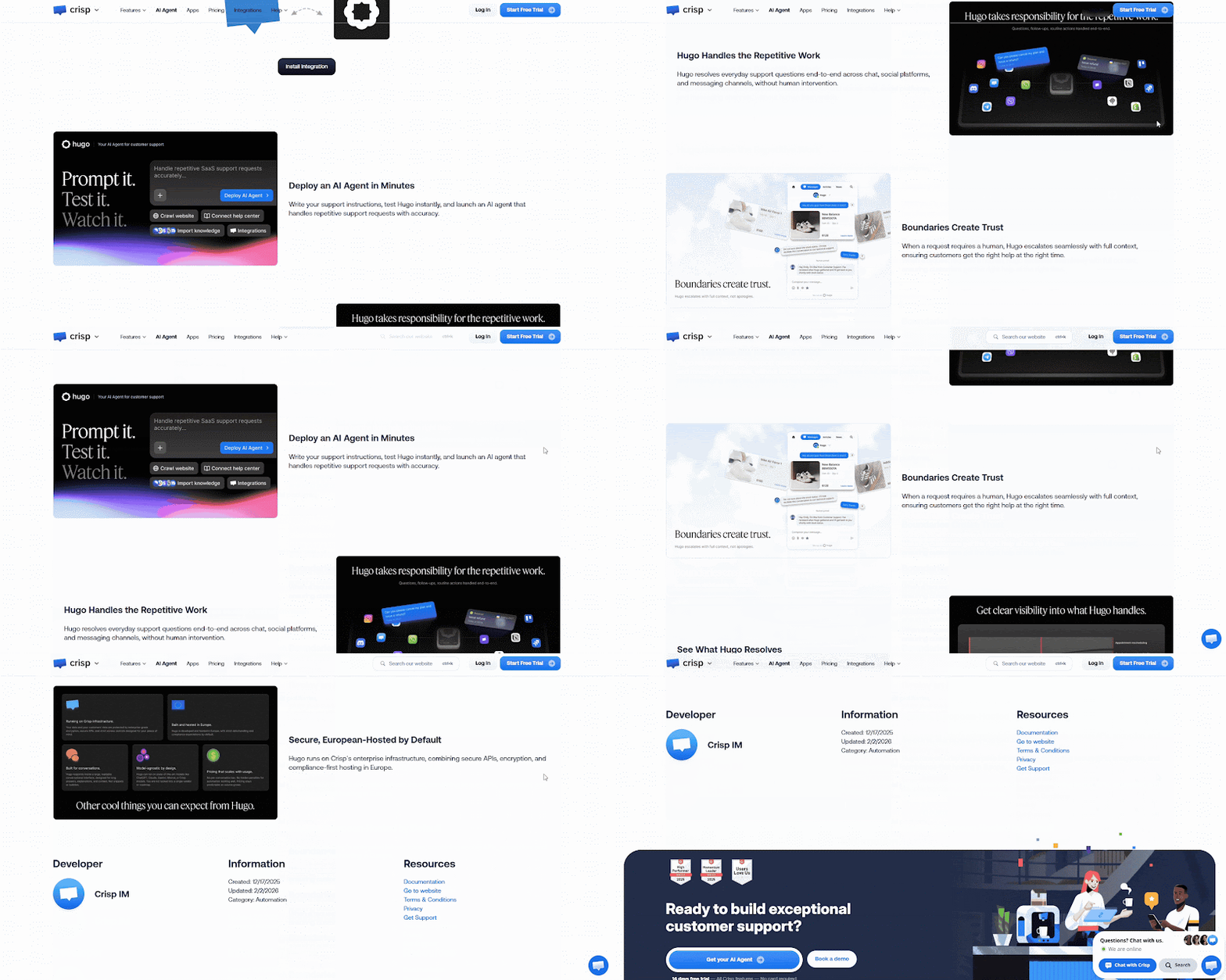
Crisp Hugo works across chat, email, WhatsApp, Instagram, forms, and other Crisp channels. Routing moves a conversation from the Automated Inbox to a named sub-inbox, where a person continues in the same thread.
Crisp stores its main messaging data in the Netherlands, plugin data in Germany, and runs its own AI infrastructure in France. External LLM providers stay off by default.
Key Strengths
Escalation can respond to a missing answer, customer frustration, or a direct request for a person
Named sub-inboxes and Operator Routing decide which team receives the conversation
Availability checks and workflows can collect customer details before a human takes over
Regular Crisp workflows can run beside Hugo without consuming AI credits
Pay-as-you-go limits can be set by the workspace instead of allowing uncontrolled AI spending
Limitations
Mini includes only €5 in monthly Hugo credits, Essentials €25, and Plus €75
Testing, training, and Playground activity can consume the same paid AI credits
When credits run out without pay-as-you-go, Hugo stops and sends new conversations to human operators
“I have experimented with a health care chatbot using Crisp application. They have introduced something called Hugo and I leveraged it to automate few of the responses and reduce costs. However, I realised that there are few topics it has gone ahead and answered weirdly though there are guardrails placed.”
Crisp is stronger than Wonderchat when the rule is that stored support data stays within the EU. Its main data sits in the Netherlands and Germany, and its in-house AI runs in France.
10. Rasa
Best for: Engineering teams that need self-hosted, private-cloud, or air-gapped AI agents.

Rasa combines autonomous reasoning, guided workflows, knowledge retrieval, and tool-backed actions in one developer platform. Teams can inspect dialogue state, choose their models, and deploy on their own infrastructure.
Rasa Studio adds a visual workspace, while its orchestrator keeps conversation state and routes work between guided skills, autonomous skills, retrieval, and external tools.
Key Strengths
CALM separates LLM-based language understanding from deterministic business logic
Flows support data collection, conditions, API actions, reusable subflows, and conversation repair
Inspector displays the active flow, event history, stored memory, slot changes, and action calls
Conversation records can be exported as end-to-end tests or raw tracker logs
Teams can choose hosted models or smaller self-hosted models such as Llama 8B
Limitations
Teams must build and maintain flows, actions, integrations, tests, and deployment infrastructure
Rasa Studio adds a visual workspace, but it does not remove production engineering ownership
Self-hosting also transfers scaling, monitoring, model operations, and security patching to the buyer
“I developed and ran a production grade complex chatbot with high scaling capabilities using RASA in the past. It was a steep learning curve (about 6 months) but no running expense since I used Rasa open source and free AWS credits.”
Rasa gives regulated buyers more deployment control than the managed platforms here. The tradeoff is the team needed to build, test, run, and improve it.
What Enterprise-Grade AI Customer Service Requires
Use procurement language that can be tested. A vendor saying “enterprise-ready” tells you almost nothing on its own.
Requirement | Proof to Request |
Identity and access | SSO method, role matrix, provisioning, and admin audit logs |
Data handling | Hosting region, subprocessors, retention, deletion, and model-training rules |
Regulated workloads | Current SOC report, DPA, and BAA availability where PHI is involved |
Deployment | Shared SaaS, private cloud, on-prem, or air-gapped architecture |
Knowledge quality | Source permissions, sync schedule, citations, testing, and correction tools |
Operations | Channels, human handoff, CRM or ERP actions, SLAs, and failure behavior |
Evaluation | Test set, simulation results, fallback rate, CSAT, escalation, and repeat contact |
Commercial fit | Minimum volume, billing unit, allowance, overage, and implementation fees |
For knowledge-heavy support, ask how grounding works. A RAG pipeline should index approved content, retrieve passages the user can access, add them to the model prompt, and return a verifiable answer. A fluent answer without visible evidence is still hard to audit.
Industry fit changes the order of the shortlist.
Finance, healthcare, legal, and government teams first put data location, access, audit logs, and human approval.
Manufacturing needs product documents and ERP actions.
SaaS and higher education often prioritize multilingual coverage, seasonal volume, and reliable intent detection.
Where Wonderchat Is Not the Best Fit
An honest take. Crisp is the stronger choice when all stored support data must remain inside the EU, while Rasa gives engineering teams on-prem, private-cloud, and air-gapped deployment. Wonderchat is also not a full ticketing or contact-center suite. It fits when you want a governed AI layer over approved knowledge and an existing helpdesk, not when you want to replace the whole service stack.
Test Wonderchat With Your Hardest Support Cases
A security checklist can narrow the field. Your own support questions will show which platform deserves the pilot.
Take one queue, 20 to 30 real conversations, and the documents your team trusts. Add an outdated article, two policies that disagree, a request that needs approval, and a question from someone who should not have access to the answer.
During the test, check the citation behind each reply, restrict sensitive sources by role, correct a weak answer, and follow one unresolved conversation into the human queue.
Your security team will have questions too. Wonderchat Enterprise is SOC 2 Type II certified, keeps its GDPR environment EU-hosted in Frankfurt, and makes a HIPAA BAA available. We should also be clear that Wonderchat does not list ISO 27001 certification.
Book a demo and bring us the hardest question in your queue. If you would rather test it yourself, build your Agent and run the same set of questions.
Frequently Asked Questions
What makes an AI customer service platform enterprise-grade?
An enterprise AI customer service platform supports SSO, role-based access, audit logs, defined data residency, governed knowledge, human handoff, and integrations with systems of record. Buyers should also confirm the deployment model, BAA availability, minimum usage, billing unit, overage rules, and failure behavior.
What is an enterprise conversational AI platform?
An enterprise conversational AI platform lets a company build and manage AI agents across channels such as web chat, email, messaging, voice, and internal tools. Unlike a basic enterprise chatbot platform, it can use business data, follow governed workflows, take approved actions, preserve context, and transfer work to a person.
How does RAG improve enterprise customer service?
Retrieval-augmented generation, or RAG, searches approved company content before the model writes an answer. The system retrieves relevant passages, adds them to the prompt, and can cite the source. RAG improves control and review, but teams still need source permissions, scheduled sync, corrections, and testing.
Which enterprise AI platform is best for regulated industries?
The best platform is the one that meets the exact control your compliance team requires. Check data residency, encryption, SSO, roles, audit logs, retention, subprocessors, model-training terms, and BAA availability. If self-hosting or an air-gapped deployment is mandatory, choose a platform that supports it directly.
How should enterprises compare AI customer service pricing?
Compare the full billing unit, not the headline rate. Model seats, conversations, actions, resolutions, credits, platform fees, implementation, minimum volume, overage, and renewal terms against the same annual workload. Define what counts as a resolved outcome before using a vendor rate in the forecast.
Can one enterprise AI agent support customers and employees?
Yes, if permissions keep the knowledge separate. Customer agents can use public product and support content, while employee agents use private HR, IT, legal, or operations sources. Role-based access and source-level permissions must prevent one audience from retrieving content meant for another.