
Summary
Intercom combines Fin with a helpdesk and tools for support agents. Wonderchat adds an AI support agent to your existing content and tools. Both ground answers in approved knowledge sources.
Fin charges per resolved conversation alongside applicable platform costs, so spending rises with successful resolution volume. Wonderchat uses monthly plans with included resolution allowances, which makes costs easier to forecast.
Intercom may require helpdesk configuration and knowledge management before launch. Wonderchat reports that 80% of Wonderchat agents that go live do so the same day, and it does not require a helpdesk migration.
If you run a larger support operation and already use Intercom, shortlist Fin for its helpdesk and Copilot. that already use Intercom should shortlist Fin for its helpdesk and Copilot. If you want a faster self-serve setup without changing your helpdesk, Wonderchat offers monthly plan pricing aimed at small B2B teams with real documentation.
Why this comparison matters right now
The core tradeoff is platform breadth versus deployment simplicity.
Fin pairs an AI agent with a full helpdesk, so you must weigh answer quality alongside helpdesk configuration, agent workflows, and usage-based resolution costs. Wonderchat adds an AI agent without requiring the same platform commitment. Intercom combines Fin with its helpdesk and Copilot tools for human agents. If you need ticketing and helpdesk support, you can manage both functions in the Intercom platform.

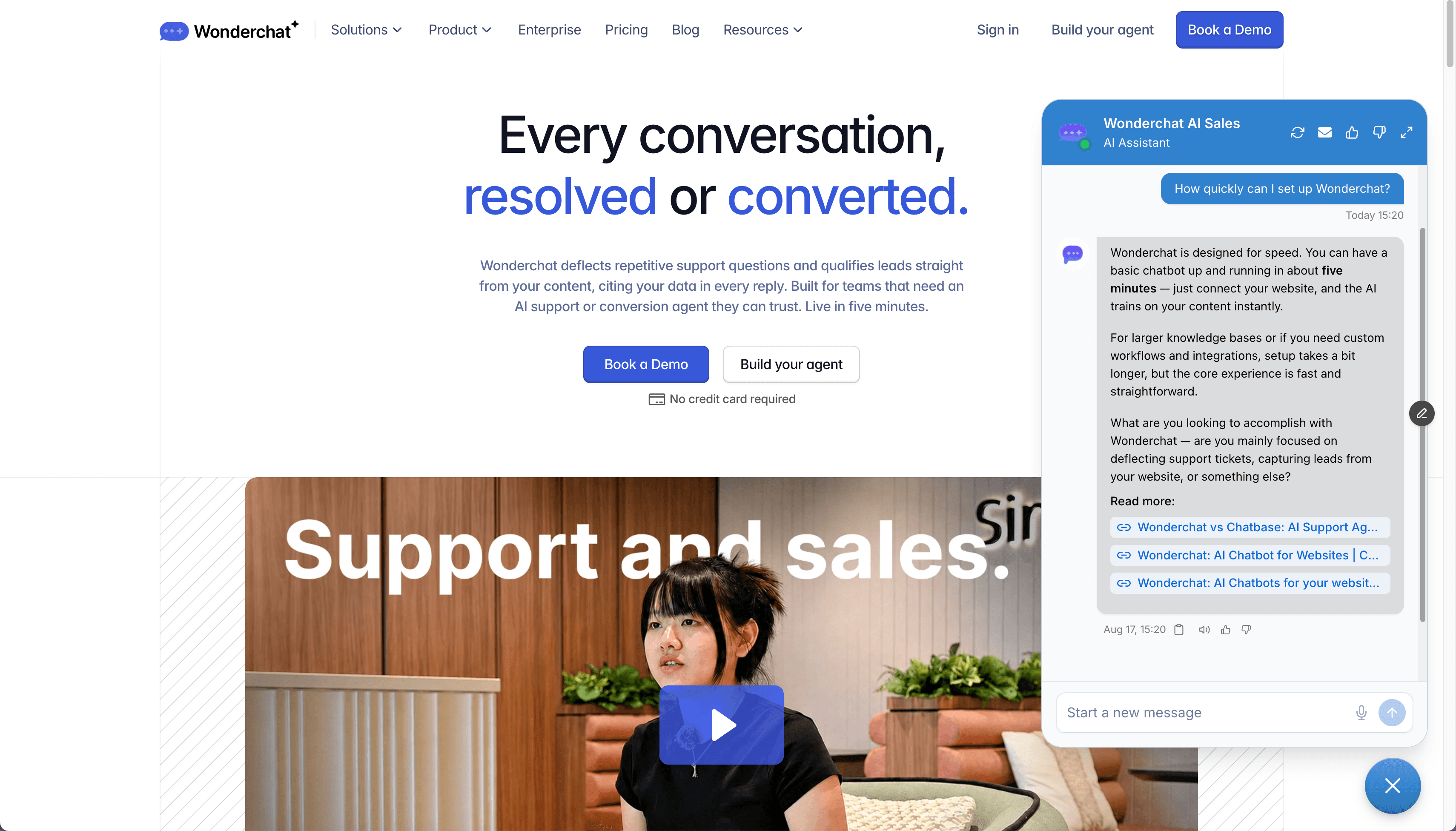
Wonderchat adds an AI agent to existing content and tools without requiring a helpdesk migration. Every Wonderchat agent can be set-up and used for both support and sales tasks, including answering questions and qualifying leads. Wonderchat is the best fit for a company that is searching for a a self-serve launch and predictable monthly spending while keeping their current support stack the same.
Setup work, pricing, source accuracy, and company size reveal more about operational fit than feature counts or broad claims about the AI response quality.
Wonderchat vs. Intercom's Fin at a glance
Your support operation and budget determine which product fits. that affect whether each product fits your support operation and budget.
Factor | Wonderchat | Intercom Fin |
|---|---|---|
Pricing model | Flat monthly plans, each with a set number of AI replies, plus a free plan that refills 50 AI replies a month. No per-seat cost on any plan. | Usage-based, about $0.99 per resolution, plus separate Intercom seat fees. |
Typical setup time | 80% of Wonderchat agents that go live do so the same day. The agent is trained on your existing website and help center content. | Intercom advertises setup in under one hour. Open.cx estimates that setup can take days even with a clean help center., though an independent review estimates days with a clean help center. |
Integrations | Connects to existing helpdesks such as Freshdesk, Zendesk, CRMs, and channels as an added layer rather than a replacement. | Native integration with Intercom's own helpdesk. Fin also connects to Zendesk, Salesforce, and HubSpot. |
Ideal team size | Small B2B teams with real documentation that want an AI support agent without replacing their helpdesk. | Larger support operations that already use Intercom or want an integrated helpdesk. |
Analytics and Reporting | Wonderchat's review inbox lists the questions the agent couldn't answer, so the team can point to the answer or write it once. | Performance dashboard tracks automation rate, resolution rate, involvement rate, and CX Score. |
Accuracy | Retrieves answers from approved content and cites sources. A Quality Assurance (QA) agent flags weak answers and knowledge gaps. | Fin refines each query, retrieves approved knowledge, and validates grounding before replying. |
Ease of fitting into a stack | Layers onto an existing helpdesk or content stack without requiring a migration. | Works best when the surrounding helpdesk is already Intercom's own. |
Support availability | Email support on paid plans, with priority support on higher tiers. | Help center, Copilot for human agents, and account support tied to plan tier. |
Customization | Configurable escalation rules, agent persona, and context/answer specificity. | Configurable Procedures and workflows, with more setup overhead. |
Security | SOC 2 Type II, GDPR, EU-hosted in Frankfurt, HIPAA BAA available. | Security and compliance controls as part of its broader helpdesk platform. |
Use these factors to build a shortlist rather than treating either product as universally better. without implying that one product is universally better.
How we compared them
A useful product choice accounts for launch work and costs as well as source grounding and company size. These criteria reveal how quickly you can launch, how support volume affects your costs, and whether each product works with your current tools and staffing.
We did not assign scores because each criterion has a different value for your support setup. If your company already uses Intercom, Fin can add AI support within the same helpdesk. If you run an SMB or mid-market company, you may prefer Wonderchat’s faster setup, predictable monthly pricing, and ability to work with existing content and support tools.
Choose the product that fits your current support stack and expected ticket volume.
Setup complexity: helpdesk integration vs. content-first setup
Fin can launch quickly with a clean, compatible help center, while Wonderchat can start without a helpdesk migration. Intercom says Fin can work with its own helpdesk and supported platforms such as Salesforce and HubSpot in less than an hour. You do not always need to migrate to Intercom. However, an Open.cx review places a typical launch in days when the help center is reasonably clean, so the condition of your content often determines launch time.
Deeper automation adds more configuration work. You must define Procedures for billing and account changes. Open.cx describes these Procedures as effective but configuration-heavy. Open.cx notes that some sources such as Notion and Confluence can support Fin Copilot for human agents but cannot ground autonomous customer replies. Fin’s source restrictions may require you to reorganize content before Fin can use it in customer-facing answers.
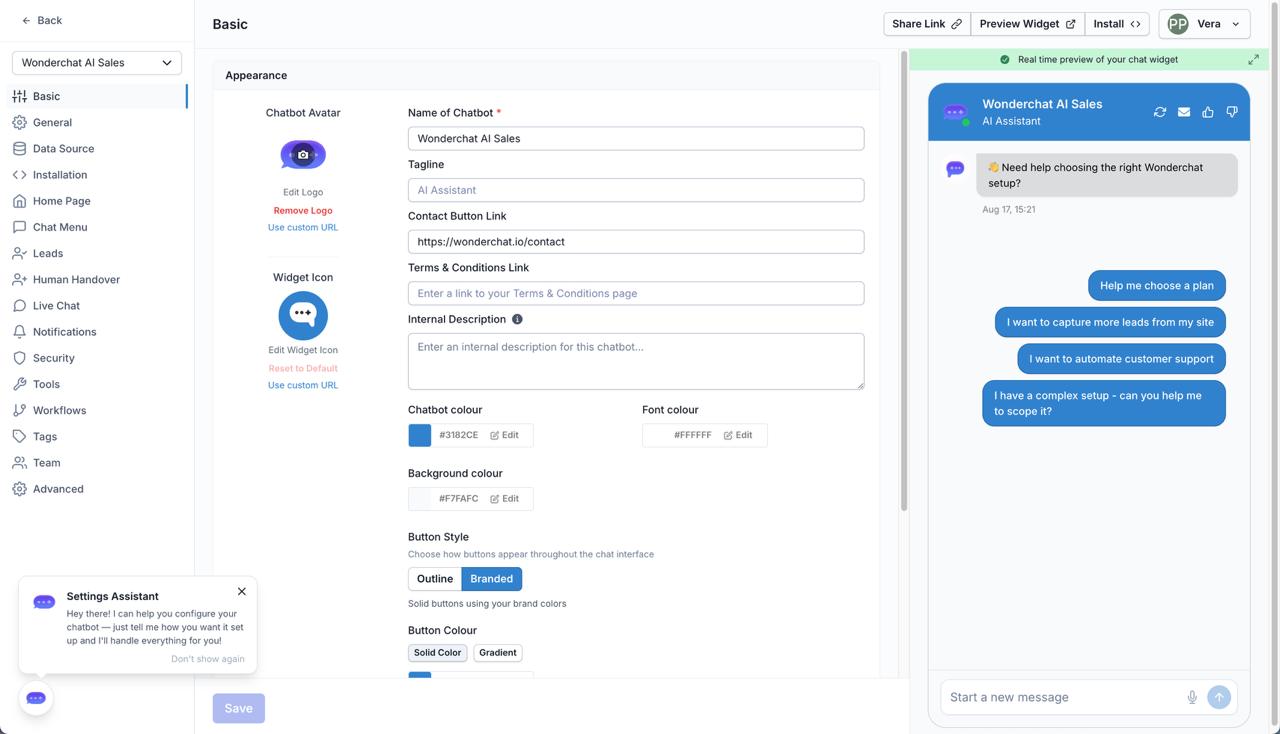
Wonderchat takes a more direct path through your existing content. You create an agent by crawling a website or uploading files. You then set its escalation rules and add the chat experience to your site. Wonderchat can be set-up within five-minutes, and a Youtube explainer video directly verifies that benchmark. More complex workflows and untidy knowledge bases will still take longer, but Wonderchat does not require you to configure or adopt a full helpdesk before the agent can answer questions.
Your existing support stack determines how much setup each product requires. Fin can launch quickly for an Intercom customer with organized content, while advanced Procedures and source restrictions increase the work. Wonderchat usually asks for less platform configuration because it starts with the content and tools you already use. Wonderchat’s narrower implementation scope generally makes it easier to launch outside an existing Intercom environment.
Integrations and fitting into your existing stack
Fin has its closest integration with Intercom's own helpdesk, since it was built as a layer inside that product. Intercom also connects Fin to external systems including Zendesk, Salesforce, and HubSpot. Those connections suit straightforward handoffs rather than full two-way synchronization, and Fin usually relies on Intercom's inbox as the system of record.
Wonderchat takes the opposite position in a support stack. Wonderchat connects to your support systems and chat channels as an added AI layer. It uses your existing website and support content without requiring you to move ticketing into a new system. When a conversation needs escalation, Wonderchat can hand off into an existing helpdesk like Zendesk rather than requiring you to adopt its own.
Intercom's helpdesk can serve as the system of record, while Wonderchat leaves your current helpdesk or CRM in that role. Intercom Fin fits naturally when a company is willing to make Intercom's helpdesk that system. Wonderchat fits when a company wants to keep its current helpdesk or CRM in place and add an AI layer on top of it.
Pricing model: per-resolution outcomes vs. flat monthly allowance
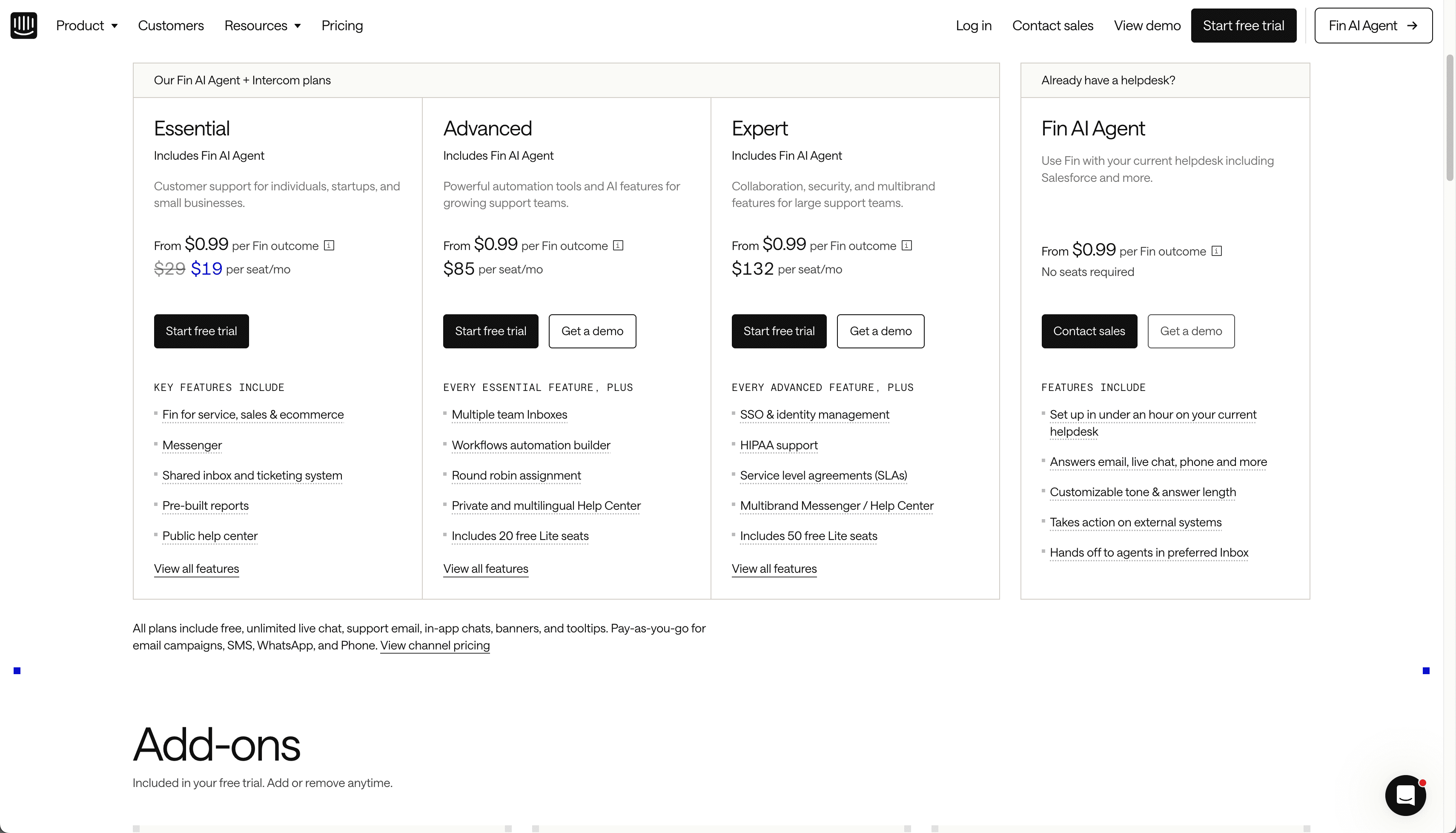
Fin charges about $0.99 for each billable outcome, so monthly cost rises with successful conversation volume. Wonderchat includes a resolution allowance in each monthly plan. Fin counts a resolution when the customer confirms that Fin solved the issue or leaves after Fin’s final response without requesting more help. Fin bills at most one outcome per conversation and does not charge when the customer requests a human or when a default escalation occurs. If the customer later reopens a resolved conversation, Fin deducts the original charge under GetMacha’s summary of Fin’s billing rules.
Fin can also charge for configured handoffs and other outcomes. When you use Fin with an external helpdesk such as Zendesk, Salesforce, or HubSpot, a 50-outcome monthly minimum applies. When you use Intercom’s helpdesk, Intercom charges separately per seat on top of Fin’s outcome fees. Your bill therefore combines per-seat and usage-based costs. Eigent reports annual-billing prices of $29 per seat each month for Essential and $132 for Expert. At the reported Advanced rate of $85 per seat, twenty seats would cost $1,700 each month before Fin outcome charges.
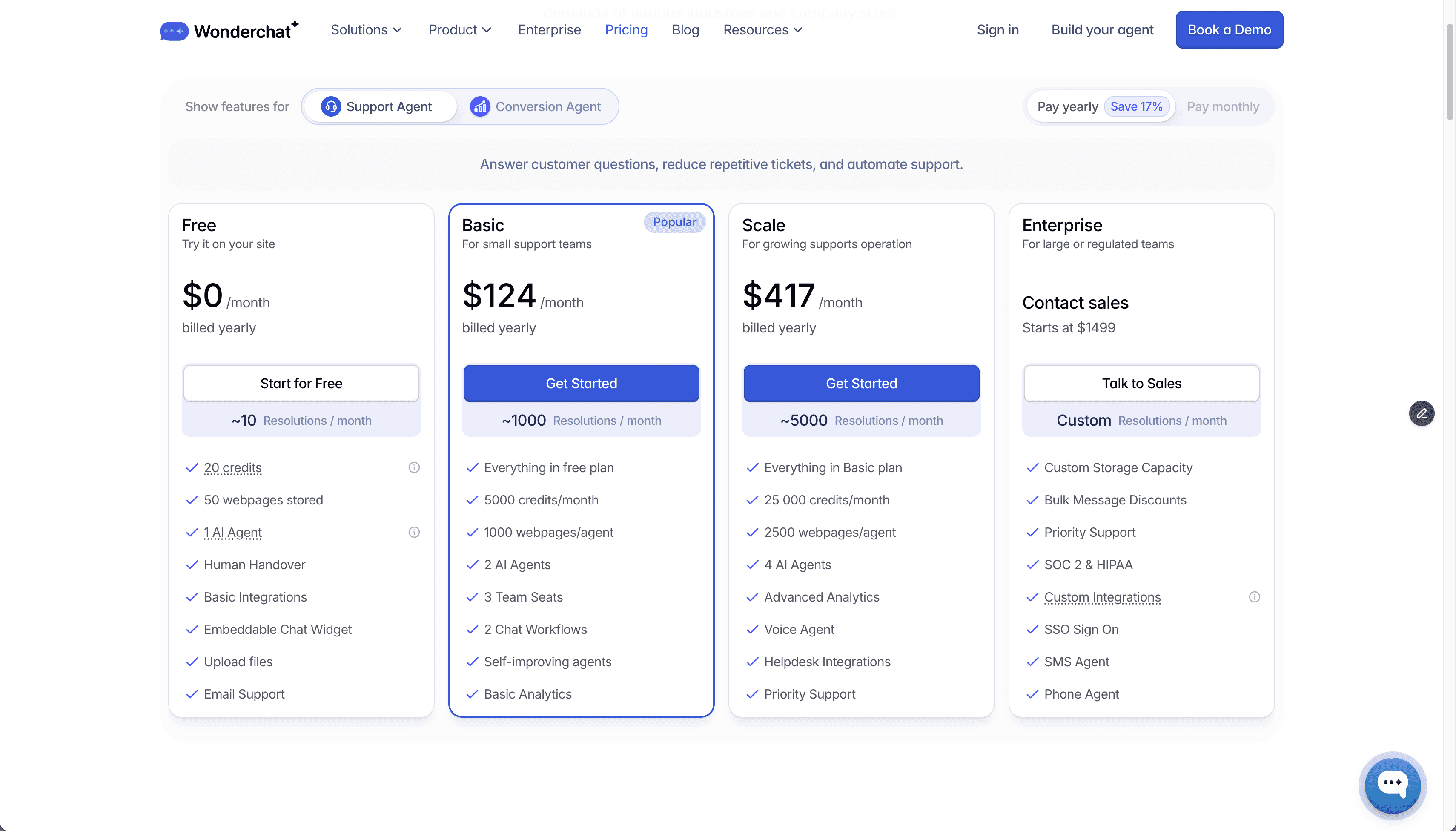
Wonderchat includes team seats in its monthly plans. Wonderchat's pricing page bundles team seats directly into every plan, including the Basic tier, so you don’t pay a separate per-seat fee on top of its resolution allowance.
The volume arithmetic makes Fin’s variable cost easy to model. At $0.99 per billable outcome, 5,000 monthly outcomes cost $4,950 and 20,000 cost $19,800. At 100,000 outcomes, the charge reaches $99,000. The estimates exclude seats, implementation, channels, and negotiated arrangements. Your total reflects how many conversations produce a billable outcome.
Wonderchat sells monthly plans that include a usage allowance and a set of team seats, which gives you a fixed bill while activity remains within the selected plan. Wonderchat's pricing page lists a Free plan with 2 team seats and up to 20 resolutions a month, and a Basic plan with unlimited team seats and about 600 resolutions. Scale includes unlimited team seats and about 1,800 resolutions a month, while the custom Enterprise plan also has unlimited seats. Higher volume may require a larger plan. Within each allowance, Wonderchat does not add a per-resolution charge or a separate seat fee like Fin’s helpdesk does.
Fin offers direct per-outcome arithmetic, while Wonderchat offers predictable spending within a chosen allowance and does not charge separate seat fees for the seats included in that plan.
In terms of budget friendliness, Wonderchat offers a better cost control pricing model, as resolutions are fixed per plan. Add-ons can be purchased at $30 per 1000 AI credits, which makes billing and costs predictable at scale. Assuming that a company has 10 000 resolved tickets per month, a plan on Intercom would cost $9000/month, while Wonderchat plans fix the resolutions per plan.
Accuracy and grounding: how each avoids hallucinated answers
Both products ground replies in approved sources. Fin validates requests throughout answer generation, while Wonderchat provides citations and reviews the knowledge base for weak answers. Fin’s AI Engine screens requests for safety and relevance, then prepares eligible questions for retrieval or a predefined workflow. Fin then uses retrieval augmented generation, which supplies the language model with approved support content and relevant customer data. Before sending the answer, Fin verifies that the response addresses the question and remains grounded in those sources. Fin asks a clarifying question or transfers the conversation to a person when its certainty and safety checks fail.
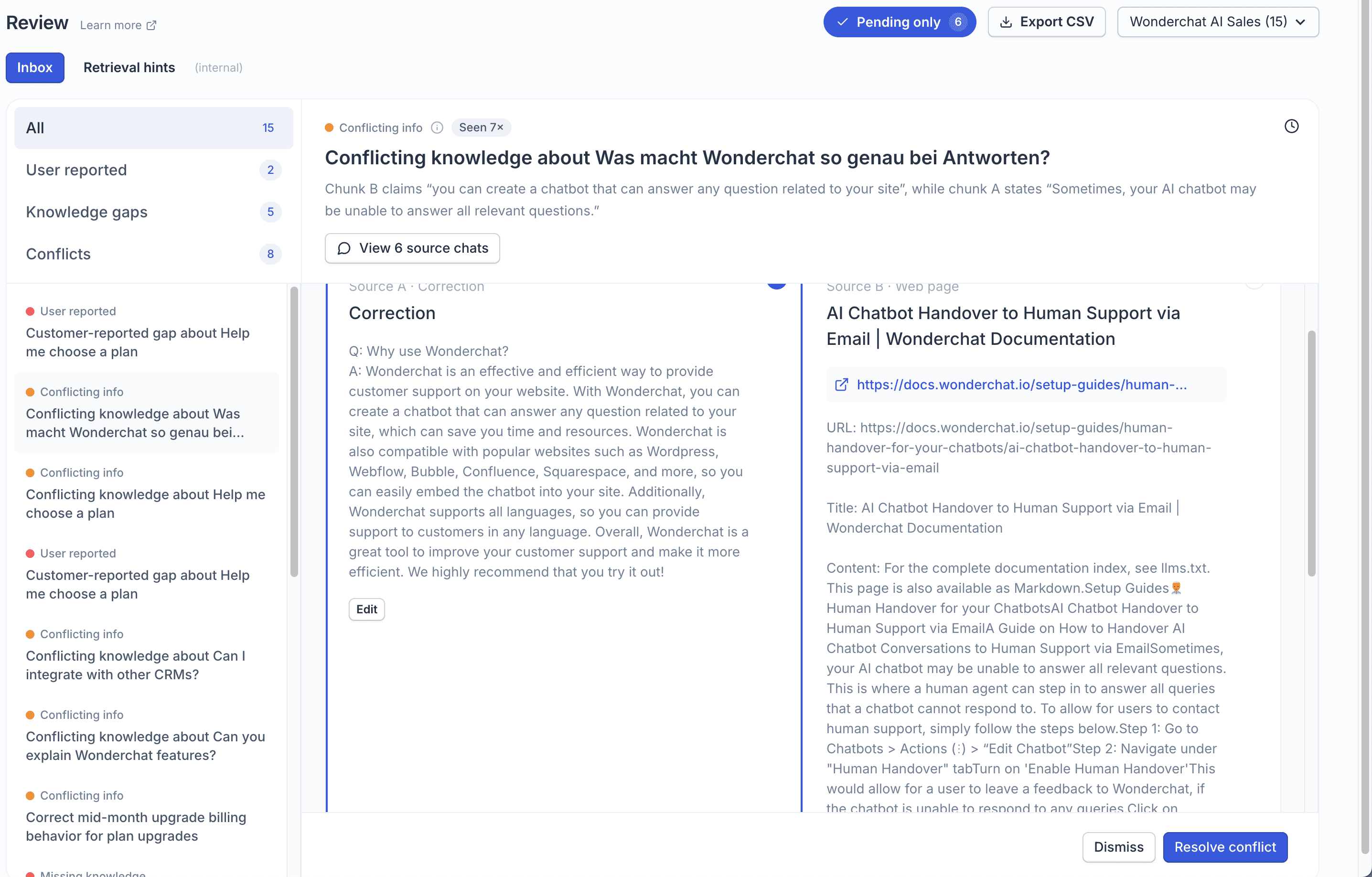
Wonderchat retrieves information from connected content and cites the source behind each reply. Its own AI Answer Engine and QA Agent monitors answers and sends the account owner a daily report about knowledge base weaknesses. The report identifies conflicting information and missing content, which you can address by adding a web page or document. The QA Agent can also recommend instruction changes that help the agent retrieve more relevant material.
Wonderchat gives you additional control over context length and answer specificity. Wonderchat’s context controls can help with a large or complex knowledge base because you can adjust how much source material the agent considers and how narrowly it answers. Citations also let you inspect whether an answer reflects the intended source, while the QA Agent helps identify content problems that retrieval alone cannot correct.
Both products depend on the quality and availability of their approved sources. Fin can ground autonomous replies in Intercom content and external material such as PDFs or web pages. However, some connected internal sources, including Notion and Confluence, remain available only to its human-facing copilot, so Fin cannot use them directly in customer replies.
Neither company provides an independently audited hallucination rate. Intercom documents more validation steps, while Wonderchat gives account owners more direct tools for finding weak answers and improving retrieval. You should test both products with difficult questions and source conflicts, including cases where the correct response is a refusal.
Support availability, customization, and security
Support. Intercom supports Fin through its help center and plan-specific account service. Copilot also assists human agents working on the same tickets. Wonderchat provides email support on paid plans and gives higher-tier customers priority service.
Customization. Fin uses Procedures to define workflows for tasks such as refunds or subscription changes, but each workflow requires configuration. Wonderchat lets you control escalation, agent behavior, and answer scope. It also allows you to independently configure AI workflows.
Security. Wonderchat became SOC 2 Type II compliant in 2024 following an independent audit, and its compliance portal documents GDPR practices in detail, including data encryption, breach notification timelines, and subprocessor disclosures. Its Enterprise plan lists HIPAA compliance as a feature, though that claim sits on the pricing page rather than in a dedicated certification document. Intercom publishes security and compliance documentation for its helpdesk platform. Verify Wonderchat's and Intercom's current certification documents during purchase evaluation because compliance scope and audit dates change.
Best fit by team size and support stack
Intercom Fin fits you if you run a larger support operation and already use Intercom or plan to adopt its helpdesk. If you use Intercom, you can manage ticketing and omnichannel support alongside Fin and Copilot. Adopting the broader Intercom platform requires staff and budget to manage it.
Wonderchat fits companies that want an AI support agent without replacing their helpdesk. You can connect it to an existing helpdesk and build its knowledge from approved content. Wonderchat says you can prepare an account in about five minutes, which may suit you if you lack dedicated implementation staff. Its plans also cover a conversion agent alongside the support agent, so you can use the same platform to qualify leads and support customers instead of buying a separate tool for each job.
Support volume affects fit because Fin’s cost grows with each billable outcome, whereas Wonderchat’s cost changes when usage requires a higher plan. If your support volume is substantial or volatile, model both products against recent ticket data rather than comparing headline rates alone.
Your company size should not decide the purchase by itself. A small company committed to Intercom may benefit from keeping support in one suite. A larger company that wants to preserve its current helpdesk may prefer Wonderchat’s flexible setup and predictable monthly allowance.
Recommendations by use case
Choose Wonderchat if
You want to add an AI support agent without replacing or reconfiguring your current helpdesk.
You need a self-serve setup that can start using existing website content and documents within minutes.
Your support volume changes enough that Fin’s per-resolution billing would make monthly costs harder to forecast.
You need approved-content grounding without the additional features of a full helpdesk suite.
You prefer a flat monthly plan with a defined resolution allowance and team seats included rather than billed separately.
You want one platform that covers both support and lead qualification instead of running separate tools.
Choose Intercom if
You already use Intercom and can add Fin to an established helpdesk.
You want AI ticket resolution, human ticketing, omnichannel support, and agent assistance within one product ecosystem.
You can manage the Procedures and other helpdesk configuration that Fin requires.
You prefer outcome-based billing and can forecast resolution volume well enough to budget for usage.
You value Intercom’s broader helpdesk capabilities and established market presence more than a lighter setup.
FAQs
How does Fin bill reopened tickets?
Fin charges once when a conversation produces a billable outcome. If a customer later reopens a resolved conversation for more help, Fin deducts the original resolution charge. You avoid paying for a resolution that did not remain resolved.
Does Wonderchat require a separate helpdesk?
Wonderchat can run without a separate helpdesk by using its own AI chat and live chat tools. You can train Wonderchat on your website and approved material from files or existing helpdesk content. You can add AI support without migrating your current support operation.
Does Wonderchat integrate with any helpdesk and CRMs?
Wonderchat integrates with Zendesk, Freshdesk, and CRMs such as Salesforce, Active Campaign, Marketo, and Hubspot. Their AI Support agents can integrate with these existing software in your stack.
How can I estimate monthly cost for each product?
Estimate monthly cost using expected billable AI resolutions and applicable platform fees. For Fin, multiply expected billable outcomes by about $0.99 and add applicable Intercom seat fees. For Wonderchat, a resolution costs around $0.15. Buyers can match expected usage to the included allowance within their existing plans. Any overage terms can be purchased off the shelf, because Wonderchat bundles team seats. Recent ticket data and your expected AI resolution rate produce a more realistic budget than total ticket volume alone.
The bottom line
Your existing support operation should determine which product you choose. Intercom Fin fits you if you already rely on Intercom or need a broad helpdesk. You must be prepared to manage the added configuration and Intercom’s other support tools. Wonderchat fits you if you want to add an AI support agent to your current tools without rebuilding your support stack. You can also connect Wonderchat to your existing helpdesk. At full use of the published allowances, Wonderchat's Basic plan costs about $0.12 per included resolution and Scale costs about $0.08, compared with Fin's reported $0.99 per outcome.
Test both products with recent tickets under the source and escalation settings you would use in production. Wonderchat offers a free plan with no credit card required, so you can test it on real content before paying. Compare setup time and total monthly cost at your expected resolution volume. Check answer quality and escalation behavior under the same conditions, then choose the product your support operation can manage. Wonderchat fits teams that want an AI agent answering from their docs and live fast, while Intercom fits buyers who need a full helpdesk and ticketing system. Intercom's combined per-seat and per-resolution charges can produce a higher total cost at the volumes modeled above.

