


03/09/2026
Grounding
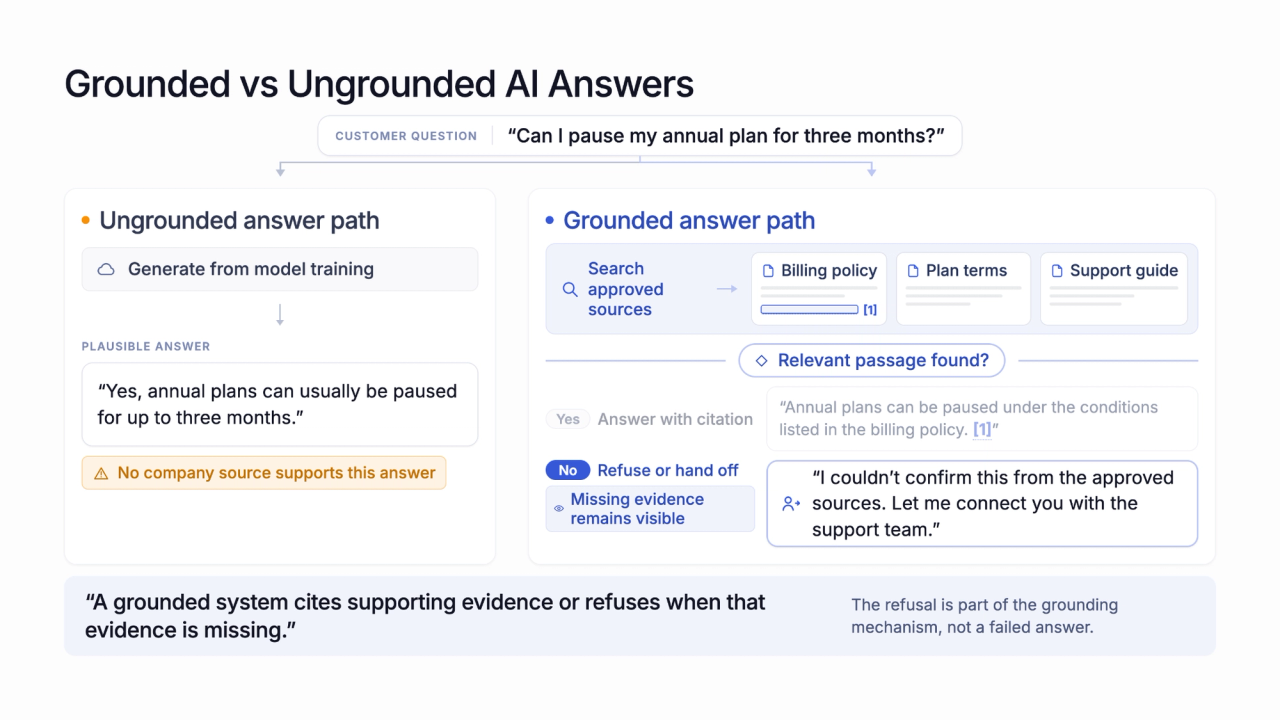
Grounding restricts an AI system to verified sources instead of letting it rely only on knowledge learned during model training. A grounded system retrieves relevant evidence first, answers only from it, and refuses when the sources cannot support a response.
How AI Grounding Works
When a customer asks a question, a grounded system searches an approved knowledge base before the language model writes its answer, following the same retrieve-then-generate pattern used by real-world RAG systems.
- Retrieve the evidence. The system searches documents, help-center articles, databases, or approved websites and returns the passages most closely related to the question.
- Generate from the evidence. The model receives those passages as context and follows instructions that limit its response to information the sources support.
- Return proof or refuse. The response can include a citation , while an empty or weak retrieval result should produce a refusal, clarification, or human handoff.
What Grounding Prevents
Grounding reduces answers based only on broad training data, including invented policies, product steps, prices, or account rules that never appeared in the company’s approved content. This makes grounded responses easier to inspect because each factual claim can be compared with the passage retrieved for that question.
What Grounding Does Not Prevent
Grounding does not prove that an answer is correct because the source may be outdated, contradictory, incomplete, or wrong, while the model may still misunderstand a relevant passage. A refund question can retrieve an old policy and produce a fluent, properly cited answer that no longer matches the rule the support team follows.
Poor retrieval creates a quieter failure because the answer appears sourced even when the system selected the wrong passage. Grounding changes the likely failure from unsupported invention to faulty source use, which still requires testing and review.
Why a Grounded System Should Refuse
When retrieval returns nothing useful, answering from memory breaks the grounding constraint and turns a missing source into a possible hallucination. Refusal, a clarifying question, or human handoff keeps the missing evidence visible instead of covering it with a plausible answer.
Whether grounded AI can handle complex customer service questions therefore depends on source coverage, retrieval quality, and a confidence threshold that stops weak answers. Before trusting an accuracy claim, test questions with no documented answer, conflicting policies, and details buried in similar documents.
Wonderchat defines grounding as a constraint on generation, not a guarantee of accuracy.
Grounding vs RAG vs Fine-Tuning
Grounding is the rule that an answer must stay tied to approved evidence, while retrieval-augmented generation, or RAG, is one common method for finding and supplying that evidence. Fine-tuning changes a model’s learned behavior or task performance, but it does not by itself retrieve current sources or show which passage supports an answer.
Frequently Asked Questions
What is grounding in AI?
Grounding in AI restricts an answer to verified source material available at the time of response, rather than allowing the model to rely solely on training data. A grounded response should remain traceable to the material, or refuse it when the material cannot support an answer.
Does grounding stop hallucination?
Grounding reduces unsupported invention, but it does not make hallucination impossible. The system can retrieve an outdated or irrelevant passage, misunderstand the passage, or add a claim that its sources do not support.
What is the difference between grounding and RAG?
Grounding is the broader requirement that AI output stays connected to approved evidence. RAG is a technical method that supports grounding by retrieving relevant content and placing it in the model’s context before generation.
