


04/09/2026
Retrieval
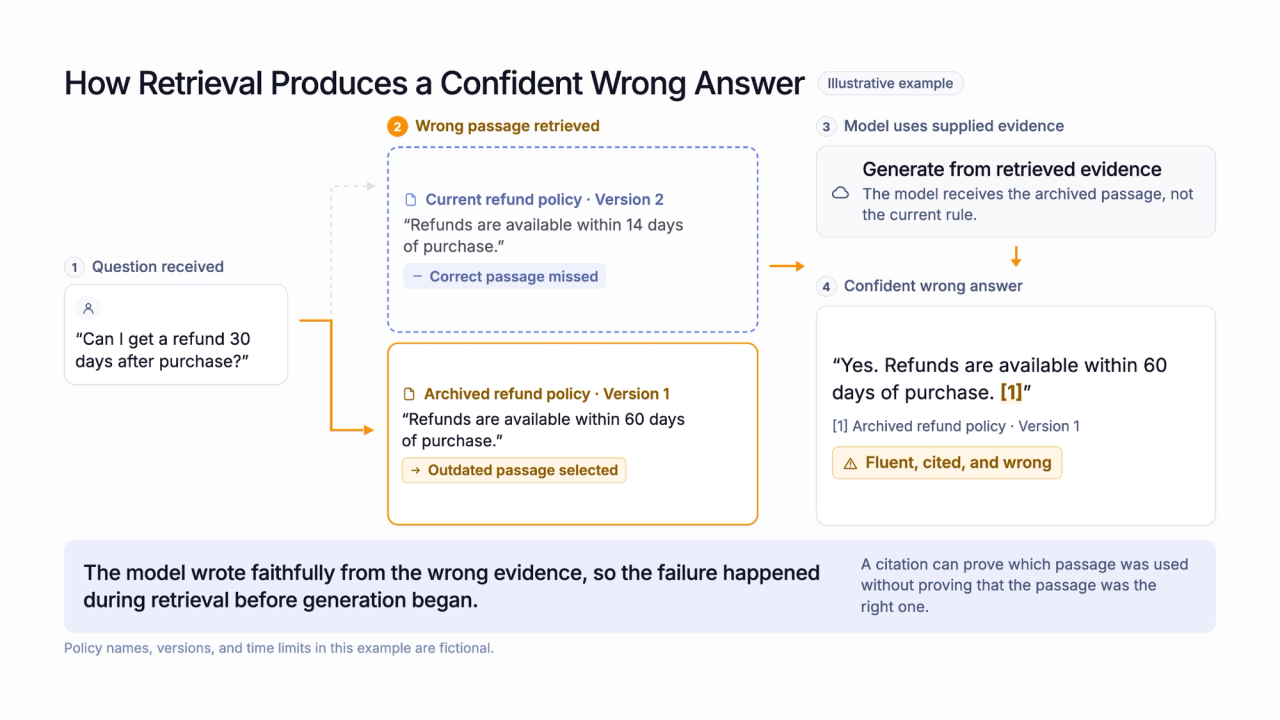
Retrieval is the step where an AI system finds relevant source passages before generating an answer to a user’s question. If retrieval returns the wrong passage, even a capable model can produce a fluent, confident answer that is still wrong.
The Two Steps Behind RAG
Retrieval-augmented generation, or RAG, separates finding information from writing the response:
- Retrieve. The system searches an index of document chunks using keywords, embeddings, semantic similarity, metadata filters, or a mix of these methods, then ranks the likely passages.
- Generate. The selected passages enter the model’s context with the customer’s question, and the model writes an answer based on that supplied evidence.
Multi-pass retrieval repeats the first step with several queries or search methods, then compares or reranks the results instead of trusting the first match.
Why Retrieval Decides Answer Quality
In a grounded AI system, the model answers from the passages the retrieval supplies. It cannot cite a policy, exception, or product step that the retrieval layer failed to find.
A help centre written in English answering a question asked in Spanish is a retrieval problem, not a translation problem. The system must match the meaning across both languages before the model can use the correct passage to write the translated answer.
The same failure appears when search returns an old refund policy instead of its replacement, because better wording cannot repair evidence that was wrong before generation began.
What Makes Retrieval Good
Three parts set the quality ceiling for AI retrieval:
- The source corpus. Current, complete, and non-conflicting documents provide useful passages, while missing or outdated content leaves no correct result to find.
- Chunking and metadata. Sections must be split without losing meaning, then labeled by product, language, date, version, or access level.
- Search and ranking. Embeddings match meaning, keywords preserve exact terms, and reranking or hybrid search can promote the most useful passage.
Your docs are the model’s working knowledge, because retrieval cannot return information the approved corpus does not contain. A different model cannot repair a missing policy or unusable document chunk.
When Retrieval Finds Nothing Useful
A reliable system should not quietly fall back to model memory when no passage supports the answer, because that turns a visible content gap into possible invention. It should refuse, ask a clarifying question, search again, or move the request to a person.
Complex customer questions often involve missing context, several matching documents, or different product versions, making an honest stop safer than a confident guess.
Wonderchat treats retrieval quality, not model choice, as the ceiling on answer quality.
Retrieval vs RAG vs Search vs Fine-Tuning
- Retrieval finds and ranks the passages that may answer a question.
- RAG combines retrieval, prompt augmentation, and generation into one answer pipeline.
- Semantic search finds content by meaning, while keyword and hybrid search offer other retrieval methods.
- Fine-tuning changes a model’s learned parameters or behavior, while retrieval supplies current external information when the question arrives.
Retrieval supplies evidence but does not eliminate hallucination and accuracy failures when the evidence or final answer is wrong.
Frequently Asked Questions
What is retrieval in AI?
Retrieval in AI finds and ranks source passages related to a question before generation. Those passages become the evidence available to a grounded answer.
What is the difference between retrieval and RAG?
Retrieval is the information-finding step. Retrieval-augmented generation is the complete process that retrieves passages, adds them to the model’s context, and generates an answer from that evidence.
Why does retrieval matter more than the model?
The model cannot use a passage that retrieval missed. Even a capable model can write a clear but wrong answer from outdated, incomplete, or irrelevant evidence.
