


04/09/2026
Semantic Search
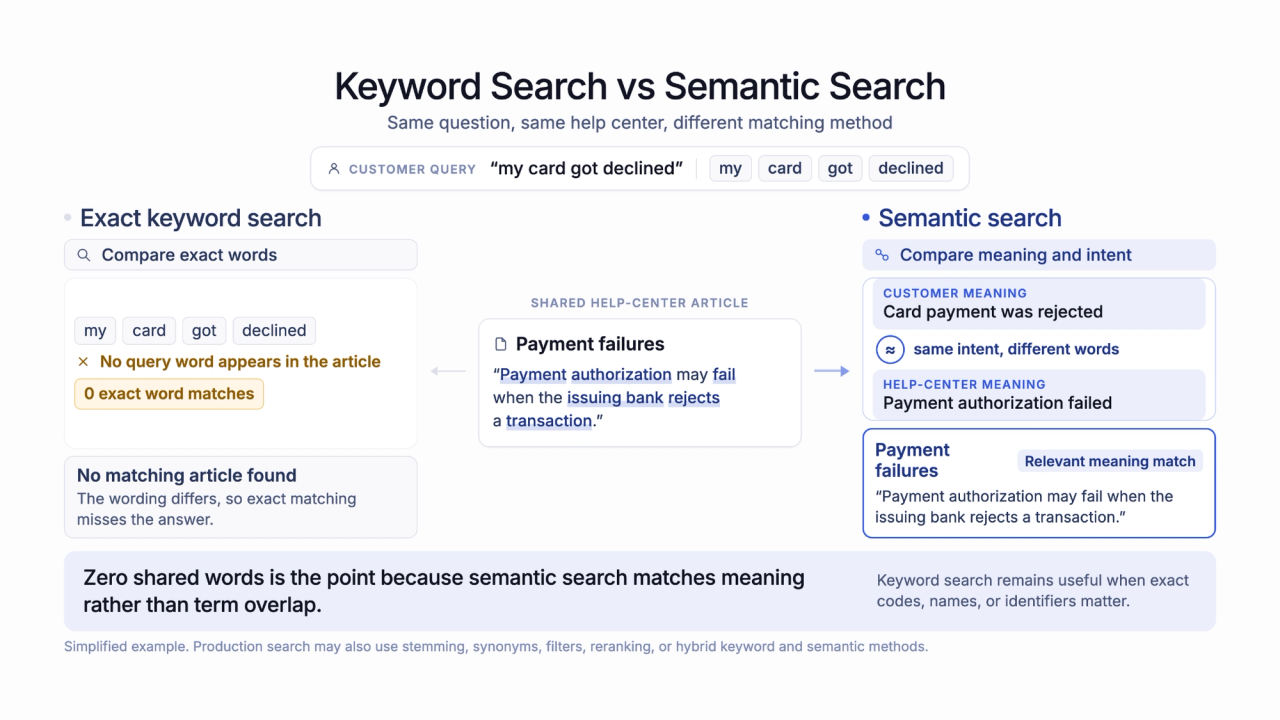
Semantic search retrieves information by meaning, context, and intent rather than requiring the query and document to share exact words. A customer typing “my card got declined” can therefore find an article titled “payment failures,” even though no words match.
Semantic Search vs Keyword Search
The two methods ask different questions when they search an index:
- Keyword search asks, “Which documents contain these words?” It matches exact terms or close word forms, making the wording of the query important.
- Semantic search asks, “Which documents mean the same thing?” It can connect different wording when the query and source describe the same idea.
In the opening example, keyword search may return nothing because “card,” “declined,” “payment,” and “failures” do not match. Semantic search can connect the customer’s everyday wording with the term used by the support team.
How Semantic Search Works
Many semantic search systems use embeddings and vector search in three steps:
- Create embeddings. An embedding model turns each document passage and the user’s query into numerical representations called vectors, which preserve features of their meaning.
- Compare meaning. The search system places those vectors in the same vector space and finds the nearest neighbours, meaning the passages most similar to the query.
- Rank the results. The closest passages are ordered by relevance, sometimes with metadata filters or a reranker that considers product, language, date, or access rights.
No step proves that the highest-ranked result is correct. Vector similarity measures closeness of meaning, so a passage can match the topic while describing the wrong product, country, policy version, or customer group.
Where Semantic Search Works Well
Semantic matching helps when people use synonyms, informal wording, industry jargon, full questions, or phrases that never appear in the source. It also supports cross-language retrieval when the embedding model understands both languages and the knowledge base contains the answer.
A help centre written in English answering a question asked in Spanish is a retrieval problem, not a translation problem. The system must find the English passage by meaning before it can generate a useful Spanish answer.
Where Keyword Search Still Works Better
Keyword search remains useful for exact product codes, error messages, order numbers, policy names, people, and other strings where every character may matter. Searching for error code `E1047` should favor the document containing `E1047`, not a passage that is merely close in meaning.
This is why hybrid search combines keyword and semantic results, then merges or reranks them into one list. The keyword side protects exact matches, while the semantic side catches changes in wording and intent.
Semantic Search vs Vector Search vs AI Search
- Semantic search is the goal of retrieving information by meaning rather than word overlap.
- Vector search is one method that compares embeddings to find similar items, including text, images, audio, or other data.
- AI search is a broader experience that may combine retrieval, semantic or hybrid search, generation, citations, and conversational follow-up.
Wonderchat treats semantic matching as necessary for retrieval and insufficient for correctness, because a close result can still be the wrong source.
For a wider look at how semantic retrieval feeds generation, see these real-world RAG examples.
Frequently Asked Questions
What is semantic search?
Semantic search is an information retrieval method that matches the meaning, context, and intent of a query instead of requiring exact keyword overlap with the source.
How is semantic search different from keyword search?
Keyword search matches the words entered by the user, while semantic search finds content with similar meaning. Semantic search handles synonyms and natural questions, but keyword search is often more reliable for exact codes, names, and identifiers.
Does semantic search work across languages?
Semantic search can match meaning across languages when the embedding model supports those languages and the indexed content contains the answer. It does not repair missing documents or guarantee that the closest passage is correct.
