


04/09/2026
Answer Engine
An answer engine gives a direct, synthesized response to a question instead of returning only a ranked list of links. It retrieves supporting passages, builds the answer from them, and cites the sources selected during that process for human review.
The Three Kinds of Answer Engine
- Search-with-answers systems, including Google AI Overviews, place a synthesized response and supporting links within the familiar search results page.
- Conversational answer engines, including ChatGPT, Perplexity, and Gemini, provide direct responses and accept follow-up questions within the same session.
- Site-level agents answer from one company’s approved content, using a smaller corpus built for customers, employees, or another defined audience.
These systems share a general answer-building pattern, but their source collections, interfaces, and permitted actions remain different enough to separate them clearly.
How Answer Engines Work
An answer engine usually turns a question into a sourced response through three connected stages:
- Retrieve supporting information. The system searches a web index, connected source, or controlled corpus for passages that match the question’s meaning, often using semantic search.
- Generate the response. A model combines the retrieved passages into one direct answer, following the same broad retrieve-then-generate pattern used in retrieval-augmented generation.
- Show the sources. A useful AI citation lets the reader open the supporting material and check whether it actually supports the answer.
During answer construction, the useful unit of retrieval is usually a passage or chunk rather than the full page, although the citation may still open that complete page.
Why Answer Engines Matter
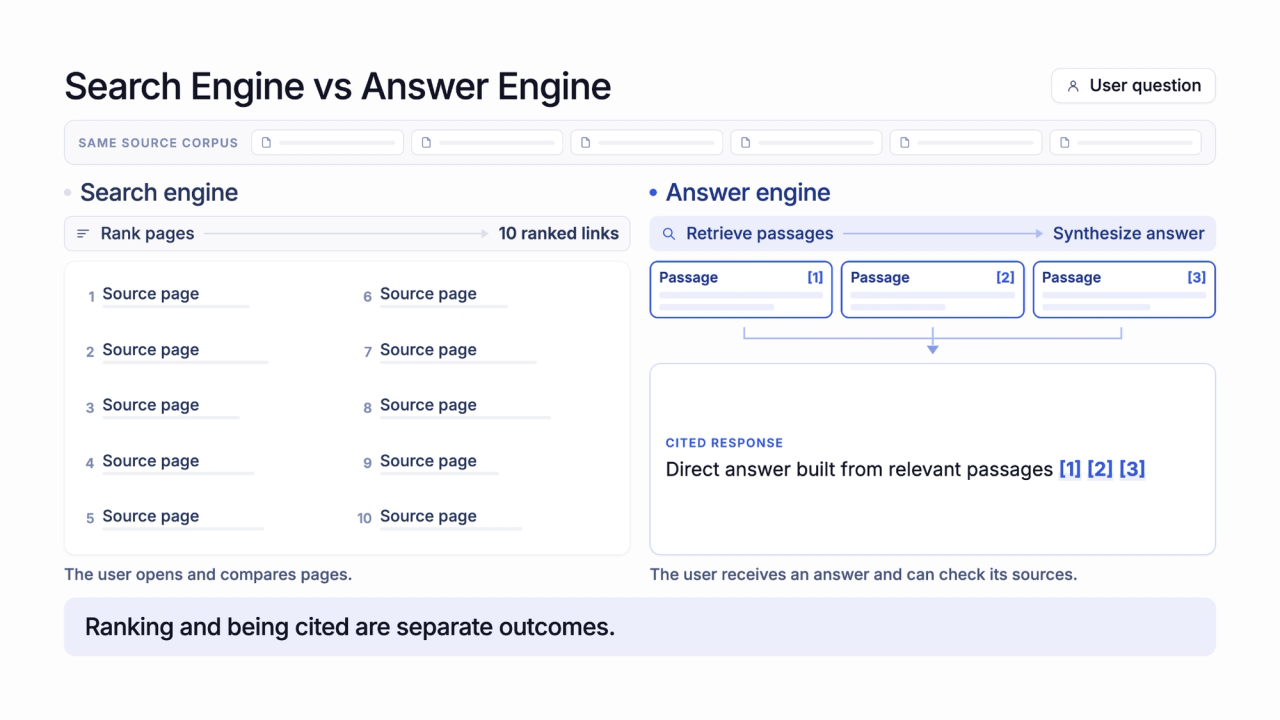
Traditional search asks the user to open links, compare pages, and assemble an answer, while an answer engine performs much of that work before showing the result. This change makes the quality and visibility of cited sources part of the answer itself.
Ranking and being cited are therefore different outcomes. A page may rank well but offer no complete passage that answers the question, while a clear, self-contained paragraph can supply the exact evidence an answer engine needs.
Answer Engine vs Search Engine vs Chatbot
- A search engine mainly ranks pages or other results so the user can choose which sources to open.
- An answer engine retrieves information, synthesizes a response, and may cite the sources used to create it.
- A chatbot describes a conversational interface, which may answer from a script, model training, company content, web search, or a mixture of sources.
Answer engine optimization, or AEO, describes work intended to make content understandable and citable within direct answers; it is not another name for an answer engine.
For that reason, Wonderchat treats the passage, rather than the full page, as the useful unit of retrieval because an answer engine needs a focused section that can directly support the response it generates.
Frequently Asked Questions
What is an answer engine?
An answer engine is an AI system that retrieves information, returns a direct synthesized response instead of only listing links, and may cite the sources used to build that answer.
How is an answer engine different from a search engine?
A search engine mainly ranks links for the user to review, while an answer engine combines retrieved information into a direct response, although modern search products may provide both experiences within one results page.
What makes content citable by an answer engine?
Citable content states a complete claim in a clear passage, supports it with checkable evidence, and identifies the source, although no page structure or search ranking can guarantee that an answer engine will include it.
