


26/09/2026
Chatbot KPIs
Chatbot KPIs are the metrics used to judge whether an AI support agent is working. Five decide a buying decision: deflection rate, resolution rate, containment, CSAT, and response time. Each one hides something, and knowing what it hides matters more than the number.
A metric records an activity or result. It becomes a key performance indicator when a team uses it to decide whether the chatbot should be bought, renewed, expanded, or changed.
5 Chatbot KPIs That Change a Buying Decision
No single chatbot metric proves that customers received useful help. Gartner found that 73% of customers used self-service during a support journey, but only 14% fully resolved their issue there, showing why activity and resolution must be reported separately.
Fin’s KPI framework gives a more direct example: a platform can report 90% deflection and only 40% true resolution when redirected or abandoned conversations remain in the deflection count. The number a vendor reports and the outcome a customer experiences can therefore be different results.
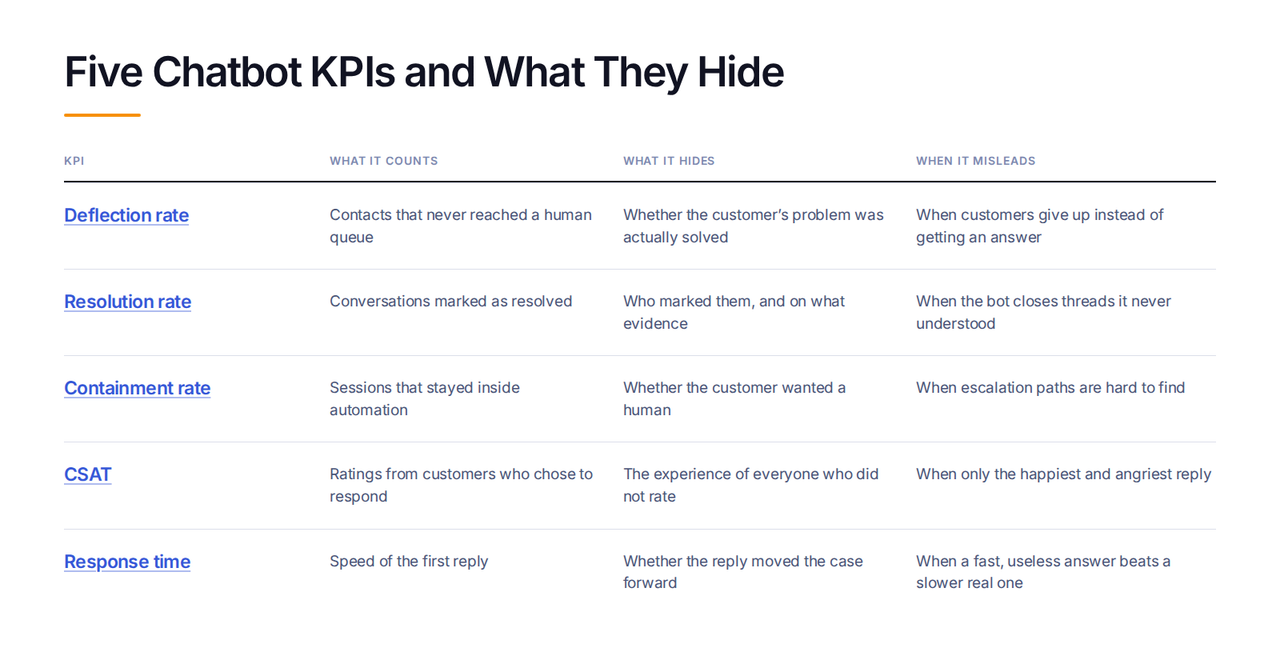
Wonderchat names what each support metric conceals, not just what it counts.
How the Metrics Work Together
Deflection, containment, and response time describe operational efficiency, while resolution rate and CSAT help test the customer outcome. A strong report pairs at least one efficiency measure with one outcome measure, then keeps AI-only, human-only, and mixed conversations separate.
Nearby metrics answer different questions.
Self-service rate checks whether eligible self-service sessions ended successfully, while zero-touch resolution requires a solved problem with no human involvement at any stage.
AI-to-human handoff shows where automation stopped and whether the customer reached a person with the conversation context preserved.
How to Test a Chatbot KPI Report
A buyer evaluating an AI support agent that reports resolutions should check how every number is calculated before accepting the dashboard.
- Confirm the numerator, denominator, exclusions, and reporting period.
- Separate abandoned conversations from completed or resolved ones.
- Check repeat contact across chat, email, phone, and helpdesk tickets.
- Split CSAT and resolution results by AI-only, human-only, and mixed support paths.
- Read response time beside answer accuracy and resolution, rather than treating speed as proof of quality.
Frequently Asked Questions
What are the most important chatbot KPIs?
The five most useful chatbot KPIs are deflection rate, resolution rate, containment rate, CSAT, and response time. Together, they cover workload reduction, problem resolution, channel control, customer satisfaction, and speed.
How do you measure AI chatbot performance?
Use the same eligible population and reporting period, then compare at least one efficiency metric with one customer-outcome metric. Report exclusions, repeat contacts, abandoned conversations, and human involvement beside the results.
Which chatbot metric matters most?
Resolution rate is usually the closest measure of whether the customer received help, but it remains incomplete without its denominator, resolution rule, exclusions, and repeat-contact window.
