


17/09/2026
Self-Service Rate
Self-service rate is the share of support sessions resolved without a human, measured against sessions rather than tickets. Using tickets as the denominator inflates the number, which is why two vendors quoting the same rate can be describing very different products.
How to Calculate Self-Service Rate
The calculation must compare successful self-service sessions with the full pool of eligible self-service sessions from the same channel and reporting period.
Self-service rate (%) = sessions resolved without a human ÷ all eligible self-service sessions × 100
The numerator includes only sessions that meet the stated resolution rule, which may use customer confirmation, completed tasks, or no repeat contact within a defined window. The denominator includes eligible sessions that were resolved, escalated, abandoned, or left unresolved, while test traffic, duplicate records, and other exclusions should be named separately.
Suppose a help center and AI agent record 1,000 eligible self-service sessions during one month, and 420 meet the stated resolution rule without human help. The self-service rate is 420 ÷ 1,000 × 100, which equals 42%.
If 180 of those sessions created tickets, calculating 420 ÷ (420 + 180) would produce 70% because 400 other unsuccessful sessions disappeared from the denominator. Tickets can help identify what happened after self-service, but they cannot replace the session pool used to calculate this rate.
What Counts as a Resolved Self-Service Session
A session should enter the numerator only when the reporting method has evidence that the customer’s issue ended without human help. Opening an article, starting a chatbot, or leaving a page records activity, but none of those events proves resolution by itself.
Before comparing rates, a buyer should check four parts of the method:
- How the platform decides where one session starts and ends.
- Which event proves that the issue was resolved.
- How long repeat contact about the same issue is monitored.
- Which sessions are excluded before the calculated rate.
An abandoned session should not become a successful resolution simply because no ticket was created, since the customer may have left without an answer or contacted support through another channel.
How Self-Service Rate Differs From Nearby Metrics
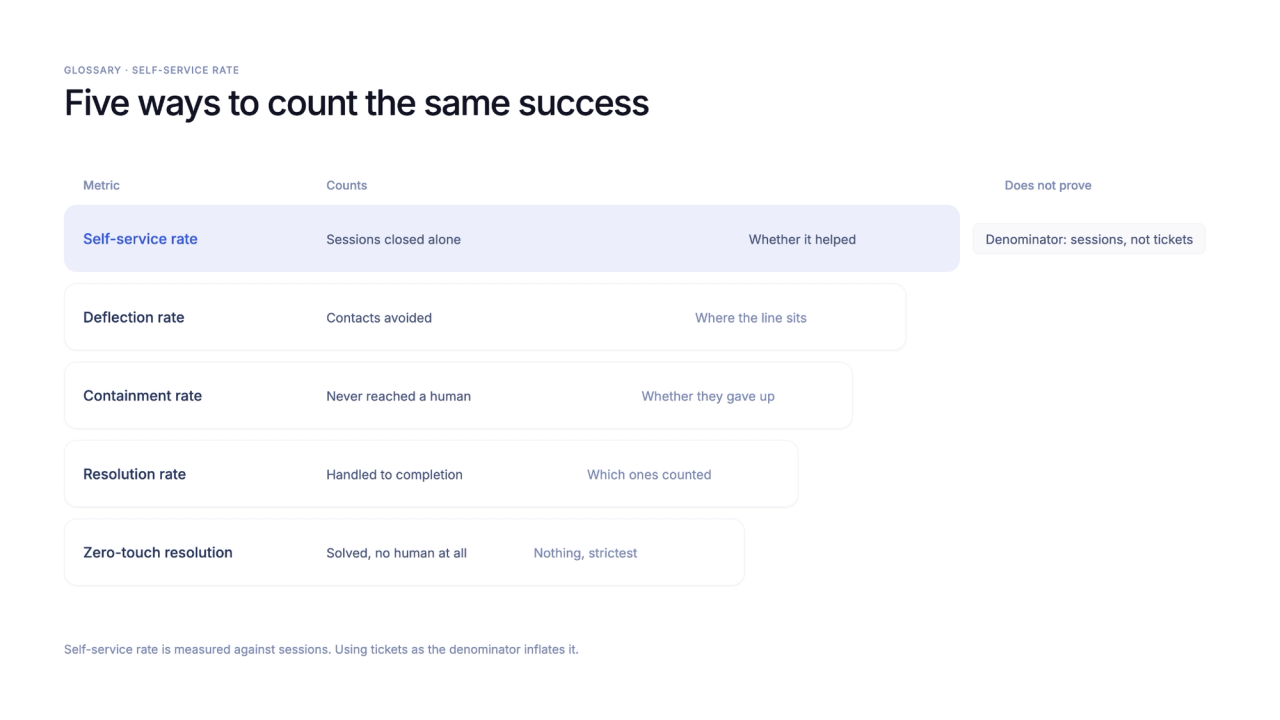
Self-service rate starts with sessions inside self-service channels and asks how many ended with the issue resolved without a human. Deflection rate starts with broader eligible support demand and counts contacts kept away from a human queue, which does not always prove that the problem was solved.
Containment rate measures interactions that remain inside an automated channel without a human transfer, while resolution rate measures issues classified as solved and may include work from an AI agent, a human agent, or both.
These rates can overlap, but their populations and finish lines are not interchangeable when teams compare AI ticket deflection tools.
Wonderchat measures self-service against sessions and says so.
Frequently Asked Questions
What is self-service rate?
Self-service rate is the percentage of eligible support sessions resolved through a help center, AI agent, portal, or another self-service channel without human help.
How is self-service rate calculated?
Divide sessions resolved without a human by all eligible self-service sessions from the same period, then multiply the result by 100.
Is self-service rate the same as deflection rate?
No, self-service rate measures successful sessions inside self-service channels, while deflection rate measures eligible contacts kept from a human queue and may include outcomes without confirmed resolution.
