


17/09/2026
Conversational AI
Conversational AI is any system that handles a customer conversation in natural language. The term covers three generations, including scripted decision trees, intent-classification bots that match questions to pre-written answers, and retrieval-grounded agents that answer from your own source material.
How the Three Generations Find Answers
Conversational AI is a broad category, so the three-generation model works as a buying framework rather than a formal technical standard. It shows where each system finds an answer, what causes failures, and which parts need more maintenance as customer requests change.
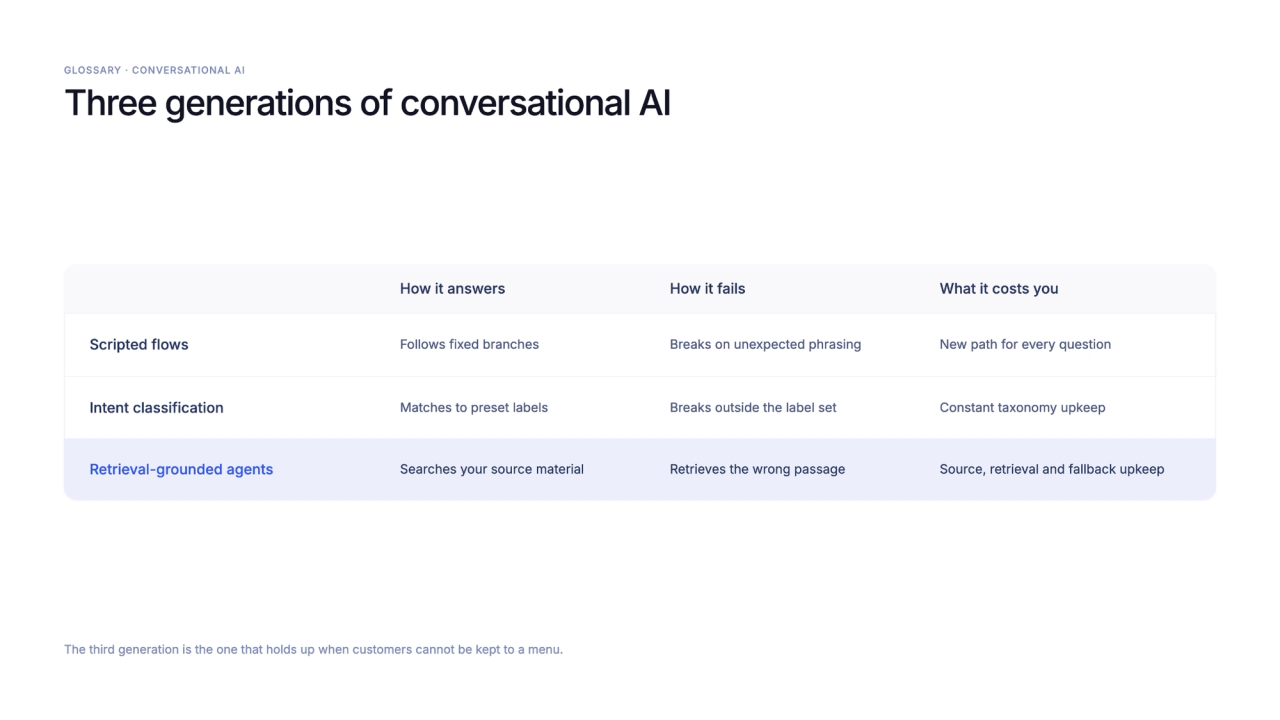
1. Scripted flows follow a decision tree.
The customer selects an option or uses a phrase that triggers the next fixed branch, which works for narrow tasks with predictable inputs. Unexpected wording, missing menu choices, and unplanned follow-up questions can stop the flow, while every new case requires another branch to be written and checked.
2. Intent-classification bots choose from a fixed answer set.
The system compares a message with known intent labels, such as “track order” or “cancel subscription,” then returns the linked answer or workflow. Mixed requests, weak training examples, and questions outside the defined labels can trigger the wrong response, so teams must maintain the intent list, examples, answers, and fallback rules.
3. Retrieval-grounded agents search source material before replying.
The system retrieves relevant passages from connected documents or knowledge bases, then generates an answer that fits the customer’s wording and conversation. Failures come from missing, stale, or conflicting content, wrong retrieval, or the model adding unsupported details, so maintenance shifts toward source quality, access rules, evaluations, and safe fallback behavior.
How Each Generation Handles an Unexpected Request
Consider a customer who writes, “My invoice is wrong, and I also need to change the address on my account.” A scripted flow may require two separate menu paths, while an intent-classification bot may choose one label and leave the second request unanswered.
A retrieval-grounded agent can search the relevant billing and account policies before forming a response, although retrieval alone does not give it permission to change account data. When the required answer is missing, or the action is not allowed, the system should ask for clarification, explain the limit, or route the conversation to a human.
How to Compare Conversational AI Systems
A product trial should test how the system behaves outside its easiest questions, because a fluent answer does not show where the information came from or whether the request was completed.
- Ask the same question with different wording and confirm that each version reaches the same answer or workflow.
- Combine two customer needs in one message and check whether the system handles both, asks a clear question, or routes the unresolved part.
- Ask about a policy missing from the source material and confirm that the system does not invent an answer when it should refuse or hand off.
Wonderchat’s AI customer support agent belongs to the third generation because it is retrieval-grounded and answers from a business’s own content.
Frequently Asked Questions
What is conversational AI?
Conversational AI handles spoken or written customer messages through scripted flows, intent matching, or retrieval-grounded generation, depending on how the system finds and forms an answer.
How is conversational AI different from a chatbot?
A chatbot is the interface used for a conversation, while conversational AI describes the technology behind the response. Chatbots may use simple scripts, intent classification, or retrieval-grounded generation, and conversational AI can also work through voice, email, or other channels.
What are examples of conversational AI in customer service?
Examples include answering product questions, checking order status, guiding troubleshooting, collecting customer details, routing requests, and handing unresolved conversations to a human agent.
