


04/09/2026
AI Agent vs Chatbot
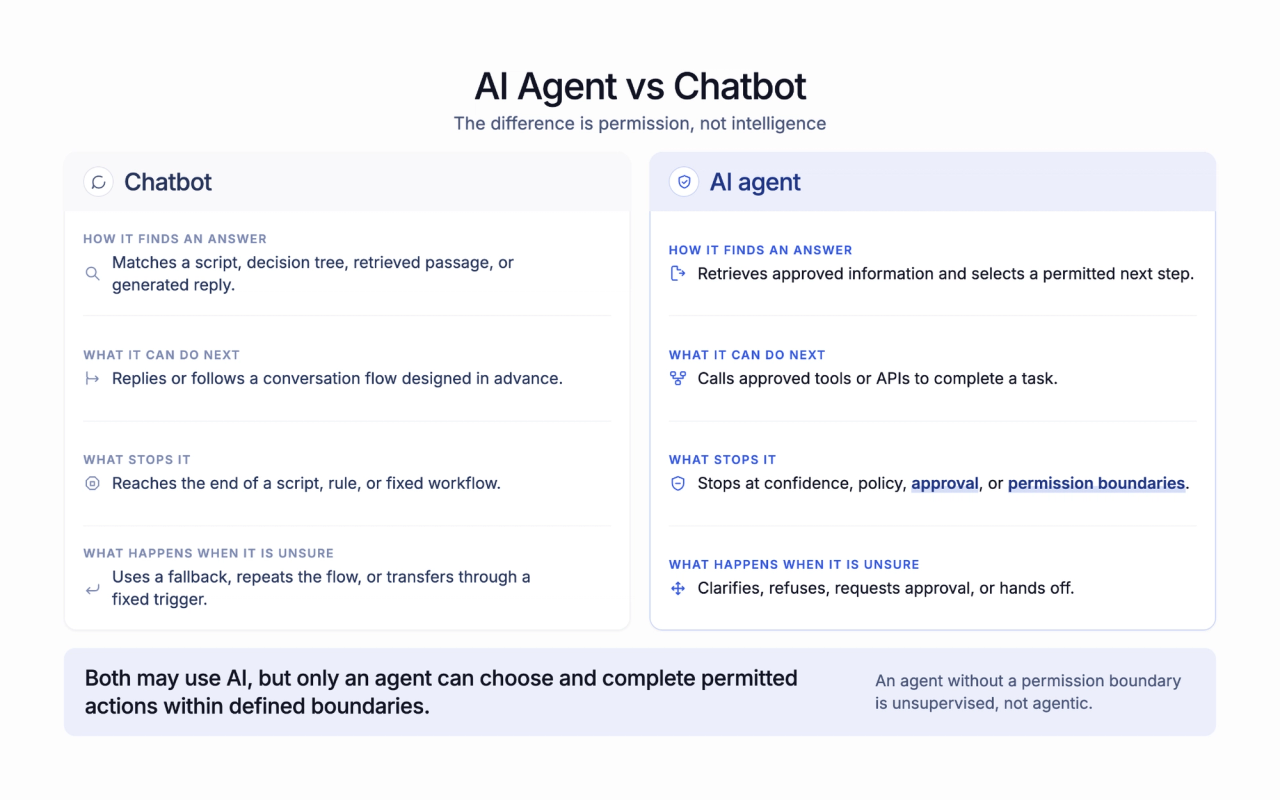
A chatbot answers questions through scripts, decision trees, or generated replies, while an AI agent can also take permitted actions. The difference is controlled autonomy, not intelligence, because a real agent knows when to act, request approval, escalate, or stop.
AI Agent vs Chatbot Comparison
The useful test is how the system handles uncertainty, actions, and permission boundaries, regardless of the name on the product page.
Finding an answer
Chatbot: Matches a script, decision tree, or generated reply.
AI Agent: Retrieves approved information and selects a permitted next step.
Unknown question
Chatbot: Uses a fallback, repeats the flow, or follows a fixed transfer rule.
AI Agent: Clarifies, refuses, or escalates when evidence is weak.
Multi-step request
Chatbot: Follows branches designed in advance.
AI Agent: Chooses permitted steps using the conversation and current system data.
Taking action
Chatbot: Explains the action or sends the customer elsewhere.
AI Agent: Calls approved tools or APIs to complete the task.
Escalation
Chatbot: Transfers through a fixed trigger or menu option
AI Agent: Applies intent, confidence, policy, and approval rules before handoff.
What Makes Something an AI Agent
Almost every modern chatbot uses AI, so natural replies, intent recognition, or access to a language model do not make a system agentic. The difference begins when the system can choose and complete an action through approved tools.
That autonomy still needs a boundary because access to an API does not permit every available action. Grounding, a confidence threshold , approvals, and escalation rules decide when the agent may act or must stop. An agent without a defined boundary is not agentic; it is unsupervised.
How to Tell the Difference in a Demo
Three questions can separate an agent from a chatbot even when both products use the same label:
- Can it complete an action? Ask it to update another system, then check whether it finishes the task or only explains the steps.
- What happens when it does not know? Use an unsupported question and watch whether it guesses, asks for clarity, refuses, or hands off.
- What stops a risky action? Request something above its authority and ask to see the approval rule and escalation path.
Which One Do You Need?
A chatbot is often right for a small website with twelve stable FAQs, where predictable answers and lower cost matter more than system actions. An agent would add permissions, integrations, testing, and monitoring without solving a larger problem.
An AI agent suits account changes, refunds, bookings, order updates, and other multi-step work across connected systems. It can handle complex inquiries only when its tools, data, and boundaries cover the request; otherwise, it should hand off.
Common Confusion
“AI-powered chatbot” is a marketing description, not a technical category, because it can describe a decision tree with generated wording or a retrieval system. Conversational AI can power either product, while agentic AI pursues goals through decisions and actions.
Wonderchat is an AI agent, defined by what it is permitted to do and what stops it, not by how it converses.
Frequently Asked Questions
What is the difference between an AI agent and a chatbot?
A chatbot mainly answers questions or follows a prepared conversation flow. An AI agent can also choose and complete permitted actions, use connected tools, and stop for clarification, approval, or human support when a request exceeds its boundaries.
Is an AI agent better than a chatbot?
Not always. A chatbot can be the simpler and less expensive choice for a small set of stable FAQs. An AI agent becomes useful when the work requires decisions, multi-step actions, connected systems, or controlled escalation.
How do I tell if a vendor’s “agent” is really a chatbot?
Ask whether it can complete an action in another system, what happens when its evidence is weak, and which actions require approval. A product that only writes replies or follows fixed branches behaves like a chatbot regardless of its label.
