


17/09/2026
Agentic AI
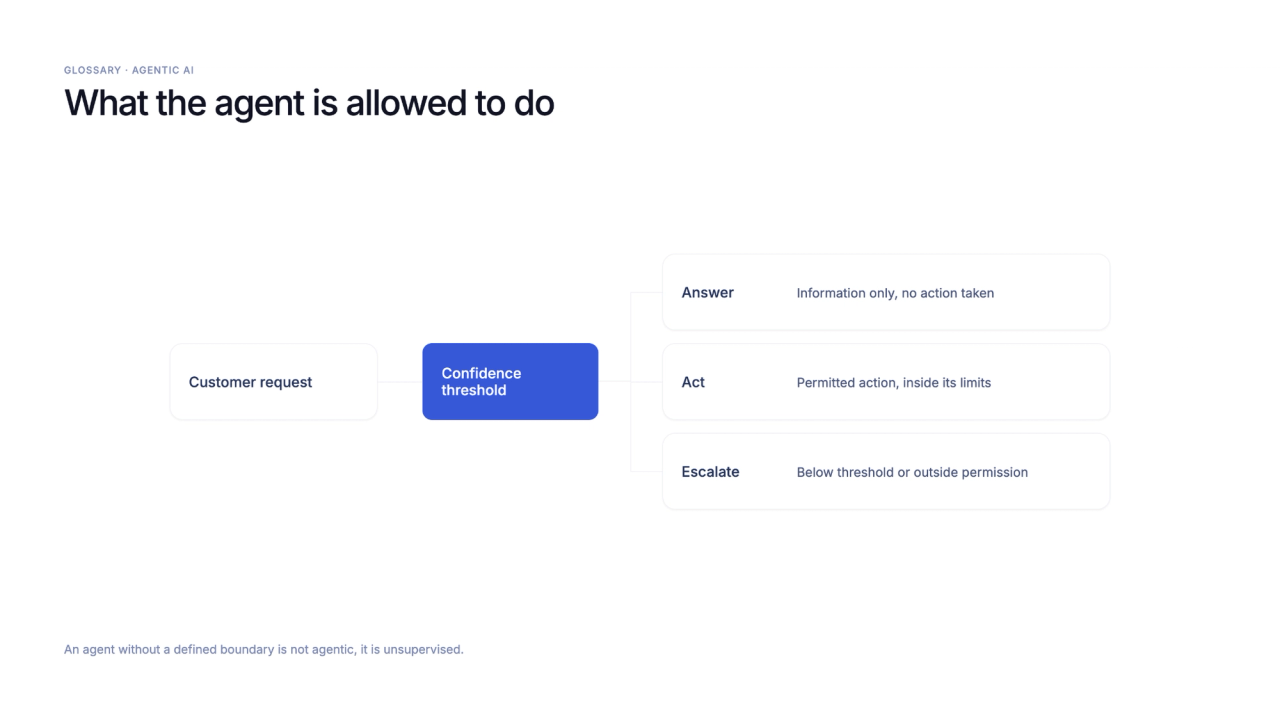
Agentic AI refers to artificial intelligence systems that can independently plan, reason, and take multi-step actions to achieve a specific goal with limited human supervision. Unlike a chatbot that only answers, an agent works within defined permissions and stops, seeks approval, or escalates when a confidence threshold or operating rule prevents further action.
How Agentic AI Moves From an Answer to an Action
An agentic system receives a task, gathers relevant context, chooses a permitted next step, and uses a connected tool or workflow to carry it out. In customer service, that step could update an address, collect required details, create a support ticket, or route the conversation to a human.
The same system should not treat every possible action as available, because access depends on the customer, request, policy, and risk involved. A request that falls outside its approved scope should trigger a question, an approval step, or an escalation instead of an unsupported action.
Three Questions That Show What an Agent Can Really Do
Broad claims about autonomy reveal little, so a useful review begins with three questions that expose the system’s decisions, tools, and limits.
- What can the agent decide? The vendor should explain which goals the system can break into steps, which sources it can retrieve, and when a fixed workflow controls the route.
- What can the agent change? The answer should name each tool and permitted action, including whether the agent can update a record, issue a refund, create a ticket, or only draft a reply.
- What stops the agent? Permission rules should block restricted actions, while a confidence threshold, missing information, or a defined high-risk topic should cause clarification, approval, or human escalation.
These questions separate an agent from a chatbot that only returns text, but they also separate controlled action from a vague promise of full autonomy.
What Happens When the Permission Boundary Is Missing
Consider a customer who asks for a refund after the allowed return period and also requests an address change. An agent may retrieve the return policy and explain it, but changing account data or making an exception may require identity checks and human approval.
Without those limits, the system could apply an action to the wrong account, exceed the refund policy, or claim success after a tool call failed. A controlled agent records the failed step, explains what remains unfinished, and sends the conversation to the approved route with its context intact.
How to Test Agentic AI Before Deployment
A product trial should test the boundary as carefully as the successful action, since polished replies do not prove that permissions or fallback routes work.
- Submit a supported request with an allowed action, then confirm that the correct record changes and the action appears in the system log.
- Remove a required source or provide an unclear request, then confirm that the agent asks a question or escalates instead of inventing an answer.
- Request a restricted action, then confirm that the workflow blocks it or waits for the required human approval before changing anything.
Wonderchat is an AI agent, defined by what it is permitted to do and what stops it.
Frequently Asked Questions
What is agentic AI?
Agentic AI describes systems that can choose and carry out permitted actions toward a goal, while stopping, requesting approval, or escalating when a rule or confidence boundary is reached.
What makes an AI system agentic?
An AI system becomes agentic when it can select and complete actions through tools or workflows within defined permissions, rather than only producing an answer.
What is the difference between agentic AI and automation?
Traditional automation follows fixed rules for expected inputs, while agentic AI can choose among allowed steps as the request changes. Both still need defined permissions, failure handling, and human oversight.
