


26/09/2026
Confidence Threshold
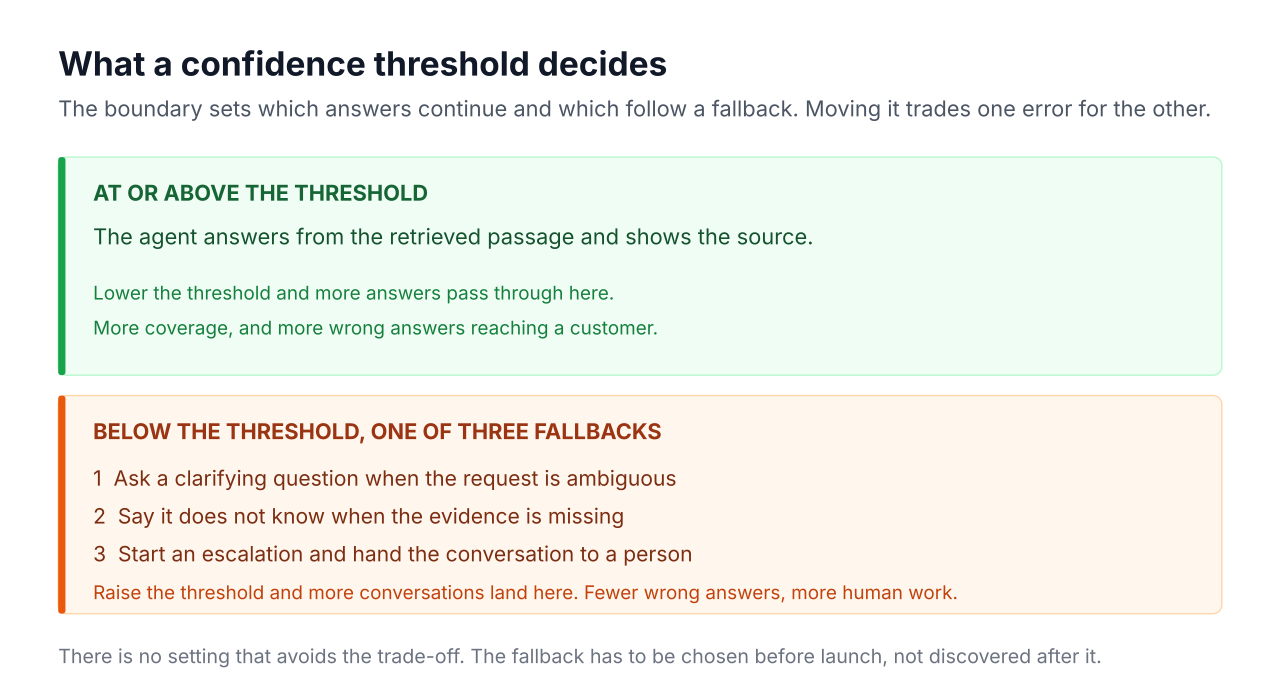
A confidence threshold is the score below which an AI agent stops answering and does something else: escalates, says it doesn't know, or offers a human. Setting it high means fewer wrong answers and more escalations. There is no setting that avoids that trade-off.
How a Confidence Threshold Works
An AI system assigns a confidence score to a proposed decision. The threshold acts as a boundary: results that meet it can continue, while results below it follow a fallback.
Confidence scores aren't universal measures of truth because systems calculate them differently. They become useful only when tests show that higher scores predict better results for the team's questions and risk level.
What Happens Below the Threshold?
The fallback should be decided before launch. The agent can:
- ask a clarifying question when the request is ambiguous;
- say it doesn't know when evidence is missing; or
- start an escalation and handoff when a person should take over.
A high threshold makes the system more cautious, but it also increases unanswered questions and human work. A low threshold lets an agentic AI system act more often, although more incorrect answers may pass through.
How to Test a Confidence Threshold
Use clear questions, vague wording, missing information, conflicting sources, and direct requests for a person. After each change, record wrong answers, correct abstentions, unnecessary refusals, and escalations.
Don't judge the threshold by automation rate alone. Check whether the fallback works and whether the customer receives a clear next step through the configured AI support agent.
Wonderchat’s handover rules fire on a direct request for a person, a message count, or repeated failed answers.
Frequently Asked Questions
What is a confidence threshold?
It is the minimum score an AI decision must meet before the system continues with an answer, intent, or action.
What happens when an AI agent isn't confident?
It can ask for clarification, state that it doesn't know, follow a safe fallback, or offer a human.
Should you set a high or low confidence threshold?
Use test results and the cost of a wrong answer. Higher thresholds favor caution, while lower thresholds favor broader automation.
