


06/10/2026
AI Hallucination
An AI hallucination is a confident answer the system was never given grounds for. Grounding does not eliminate hallucination; it changes the failure. Instead of inventing a fact, a grounded system can retrieve the wrong passage and answer from it.
How Grounded AI Can Still Give a Wrong Answer
An ungrounded language model may answer from patterns learned during training, even when it has no reliable information about a company’s current policies. Grounding limits the model to approved sources, usually through the retrieve-then-generate process used by real-world RAG chatbots.
This process reduces unsupported invention, but it creates another possible failure. If retrieval selects an outdated, incomplete, or unrelated passage, the model can produce a clear answer that matches the passage but doesn’t answer the customer correctly. Research into corrective retrieval-augmented generation identifies the relevance of retrieved documents as a central weakness when retrieval goes wrong.
Consider a customer asking about the current cancellation policy. The system may retrieve an archived policy, explain it correctly, and provide a valid citation to the wrong document. The answer looks supported, which makes the mistake less visible than an invented policy.
What Reduces Hallucination Risk
No single control makes an AI chatbot completely accurate. Reliable systems use several checks because each one catches a different problem.
- Retrieval quality: Test whether different wording finds the same current source and whether old or conflicting documents are ranked correctly.
- Citation surfacing: When evaluating an AI support agent that shows its sources, open the cited passage and confirm that it supports the complete answer, not just one related sentence.
- Confidence thresholds: When the available evidence is weak, the agent should refuse, ask a question, or offer a human instead of guessing.
A citation proves which source the system used. It doesn’t prove that the source was current, relevant, or interpreted correctly.
What Wonderchat’s Resolution Trend Shows
Wonderchat measures accuracy and publishes the mechanism behind the number.
Wonderchat’s 30-day rolling resolution rate moved from about 54% in late 2024 to about 76% in 2026, calculated as resolved ÷ (resolved + unresolved), with unclear conversations excluded. Customer feedback takes priority, while an AI judge reviews conversations without direct feedback.
Wonderchat attributes the improvement to multi-pass retrieval and a QA correction loop shipped in late 2025. Multi-pass retrieval gives weak searches another attempt, while the correction loop uses reviewed errors to improve later responses.
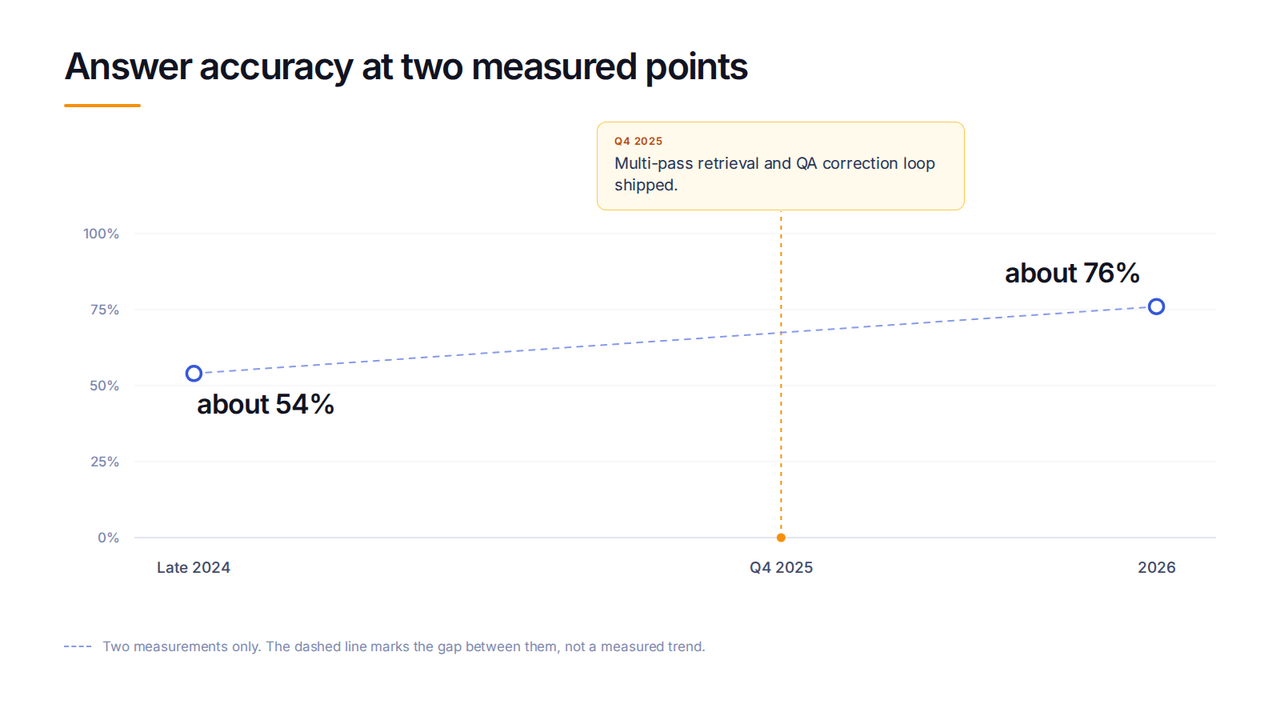
A resolution rate is an outcome measure, not a direct hallucination rate. It shows whether conversations were judged solved under a stated method, so it should be reviewed alongside incorrect answers, escalations, and repeat contacts.
How to Test Chatbot Accuracy
A useful accuracy test should include questions that sit outside the system’s easiest cases.
- Ask something the connected documents do not answer and check whether the agent admits the gap.
- Add an outdated policy beside its replacement and check which version the agent retrieves.
- Ask the same question using different wording and compare the answers and cited passages.
The clearest failure is a plausible answer supported by an unrelated citation. When that happens, the system found evidence, but it did not find the right evidence.
Frequently Asked Questions
What is an AI hallucination?
An AI hallucination is a confident response that is invented, unsupported, or based on evidence that doesn’t answer the question correctly.
Can AI chatbots be made accurate?
Retrieval, grounding, citations, testing, and confidence thresholds can improve accuracy, but none guarantees that every answer will be correct. Teams must continue reviewing failures and updating source material.
How do you stop a chatbot giving wrong answers?
Improve its sources and retrieval, show citations for inspection, test missing and conflicting information, and configure the agent to refuse or hand off when the evidence is weak.
