


04/09/2026
Citation
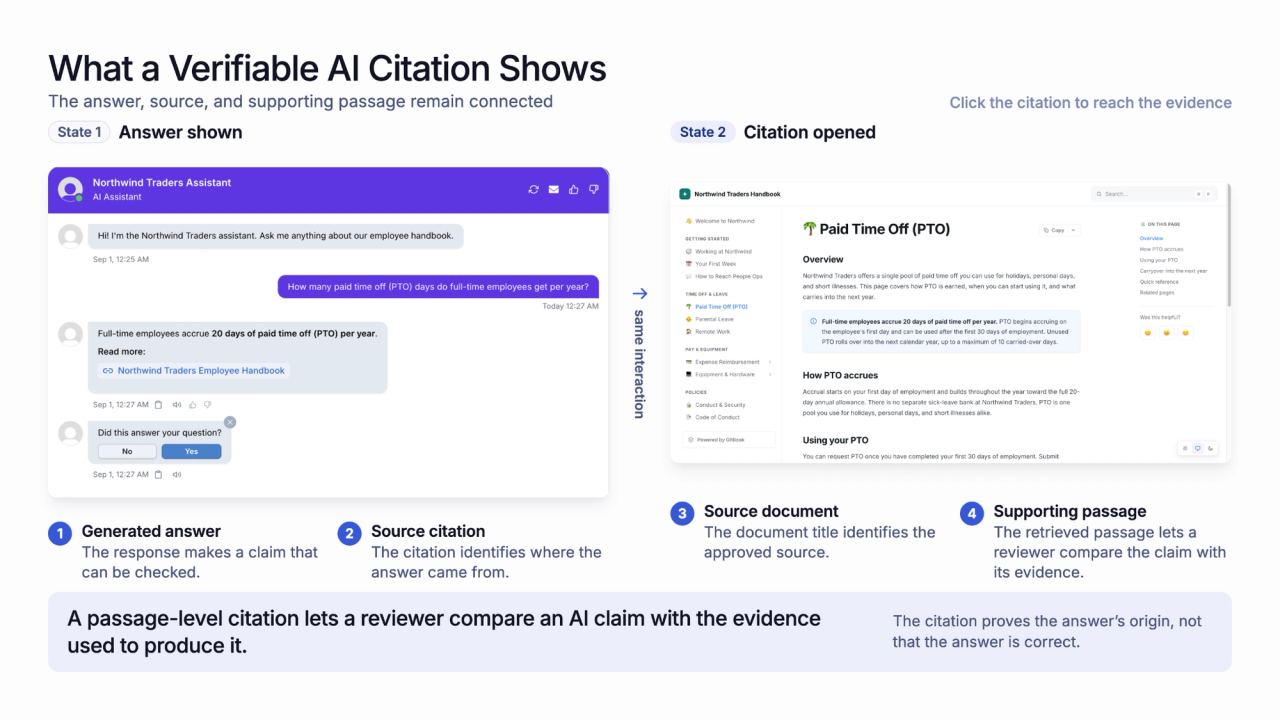
An AI citation identifies the source used to support part of an answer, allowing a reader to inspect its evidence. It proves where the answer came from, not that the answer is correct, complete, current, or faithful to the source.
The Three Levels of AI Citation
“Cites its sources” can describe three different product behaviors, and each level gives the reader a different amount of evidence:
- Named source. The answer names a document, website, or policy, but the reader must find the source and supporting text without help.
- Linked source. The citation opens the document or webpage, but it may still leave the reader searching through a long file for the relevant section.
- Passage-level citation. The citation opens or displays the specific passage retrieved for that claim, allowing the reader to compare the answer with its evidence.
Only the third level lets a reader verify the supporting passage directly. Even then, it confirms which text was used rather than proving that the source was current, relevant, or interpreted correctly.
How to Test an AI Citation
A buyer can run the citation test during a product demo in about a minute:
- Ask a narrow question. Choose a question answered by one clear paragraph in an approved document rather than a broad topic covered across several pages.
- Open the citation. Check whether it names a file, opens the full document, or takes the reviewer to the passage behind the claim.
- Compare answer and evidence. Confirm that every important detail appears in the cited text without added conditions, dates, exceptions, or promises.
Run the same test with a question the documents do not answer, because a reliable system should show the missing evidence rather than attach an unrelated citation to a plausible response.
Why Cited Answers Matter
A citation turns source attribution into a review tool rather than a decorative footnote. When an AI support agent gives the wrong refund, security, or account answer, a reviewer can inspect the evidence and decide whether the failure came from the document, retrieval, or generation.
That difference matters for complex customer inquiries because the source may contain product versions, regional rules, or exceptions that a short answer leaves out.
An uncited answer hides the failure point, while a passage-level citation gives the support team somewhere specific to begin its review.
Wonderchat treats citation as an audit mechanism, not a formatting choice.
Citation vs Grounding
Grounding restricts the information an AI system should use, while citation shows the evidence connected to the resulting answer. Grounding is a generation constraint; citation is the visible record that lets a person check whether the constraint worked.
The two can still fail together because an agent may retrieve the wrong passage and cite it accurately. A citation proves where the answer came from, not that the answer is right.
For examples of how retrieval, grounding, and cited answers work together, see these real-world RAG systems.
Frequently Asked Questions
What is a citation in AI-generated answers?
An AI citation identifies the source used to support a claim in a generated answer. The most useful citations link directly to the retrieved passage, allowing a reader to compare the claim with its evidence.
Do citations mean the answer is correct?
No, a citation shows where an answer came from, but the source may be outdated, irrelevant, or misunderstood. The cited passage must still be checked against the claim.
Why do AI support agents show sources?
AI support agents show sources so customers and reviewers can inspect the evidence behind an answer, trace mistakes to their likely cause, and confirm whether important conditions or exceptions were omitted.
