The best Zendesk alternative depends on what is actually wrong. If the bill is the problem, Freshdesk and Zoho Desk are the usual replacements: full helpdesks with the same shape at a lower entry price. If your team wants a shared inbox rather than a ticket queue, Help Scout. If you run a Shopify store, Gorgias. If you already live in HubSpot or Salesforce, their service products. And if the real cost is a team answering the same documented questions all day, the better move is often not a new helpdesk at all. It is an AI agent in front of the helpdesk you already have, which is the job Wonderchat does; teams without one can use Wonderchat's own help desk.
Why switching helpdesks rarely fixes the problem
The obvious move is to swap Zendesk for something cheaper with the same shape. That fixes the invoice and changes little else. The ticket volume that made Zendesk expensive arrives at the new tool on day one.
Across 1,309 complaints in reviews of 18 vendors, pricing was the biggest theme (211), then setup (197), UI and bugs (166), trust (128) and stale knowledge (38). Nobody shops for a Zendesk alternative because Zendesk cannot route a ticket. They shop because they are paying, per seat, to route tickets a good help center article should have answered first.
Most helpdesk add-ons paper over that with one word: deflection, which counts a closed tab as a success whether or not anything was answered. Most of what is sold as help desk automation moves the ticket without answering it. Resolution is the number that matters, and vendors rarely publish it. A rate without a denominator is a guess wearing a number. Ask every vendor below for theirs.
The 11 best Zendesk alternatives, by what they fix
Competitor prices move often, so each entry says how the vendor meters and links its pricing page; facts marked October 2026 were checked there that month.
1. Wonderchat: an AI agent with its own help desk, or on top of yours
Wonderchat is an AI Customer Service Agent with its own help desk on every plan, and it also sits on top of the one you already have. It answers from your help center, docs, website, files and past tickets, shows the source on every reply, and says so when the content does not cover the question. When a person is needed, it hands over with the whole conversation: by email or as a ticket in its own help desk on every plan, or into Zendesk or Freshdesk.
It is a Zendesk alternative in one sense: it answers the repeat questions before they become tickets, so fewer of them reach Zendesk. Across all accounts, the long-run average is about 75% of evaluated conversations resolved without a person. Jortt, a Dutch accounting platform that uses Wonderchat, resolves about 92% of roughly 30,000 monthly inquiries without a person.
Pricing: a Free plan at $0 with 50 AI replies a month, refilled monthly, no card; it's a plan, not a trial. Paid plans add more AI replies a month. HubSpot contact sync and the analytics dashboard start on Basic; Scale includes 9,000 AI replies a month. The meter is AI replies, with no per-seat charge. See Wonderchat's pricing page.
Best for: teams whose queue is mostly questions the documentation already answers. The honest limit: Zendesk is the deeper help desk, so a team that runs its whole queue there should keep it and put Wonderchat in front. Big libraries also take longer: knowledge bases over 500 pages take a median 15 days to go live, while 80% of Wonderchat agents that go live do so the same day.
How Wonderchat connects to Zendesk
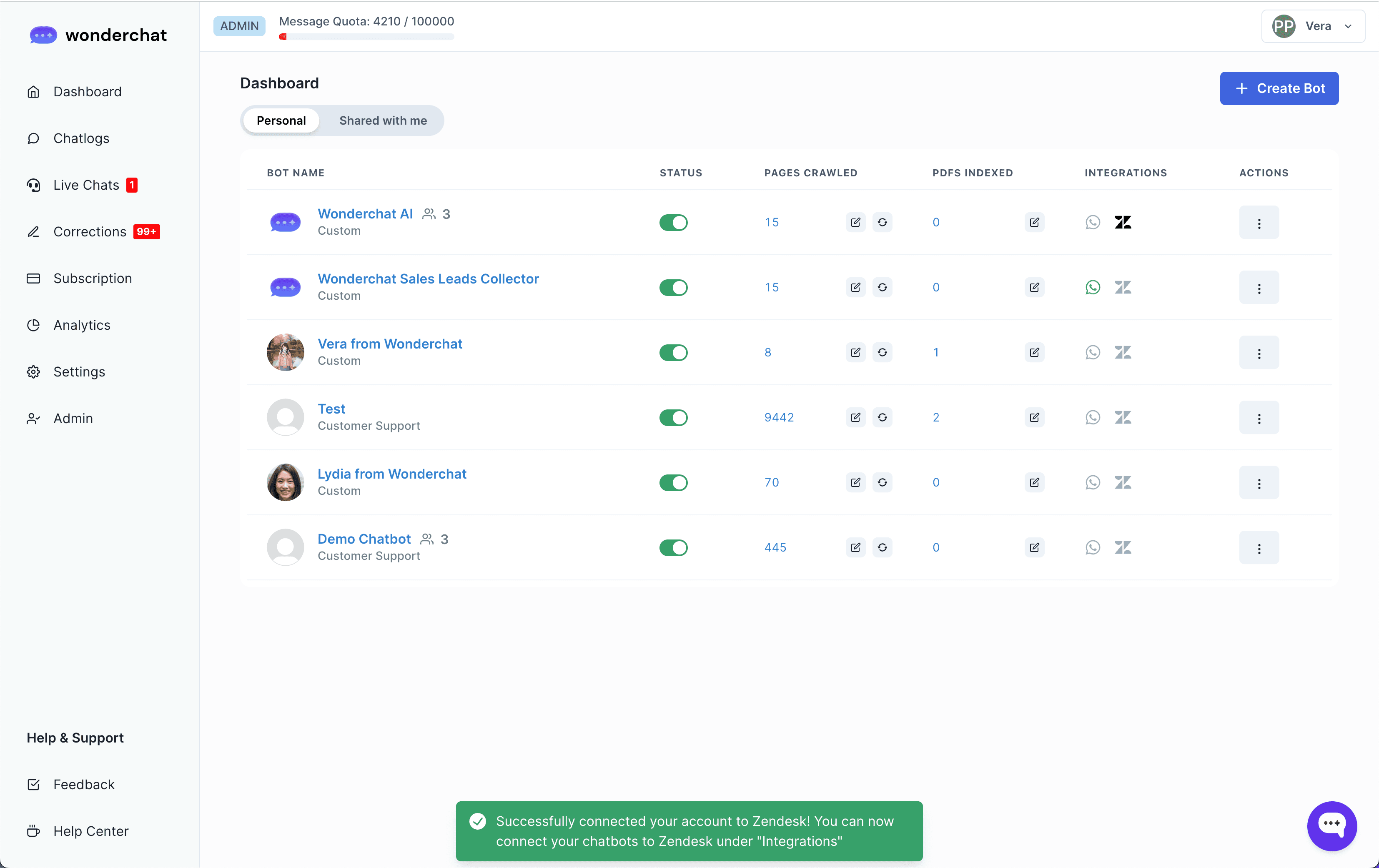
The Zendesk integration takes three steps once the agent is trained on your content.
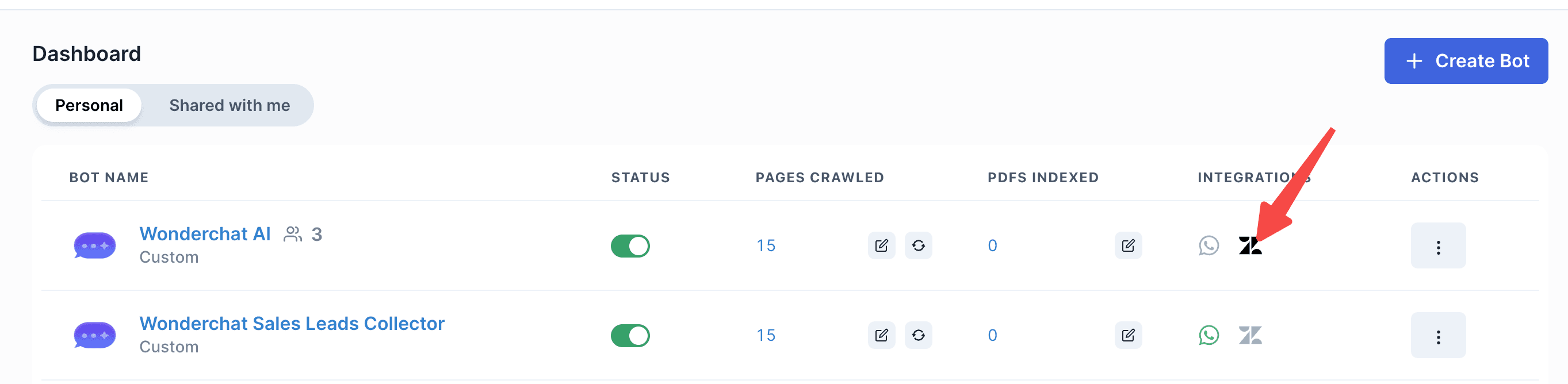
In the dashboard, click the Zendesk logo in the agent's Integrations column.
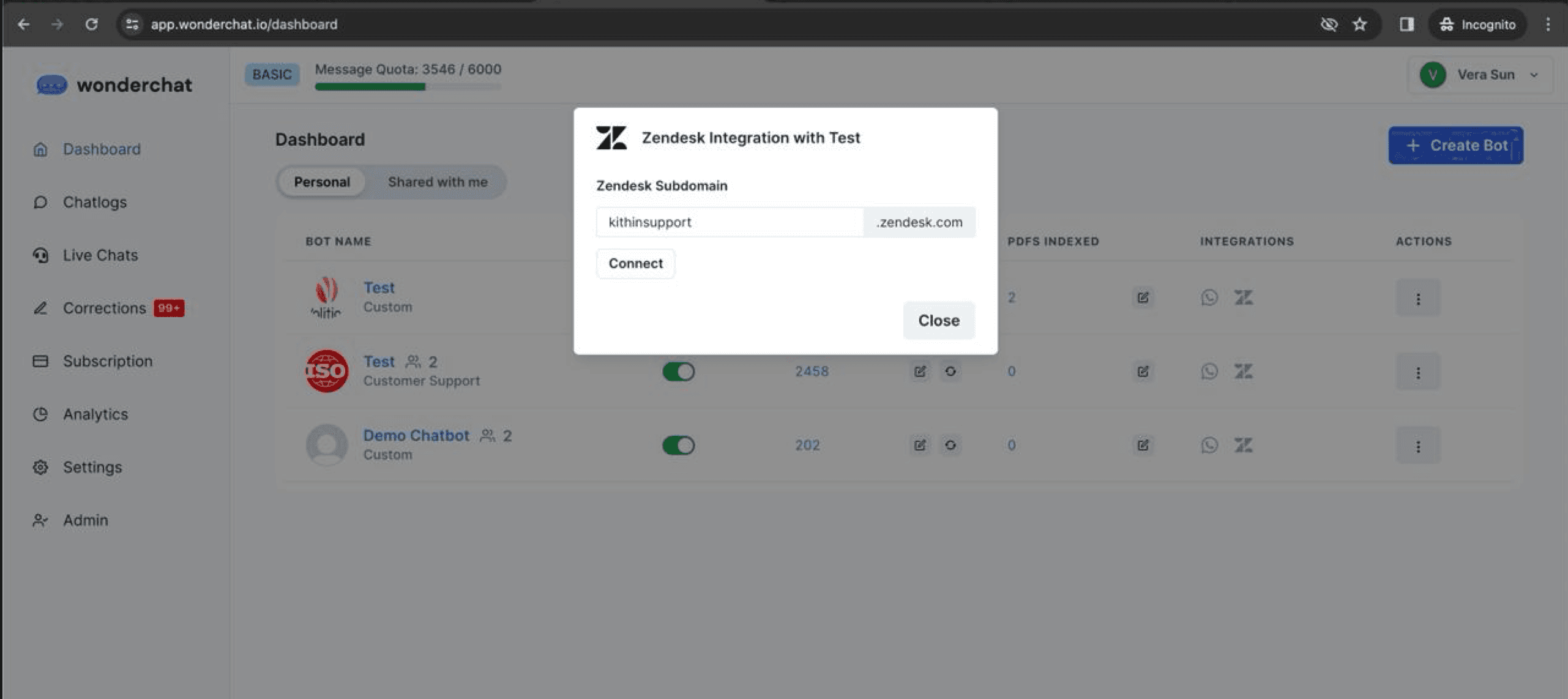
Click Connect Zendesk and sign in with your Zendesk helpdesk details.
After the confirmation, conversations the agent cannot finish arrive in Zendesk as tickets.
2. Freshdesk: the default cheaper helpdesk
Freshdesk is the alternative most teams try first: the same shape as Zendesk at a lower entry price, with ticketing, chat, social channels, routing and a self-service portal. Freddy, Freshworks' AI, answers customers from your help articles and drafts replies for agents. An unanswered chat becomes a ticket in the same queue.
Pricing: per agent per month. In October 2026 the pricing page listed no free plan, only a trial, with the AI agent metered in sessions. See Freshdesk's pricing page.
Best for: small and mid-sized teams that want a full helpdesk for less. The honest limit: the AI answers best from Freshdesk's own articles, so a team whose answers live in PDFs, a product site and old tickets gets a thinner agent than its content deserves. That is the case the Freshdesk integration exists for: Wonderchat answers from everything, and Freshdesk gets the ticket when it cannot.
3. Help Scout: a shared inbox instead of a ticket queue
Help Scout replaces the ticket queue with a shared inbox that behaves like email, plus a chat widget and a hosted help center. Its AI Answers replies from the help center, and a chat it cannot answer lands in the inbox as a conversation, not a ticket.
Pricing: as of October 2026, a free plan for small teams, per-user paid plans, and AI Answers billed per resolution. See Help Scout's pricing page.
Best for: small teams that want support to feel like email. The honest limit: no ticket workflows in the Zendesk sense, so teams with SLAs and tiers outgrow it, and per-resolution billing gets harder to forecast as volume climbs.
4. Zoho Desk: for teams already in Zoho
Zoho Desk is a full ticketing helpdesk with email, phone, chat, social and a self-service portal, plus Zia, Zoho's AI, on the higher tiers. The reason to pick it is the rest of Zoho: with Zoho CRM in the same account, customer context arrives with the ticket.
Pricing: per user per month, and as of October 2026 still a free plan for three users. See Zoho Desk's pricing page.
Best for: Zoho CRM users and small teams on a tight budget. The honest limit: the AI sits on the upper tiers, and teams outside Zoho lose the main reason to choose it.
5. Salesforce Service Cloud: for enterprises inside Salesforce
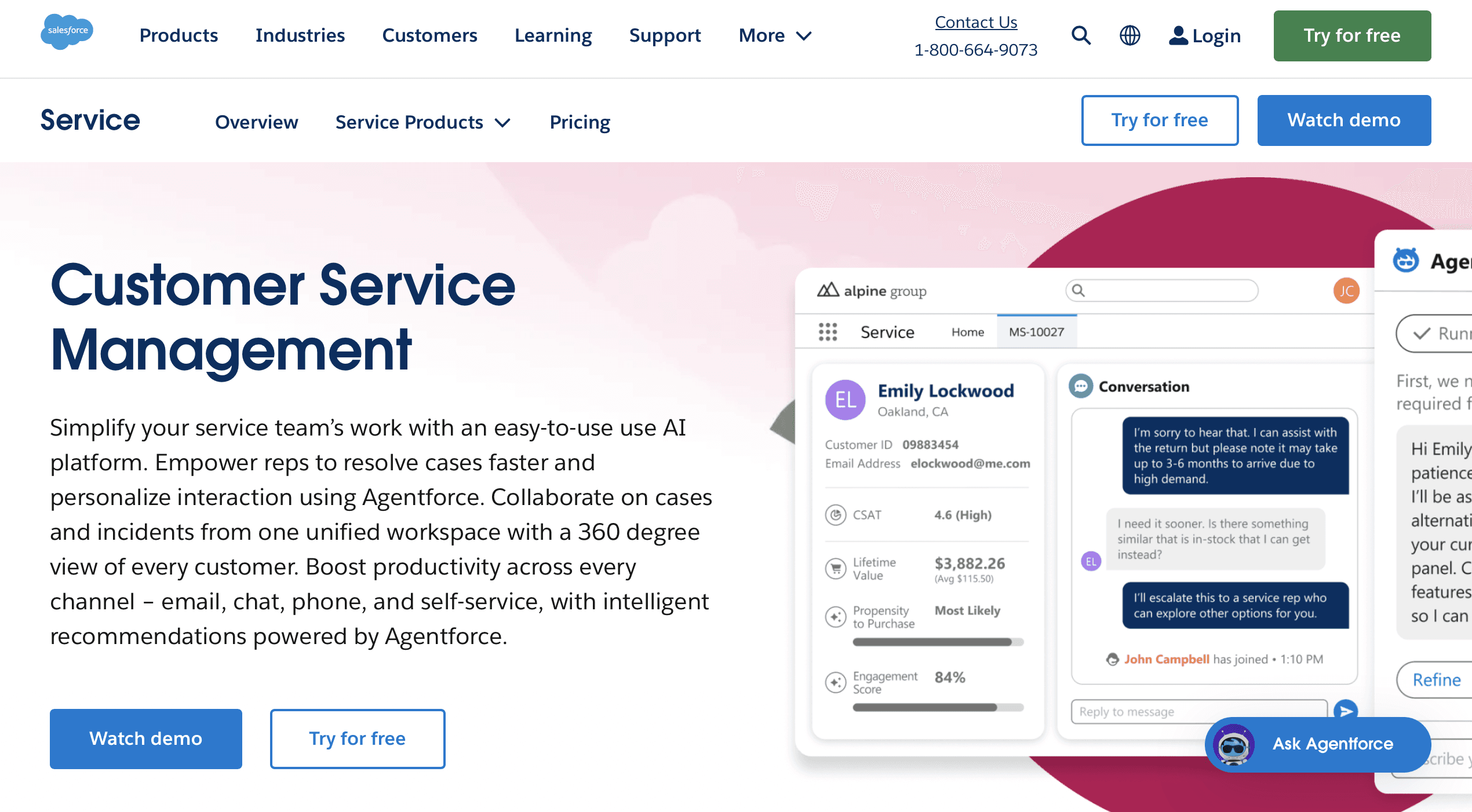
Service Cloud is the enterprise option: case management, omnichannel routing, reporting, and Agentforce, Salesforce's AI agent, all tied to the CRM record. Agentforce escalates into a case with that record attached. Fin, formerly Intercom, now belongs to the same company: Salesforce completed the acquisition in September 2026. Between the two, no vendor on this list has a deeper AI support ecosystem.
Pricing: per user per month across editions, with AI priced separately. See Salesforce's Service Cloud pricing page.
Best for: large companies already on Salesforce. The honest limit: cost and implementation time. A rollout is a project with a partner, and a ten-person team will never use most of it.
6. Gorgias: for Shopify and ecommerce stores
Gorgias pulls Shopify, WooCommerce and BigCommerce order data into the ticket, so a person or its AI Agent can see the order, change it, refund it, or answer "where is my order" without leaving the helpdesk. The AI works the ticket itself and passes it to a person when the request falls outside its rules.
Pricing: by monthly ticket volume, never per agent, with the AI Agent billed per automated interaction (October 2026). See Gorgias's pricing page.
Best for: stores where most tickets are about orders. The honest limit: outside ecommerce the order-centric design is dead weight, and ticket-based pricing punishes a busy month. A store whose questions are about products, sizing and policies may need an answer layer on the website more than a new helpdesk; the comparison of AI chatbots for Shopify stores covers that case.
7. HubSpot Service Hub: for HubSpot CRM users
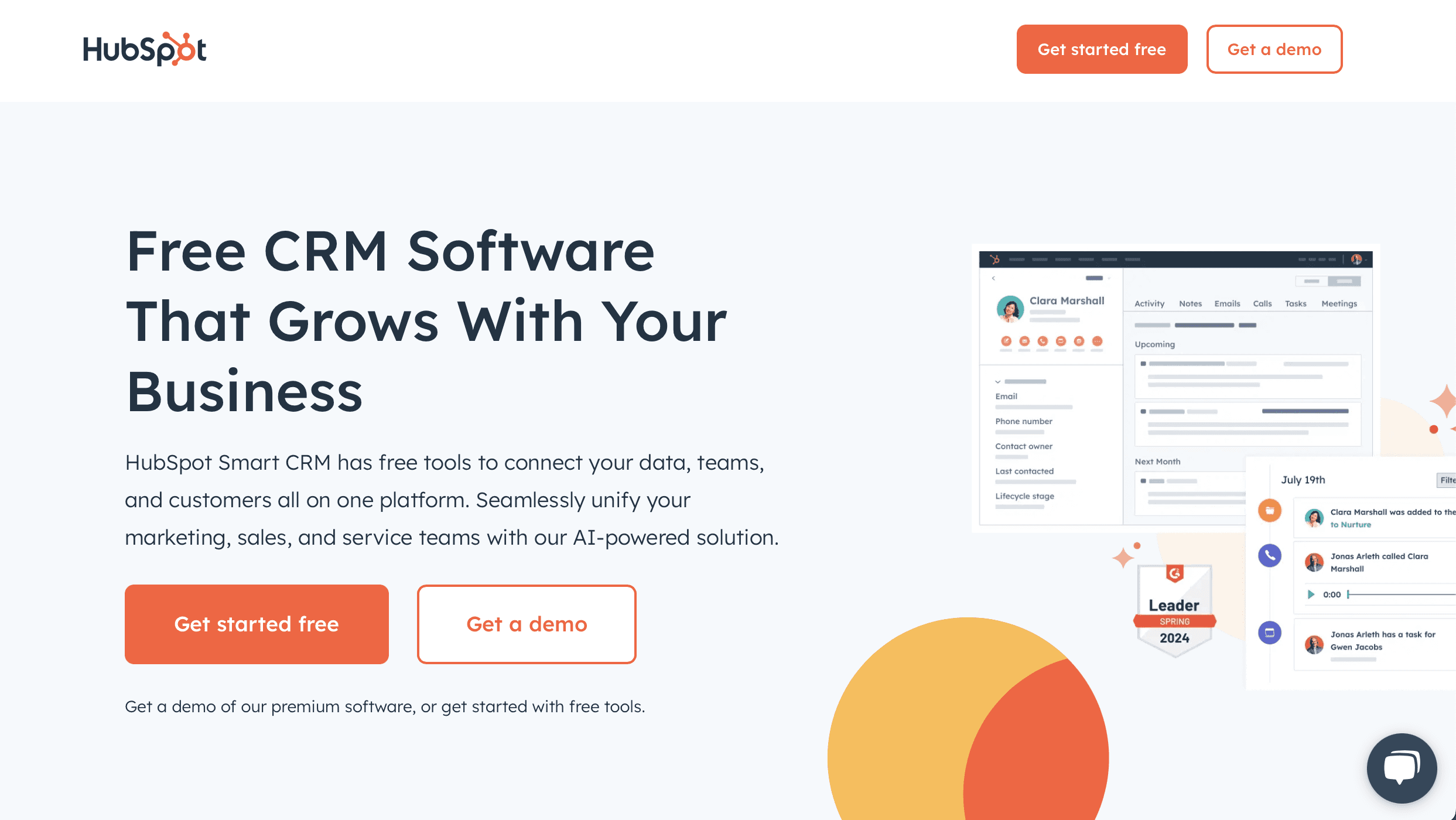
Service Hub adds tickets, a shared inbox, live chat, a knowledge base and an AI Customer Agent on top of the HubSpot CRM. The agent escalates into the inbox or a ticket with the contact record attached, so everything sales and marketing know about a customer is on the ticket.
Pricing: as of October 2026, a free plan for up to two users, then per-seat tiers, with the Customer Agent billed on usage. See HubSpot's Service Hub pricing page.
Best for: companies already paying for HubSpot. The honest limit: the useful tiers are not cheap per seat, and usage billing is hard to budget before you know your volume. Wonderchat's HubSpot integration (Basic plan and up) suits teams that want answers from the whole product site and docs, with the contact still synced to HubSpot.
8. LiveAgent: budget ticketing with a call center
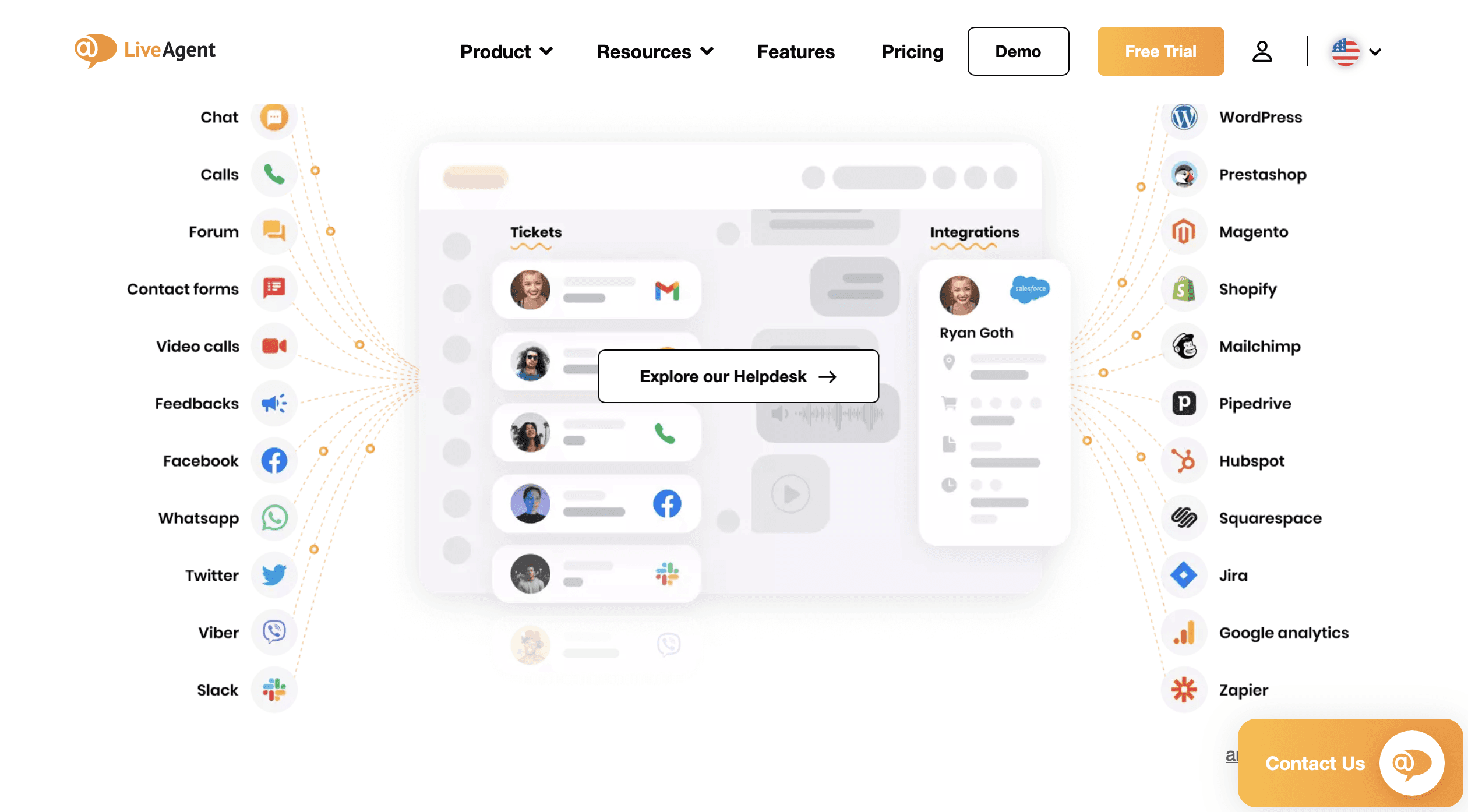
LiveAgent bundles ticketing, live chat, an AI chatbot and, from its middle tier, a call center with IVR, all at a low per-agent price. The chatbot answers first; chats, emails and calls that need a person become tickets in one queue.
Pricing: per agent per month, with social channels such as Facebook and Instagram sold as add-ons on the lower tiers (October 2026). See LiveAgent's pricing page.
Best for: startups that need phone and chat in one tool. The honest limit: it does many things cheaply, each shallower than the specialist tool, and channel add-ons push the real bill above the headline.
9. HappyFox: straightforward ticketing
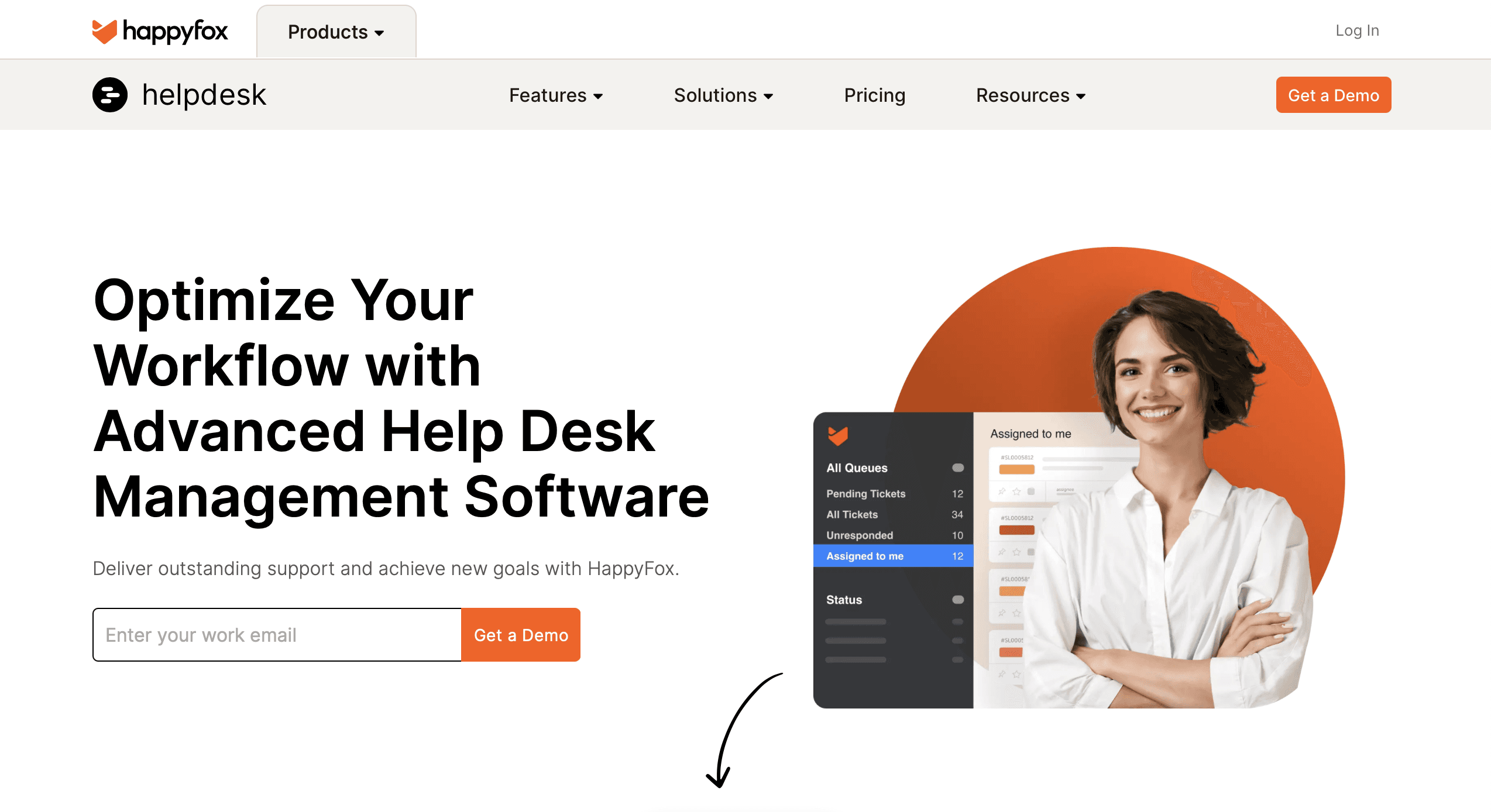
HappyFox is a web helpdesk with tickets, email, chat and social channels, automation, reporting and a self-service knowledge base. It is simpler to run than Zendesk. Its chatbot and Autopilot AI agents are separate products that sit in front of the ticket form.
Pricing: per active agent per month, with the AI products priced on their own (October 2026). See HappyFox's pricing page.
Best for: small and mid-sized businesses that want plain ticketing; the guide to helpdesk tools for SaaS companies compares more of them. The honest limit: a smaller ecosystem than Zendesk or Freshdesk, and buying helpdesk and AI separately makes the total harder to predict.
10. Nextiva: when phone is the main channel
Nextiva is a communications platform first: VoIP phones, text messaging and video, with customer service features attached. It is built around a person answering, not an AI answering first.
Pricing: per user per month on the business plans, with the full contact center on separate enterprise plans (October 2026). See Nextiva's pricing page.
Best for: mid-sized businesses where most support arrives by phone. The honest limit: as a helpdesk it is thinner than the dedicated tools, and the contact center features live on the pricier plans.
11. Shared Inbox by Canary: email-first for very small teams
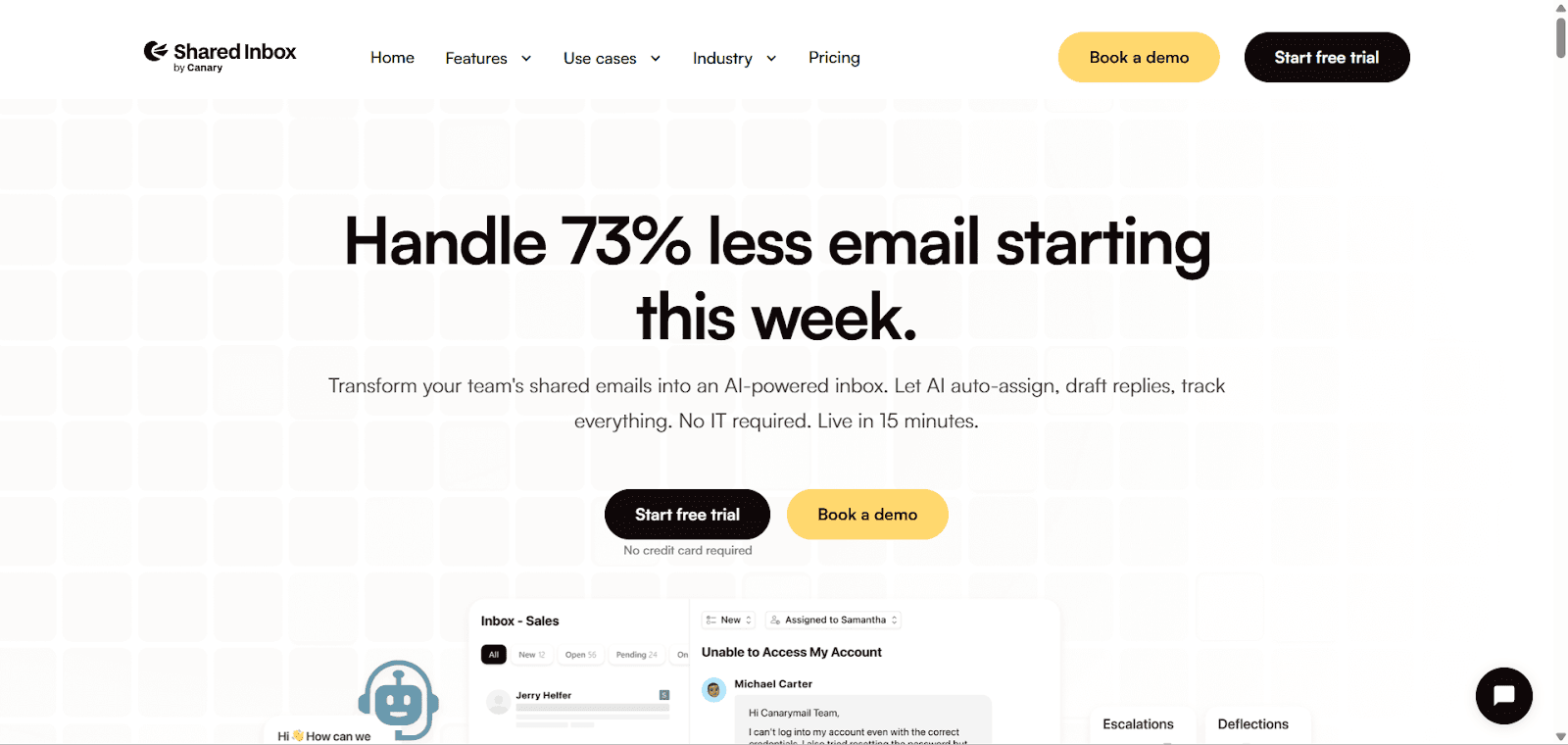
Canary turns a team mailbox into a lightweight helpdesk: one inbox for customer email, AI-suggested replies, assignment, internal notes and analytics. A person decides what to send.
Pricing: per user per month after a seven-day trial. See Canary's pricing page for current tiers.
Best for: a handful of people who live in email. The honest limit: it is an inbox first. A public help center, deep ticket workflows or phone support need another tool.
Zendesk alternatives compared
Zendesk alternative | What it is | How it meters | Best for |
|---|---|---|---|
Wonderchat | AI agent with its own help desk, or on top of yours | AI replies; Free plan, then paid plans | Repeat questions the docs already answer |
Freshdesk | Full helpdesk | Per agent; AI agent by sessions | A cheaper Zendesk, same shape |
Help Scout | Shared inbox and help center | Per user; free plan; AI per resolution | Email-style support |
Zoho Desk | Full helpdesk | Per user; free plan for three users | Teams already in Zoho |
Salesforce Service Cloud | Enterprise case management | Per user; AI separate | Enterprises on Salesforce |
Gorgias | Ecommerce helpdesk | By tickets; AI per interaction | Shopify stores |
HubSpot Service Hub | Helpdesk inside HubSpot CRM | Per seat; free plan; AI on usage | HubSpot customers |
LiveAgent | Helpdesk with call center | Per agent; social add-ons | Phone and chat on a budget |
HappyFox | Plain ticketing | Per agent; AI separate | Small and mid-sized businesses |
Nextiva | Phone system with support tools | Per user | Phone-first support |
Shared Inbox by Canary | Team inbox | Per user; seven-day trial | Very small teams in email |
When the alternative is not a helpdesk at all
A field technician needs the torque spec for one part in a service manual thousands of pages long. A bank's client asks which policy governs a fee waiver after last month's update. A graduate applicant finds three different English test scores on three university pages. These are precise questions buried in large documentation, and in a ticketing setup the answer is a queue and a wait while someone finds the page.
For manufacturers, banks, universities and law firms, the alternative that works is an AI agent that answers from the knowledge base itself: the technician gets the figure and the manual page it came from, the applicant gets the requirement and the handbook section. Zendesk sells AI agents of its own, so the test for every option, Zendesk's included, is the same: can it answer from all of your documentation and show where each answer came from?
Why the source on every answer matters most
The market still describes this category as routing. Across 1,679 AI answers in the help desk category, the word "citations" appeared zero times and "ticket" appeared 671 times. Three things make an agent trustworthy.
First, it answers only from your content, shows the source on every reply, and says so when the content does not cover the question. The failure Wonderchat's support team sees most often is not invention. It is retrieval pulling an archived policy and answering from it correctly: the citation is real and the answer is wrong. A visible source is what gives someone the chance to notice.
Second, it keeps a list of what it could not answer, which is the cheapest documentation audit a team will run. Wonderchat sends each question your content did not answer to its review inbox. Closing them is the lever you control: answer each one once and it answers from then on.
Third, compliance. Wonderchat's security: SOC 2 Type II, GDPR, EU-hosted in Frankfurt, HIPAA BAA available. Ask every shortlisted vendor for the same four in writing.
Where Wonderchat loses
If you need a full ticketing helpdesk, Freshdesk or Zoho Desk is the better first purchase; Wonderchat's help desk is where the agent's handovers land. If most of your tickets are order changes and refunds, Gorgias wins: it edits the order inside the ticket, where Wonderchat answers and hands the change to a person. If you want support that feels like email, Help Scout wins: it is genuinely simple to run. For multi-step actions across systems, such as changing a booking or issuing a credit, Ada, Decagon and Sierra are built for it; Wonderchat answers and hands over. And if Zendesk is already installed with two years of triggers and macros, keep it. Teams migrating off a chat widget hit the same wall: the export carries the transcript but not the routing rules, so every rule is rebuilt by hand. A helpdesk migration multiplies that by every trigger and macro.
Verdict
Pick by the problem. Bill too high, same tool wanted: Freshdesk or Zoho Desk. Email rather than tickets: Help Scout. Shopify: Gorgias. Already in a CRM: HubSpot or Salesforce. Phone first: Nextiva or LiveAgent. A handful of people in one mailbox: Canary. And if the queue is full of questions your help center already answers, keep the helpdesk you have and put an AI agent in front of it. Wonderchat’s Free plan gives 50 AI replies a month, refilled monthly, with no card, enough to see what share of your real questions it resolves before anyone pays.
Frequently asked questions
What is the cheapest Zendesk alternative?
As of October 2026, Zoho Desk, HubSpot Service Hub and Help Scout all offer free plans for small teams; Freshdesk's pricing page lists none. Prices move, so check each page. Wonderchat's free plan refills 50 AI replies every month, and no plan charges per seat.
Is Wonderchat a replacement for Zendesk?
No. Wonderchat is an AI Customer Service Agent with a help desk included, and it also works on top of Zendesk or Freshdesk. It answers from your content, shows its source, and hands conversations it cannot finish into Zendesk as tickets. The helpdesk stays. It gets fewer tickets.
What is the difference between deflection and resolution?
Deflection rate counts contacts that did not become a ticket, whether or not the customer got an answer. Resolution counts conversations the agent actually finished. Deflection rate is the number a vendor reports when resolution rate would be embarrassing, so ask for resolution and its denominator.
Which Zendesk alternative is best for ecommerce?
Gorgias. It pulls Shopify, WooCommerce and BigCommerce orders into the ticket so a person or its AI can change, refund or track an order in place. Stores whose questions are mostly about products and policies may need an answer layer on the website more than a new helpdesk.
Can an AI agent answer from thousands of pages of documentation?
Yes, if it retrieves rather than summarizes and shows the page it answered from. Expect setup to take longer on big libraries: Wonderchat's support team sees a median of 15 days to go-live on accounts with more than 500 documentation pages.