
AI chatbots in MedTech handle the repetitive patient admin: answering common questions, taking intake details, managing appointments and following up after treatment. For patients, that means fewer forms, phone calls and waits on hold.
They don't replace doctors or nurses; clinical questions still go to a person. Think: booking appointments, answering basic questions, even checking symptoms before you go in.
This article covers how AI chatbots are used in MedTech, what they deliver, where they fall short, and how to set one up on your own documentation with Wonderchat.
The Rise of AI Chatbots in Healthcare and MedTech
The MedTech industry itself is booming. McKinsey says it’ll grow from $590 billion in 2024 to over $800 billion by 2030. AI tools that take routine work off doctors and clinics are part of that market.
Doctors' Trust in AI Tools Is Growing
According to a 2023 survey reported by Statista, 77% of U.S. doctors whose practices use website chatbots were at least somewhat confident a chatbot can assess symptoms accurately and escalate emergencies. Only 2% were extremely skeptical.
Adoption is strongest for repetitive, low-risk tasks like:
Answering FAQs
Managing appointments
Collecting data
Who are the top 10 medical device companies in the world?
Here’s a quick look at the top 10 MedTech companies by annual revenue in 2024. Medtronic and Johnson & Johnson are among the names on it.

Image source: Proclinical
Top Use Cases of AI Chatbots in the MedTech Industry
According to a 2024 survey by John Snow Labs, the top uses for AI in healthcare include:
Answering patient questions (21%)
Powering chatbots (20%)
Extracting data from records (19%)
Here is a snapshot of the respondents' answers on using LLMs in healthcare:
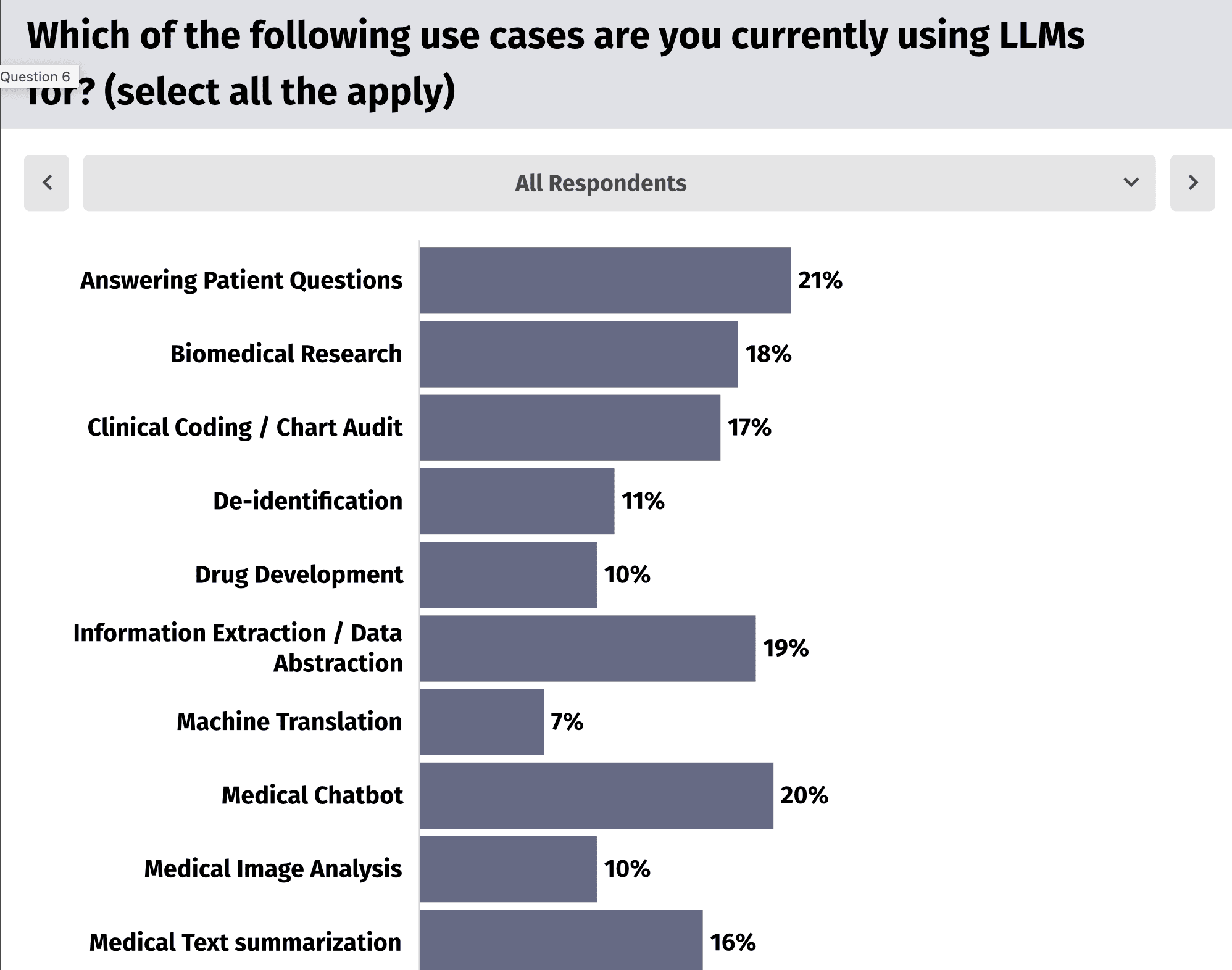
Image source: John Snow Labs (2024)
Here’s how MedTech and Healthcare companies are applying chatbots:
1. Patient Intakes
AI chatbots can pre-screen patients by collecting symptoms, asking relevant questions, and providing guidance on the steps to register new patients. This saves time for both patients and healthcare professionals and makes the process smoother, reducing physical queues.
2. Appointments Management
Patients can book, confirm, or cancel appointments through a chatbot. Some chatbots and voice AI agents also send automated reminders to reduce no-shows.
3. Post-Treatment Follow-ups
After a medical procedure, chatbots can follow up with patients, asking about symptoms or recovery progress, and alert medical providers if any further care is needed.
4. Patient FAQs
Chatbots answer common questions about medications, procedures, insurance, or home care instructions. This reduces the load on call centers and support staff.
5. Data Collection and Analytics
They help collect data on symptoms, medication use and patient satisfaction, giving providers a clearer picture of how patients are doing.
Summary Table: AI Chatbot Use Cases in MedTech
Use Case | Description |
|---|---|
Patient Intake | Onboards patients, gathers symptoms, asks questions, and provides next-step guidance |
Appointments Management | Books, confirms, cancels appointments; sends automated reminders |
Post-Treatment Follow-ups | Checks recovery status, flags issues to medical providers |
Patient FAQs | Answers common questions, reducing staff workload |
Data Collection & Analytics | Collects symptom, medication and satisfaction data for the care team |
Key Benefits of Using AI Chatbots in MedTech firms
The benefits MedTech teams see from chatbots:
Improved Patient Engagement
Chatbots are easy to use and can improve access to care.
Operational Efficiency
Chatbots take routine questions off the phone line, so staff can focus on more complex cases.
24/7 Availability
AI chatbots never sleep. Patients can interact with them anytime, during off-hours, weekends, or holidays, without needing to wait for human support.
Reduced Costs
Juniper Research forecast that annual savings from healthcare chatbots would reach $3.6 billion globally by 2022, up from $2.8 million in 2017.
Improved Data Collection
Real-time data collection helps providers understand patient needs better and personalize care. Chatbots can log symptoms, medication use, and satisfaction levels, offering insights that traditional systems often miss.
Addressing the Limitations: When AI Chatbots Aren't Enough
While AI chatbots offer many advantages, there are limitations. A 2019 study published in JMIR found that doctors believe chatbots are best suited for handling administrative and basic clinical tasks, not complex decisions requiring deep medical knowledge and experience at hand.
This reinforces the idea that chatbots should support, not replace, human care. Tasks involving empathy, clinical reasoning, or urgent decision-making still need expert oversight.
How to Set Up an AI Agent for Your MedTech Business with Wonderchat
Why Choose Wonderchat?
Wonderchat makes it easy to build an AI agent from your own documentation, including in healthcare, without writing a single line of code. Add your FAQs, PDFs, instructions or policy docs, and the agent answers patients from that content and shows the source on every reply.
Pro tip: Follow this step-by-step guide on how to build your first AI agent in Wonderchat; 80% of Wonderchat agents that go live do so the same day.

Wonderchat can help you:
Answer patients from your own material, with the source on every reply
Say so when your content doesn't cover a question, and hand the patient to your team with the whole conversation
Answer patients at any hour, in 40+ languages
Customize the chatbot’s design, behavior, and tone to match your brand
Track usage and performance in the analytics dashboard (Basic plan and up)
Whether you’re running a health app, a MedTech website or a virtual consultation clinic, Wonderchat gives you the tools to automate patient communication while staying fully in control. On security, Wonderchat is SOC 2 Type II, GDPR, EU-hosted in Frankfurt, HIPAA BAA available. Wonderchat suits a small MedTech team with written patient instructions and policy docs: the agent answers only from them, says when it cannot find the answer and hands the full chat to staff.
Final Thoughts
AI chatbots fit MedTech best on the repetitive, low-risk work: patient questions, intake and appointments. Clinical judgment, empathy and urgent decisions stay with people.
Ready to get started? Set up your AI agent today on Wonderchat's free plan, no credit card needed.

