Fin pricing in brief
Fin's variable outcome and seat charges can make costs difficult to predict as support volume changes. Wonderchat instead bundles resolution allowances and seats into fixed plans, making spending easier to forecast within each tier.
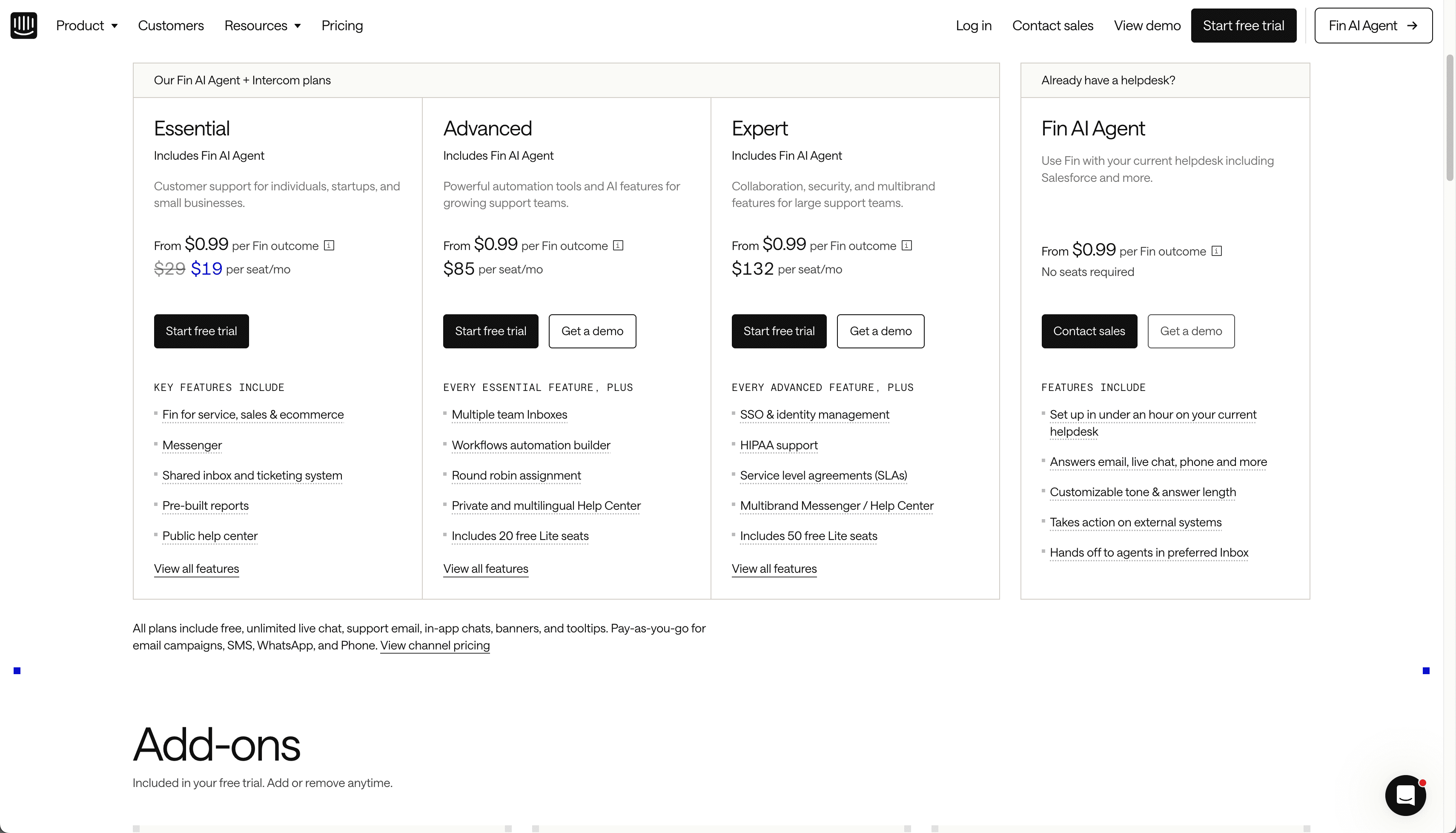
Fin charges $0.99 per outcome after a $49 monthly base that includes 50 outcomes. Unused outcomes do not carry forward.
Fin bills for resolved conversations and successful procedures configured to transfer the conversation to a person or workflow. Each conversation can incur only one outcome charge.
Intercom helpdesk customers also pay seat fees. Essential seats run $29 per month, or $19 with annual billing, up to $99 per month for an Expert seat, while some add-ons cost extra.
Wonderchat plans bundle a monthly allowance of AI replies into a printed monthly plan price, with no per-seat cost on any plan, compared with Fin’s $0.99 per outcome.
Why Fin's pricing model is hard to estimate in advance
Fin's costs are harder to forecast than those of a flat plan because the bill depends on the number of successful outcomes. Intercom describes this as an outcome-based pricing model: spending tracks Fin's reported performance, but traffic or resolution-rate spikes can raise the bill without a plan change.

The $0.99 unit price does not capture the full cost for every deployment. Fin’s $19 base plan includes 50 outcomes, while Intercom helpdesk customers may also pay seat fees and charges for products such as Fin Voice or Proactive Support Plus. Unused included outcomes expire each month, which can raise the effective cost per outcome during quieter periods.
Fin may charge when a customer confirms an answer or disengages for 24 hours. A procedure you configured to end in a handoff can also trigger a charge. Failed procedures and some escalations do not. The once-per-conversation billing cap and reopened-conversation adjustments reduce some overcharging risk, but you still need forecasts that separate billable outcomes from non-billable activity and account for volume growth.
What counts as a billable resolution
Fin uses “outcome” as the billing unit, and its billing rules recognize two billable outcome types. A resolution occurs after Fin provides an answer and the customer either confirms that it helped or stops requesting assistance. Fin records a procedure handoff when it completes a procedure you configured to transfer the conversation to a person or workflow.
Fin records a confirmed resolution when the customer responds positively after its last answer. Fin records an assumed resolution when the customer exits without seeking more help or remains disengaged for 24 hours after the answer. A greeting does not qualify because Fin must provide an actual answer before it can record a resolution.
Fin can charge at most one outcome per conversation. The cap still applies when Fin answers several questions or runs multiple procedures within the same conversation.
Several incomplete interactions remain non-billable. If Fin asks a clarifying question and the customer never responds, the inactivity closure does not count as a resolution. A failed procedure also produces no charge. Requests for a person or signs of customer frustration can trigger default escalations, which remain non-billable. Workspace escalation rules can also cause non-billable transfers.
A human agent joining the conversation does not automatically prevent billing. Fin can still record a resolution if it already answered and the customer did not request further help. Fin does not record a resolution when the customer asks for a person or additional assistance.
Intercom reverses a recorded resolution when the customer returns to the same conversation for more help. The deduction applies even when the customer reopens the conversation during a later billing period.
How seat fees and the 50-outcome allowance affect total cost
Intercom helpdesk customers pay seat fees in addition to Fin outcome charges. Essential costs $29 per seat per month, Advanced costs $99, and Expert costs $139, each billed per seat per month. Fin access comes with each tier, but successful outcomes still cost $0.99 each.
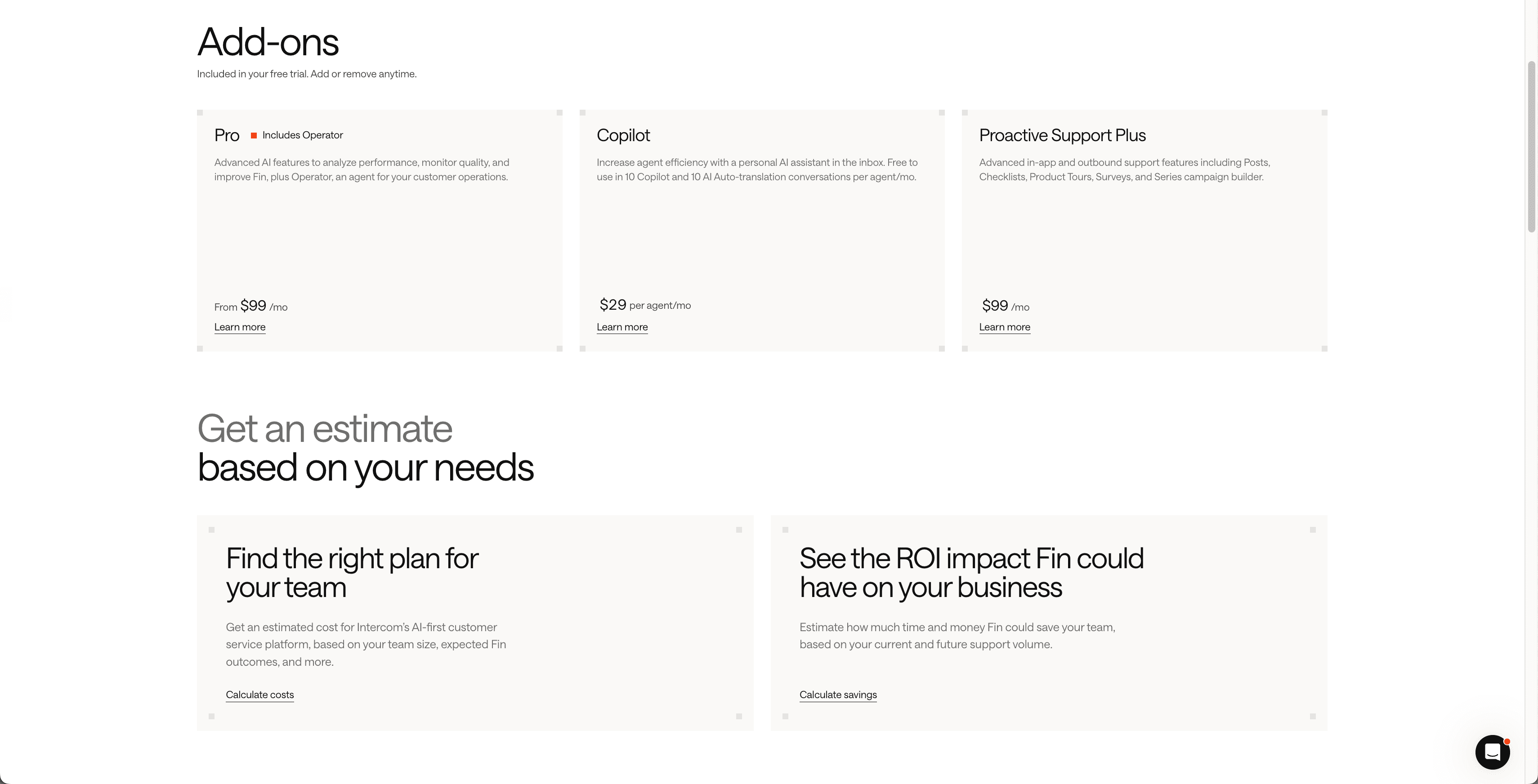
Advanced includes 20 free Lite seats, and Expert includes 50. Lite seats provide limited internal access without a full-seat charge, while Essential includes none. Optional products can raise the bill further. Copilot costs $29 per agent monthly with annual billing, or $35 billed monthly, and Proactive Support Plus costs $99 monthly for 500 messages, with additional messages charged per unit.
If you use Fin with Zendesk or Salesforce, you avoid Intercom seat fees but still face a monthly spending floor. The same pricing applies when you use Fin with HubSpot. Fin’s $49 base plan includes 50 outcomes, whether you use all 50 or not. Unused outcomes expire at the end of the month, and each additional outcome costs $0.99. With low or uneven volume, you therefore pay at least $49 monthly before any extra outcomes.
What Fin actually costs at different ticket volumes
Fin’s published pricing produces a nearly linear bill once usage exceeds the 50 outcomes included in the $49 base plan. The estimates below apply the standard $0.99 charge to each additional outcome and exclude platform fees and negotiated pricing. The conversation estimates assume 40 percent of conversations become billable outcomes.
Monthly outcomes | Conversations at 40% | Estimated Fin charge |
|---|---|---|
5,000 | 12,500 | $4,949.50 |
20,000 | 50,000 | $19,799.50 |
100,000 | 250,000 | $98,999.50 |
Intercom’s published pricing formula makes the usage portion easy to calculate, but fixed platform costs raise the effective price at lower volumes. Seat fees and paid add-ons sit outside these estimates.
A 60-day test by Builts AI shows how those fixed costs affect smaller deployments. The test covered four small-business clients with a combined 500 monthly tickets and reported a 38 percent resolution rate. Builts AI calculated an all-in cost of $1.40 per resolved ticket, including $0.41 in attributed base-subscription overhead. The report also put total monthly Intercom spending between $272 and $487 across the tested configurations. The reported $0.41 in base-subscription overhead represented about 29 percent of the $1.40 all-in cost per resolved ticket.
Fin's standard usage model has no published monthly cap, so traffic spikes increase charges. Builts AI recommends that you budget at two or three times normal usage when seasonal demand or product launches make support volume unpredictable.
Enterprise discounts can pull the estimate in the other direction. Builts AI reports that Intercom sales offered rates as low as $0.59 per resolution for contracts above 10,000 monthly resolutions. At that rate, the usage portion would equal about $11,800 for 20,000 outcomes or $59,000 for 100,000 outcomes. You need a negotiated quote to know whether that discount applies and what commitment it requires.
How Fin grounds answers and why accuracy still needs testing
A billed resolution that gives the customer a wrong or incomplete answer creates both an AI charge and more support work. Fin addresses that risk with a three-phase AI engine. Fin first refines each query with safety and relevance checks. Fin then retrieves information from approved support content and connected data, and it validates the answer against the question and those sources before replying.
Fin asks a clarifying question or escalates to a person when an answer fails its certainty checks. However, autonomous replies cannot use some internal sources, including certain Notion and Confluence content available only through Copilot. Missing information in customer-facing sources can therefore produce an escalation or an answer that prompts a follow-up.
Fin's published customer results cite resolution rates as high as 50% in production deployments, though actual rates vary by account and Intercom does not publish one standardized figure across all customers. Resolution rate measures how often Fin closes conversations under Intercom's criteria, not how often each answer was factually correct. Intercom does not publish an independently audited hallucination rate or a numeric certainty threshold, so you should test Fin's accuracy against your own content before estimating savings.
Wonderchat's flat-plan alternative to per-resolution billing
Wonderchat charges a fixed plan price for a bundled resolution allowance, so volume within the allowance does not create a separate charge for every successful outcome. Its published pricing includes four tiers.
Free costs $0 and provides about 10 monthly resolutions, 50 AI replies a month, one AI agent, and storage for 50 webpages.
Basic includes about 600 monthly resolutions, 3,000 AI replies, and two AI agents, with no per-seat cost.
Wonderchat calls the same tier Scale in its comparison grid. Scale includes about 1,800 monthly resolutions, 9,000 AI replies, and four AI agents, with no per-seat cost.
Enterprise custom pricing per month and uses custom resolution allowances. Enterprise adds controls such as SAML SSO, an audit log, and a SOC 2 report and DPA, and seats are not billed, as on every plan. Wonderchat also offers bulk message discounts on this tier.
The listed Basic and Scale rates include a 17% annual-billing discount. Monthly billing costs more. Paid plans bundle team seats into the subscription, so adding colleagues within the plan limit does not create a separate per-seat charge.
Each plan includes a monthly allowance of AI replies; current plans and prices are on the pricing page. The add-on provides a pay-as-you-go option for short spikes. For recurring overages, compare the total add-on cost with the price and allowances of the next tier before renewing.
Wonderchat's tier prices let you budget for higher resolution volume. At about 1,000 monthly resolutions, you can budget for the Basic tier. If demand grows toward 5,000 resolutions, you can move to Scale at a known plan price. Fin instead adds charges as each billable outcome accumulates, so the same increase in resolved volume raises the variable portion of the bill unit by unit.
Fin vs. Wonderchat pricing at a glance
Fin ties spending to resolved conversations, while Wonderchat sets a monthly allowance that makes costs easier to forecast.
Fin (formerly Intercom) | Wonderchat | |
|---|---|---|
Pricing model | Usage-based pricing per outcome | Flat monthly plan with an included allowance |
Base cost | $1299 per month, 50 outcomes included | Basic plan, about 600 resolutions included |
Cost per resolution | $0.99 per additional outcome | About $0.12 on Basic and $0.08 on Scale with annual billing, assuming full use of the allowance |
Seat fees | Extra Helpdesk seat fees of $19 to $132 per seat may apply | Team seats included with the plan, no separate per-seat charge |
Cost at higher volume | Costs rise with resolved ticket volume and team seats | Costs remain fixed within the allowance, or move up one plan tier |
Best Fit for | You already use Intercom's helpdesk and can accommodate variable outcome and seat costs | You want predictable spending without replacing your current helpdesk and CX support stack |
At full use of its allowance, Wonderchat's per-resolution cost is roughly one-eighth to one-twelfth of Fin's $0.99 charge, even before Fin's seat fees are added to the bill.
When to consider Fin or Wonderchat
Consider Fin if
Your support operation already uses Intercom’s helpdesk, so Fin fits without another platform or migration.
You need Intercom's other support products and Copilot for agents.
Your budget can absorb seat fees and variable usage. Fin charges $0.99 per additional outcome after the base plan’s 50 included outcomes, so higher resolution volume raises the bill.
Consider Wonderchat if
You want a monthly plan with a defined resolution allowance instead of a charge for every successful outcome.
You want to add an AI agent without replacing your current helpdesk.
Your SMB or mid-market support operation expects ticket volume to grow. Wonderchat’s plan tiers let you budget for an allowance, then buy extra AI replies or move to a higher tier when usage consistently exceeds it.
Choose based on the cost driver your team can manage: Fin if its Intercom integration outweighs variable outcome and seat costs, or Wonderchat if a defined allowance matters more. Before committing, model normal, low-volume, and peak months, then test answer accuracy against your own support content so the comparison reflects both cost and support quality.
For a broader look at what AI support agents cost across the market, see Wonderchat's guide to AI customer support pricing. Teams evaluating Intercom specifically may also want a rundown of Intercom alternatives beyond the pricing question alone.
FAQs
Does Intercom offer a free trial?
A free trial is a limited period for evaluating a product before purchasing it. Intercom offers a 14-day free trial without requiring a credit card. This lets your team test the helpdesk workflow before committing to a paid plan.Does an unanswered clarifying question get billed?
An unanswered clarifying question is a request for more detail that the customer never answers. Under Intercom's billing rules, Fin does not count it as an outcome because it has not provided an answer. This prevents an inactivity closure from adding an outcome charge.What happens if a resolved ticket reopens?
A reopened ticket is a previously closed conversation in which the customer returns for more help. Intercom reverses Fin's recorded resolution when this happens in the same conversation, even during another billing period. This removes the associated outcome charge from the customer's bill.Does Intercom offer volume discounts?
A volume discount lowers the unit price when usage or contractual commitments reach a specified level. Intercom does not publish standard tiers, although one third-party report cites rates as low as $0.59 per resolution above 10,000 monthly resolutions. Requesting a contract-specific quote lets you confirm the rate and commitment before using a discount in your forecast.What is the minimum spend without Intercom’s helpdesk? A minimum spend is the lowest recurring amount due regardless of actual usage. For standalone Fin, the published floor is $49 per month for 50 included outcomes, without Intercom helpdesk seat fees. Knowing this floor lets teams budget for low-volume months before requesting confirmation of any additional contract terms.
Should I choose Wonderchat’s flat allowance or Fin’s per-outcome pricing?
A flat allowance bundles a defined amount of usage into one plan price, while per-outcome pricing varies with billable results. Wonderchat uses the allowance model, whereas Fin charges for each billable outcome beyond its included amount. Choose Wonderchat when predictable spending is the priority, or Fin when Intercom integration and usage-linked costs better fit your operation.
Does Wonderchat offer a free plan?
A free trial provides temporary product access, while a free plan is a plan, not a trial. Wonderchat offers a free plan that refills 50 AI replies every month, with no credit card, rather than a time-limited trial. This lets users train and test the agent on a small number of questions before selecting a paid tier.
Where can I get more detail on how Wonderchat's pricing works? Wonderchat's pricing page lists each plan's price and monthly AI replies in more depth than a single comparison article can cover.