


03/09/2026
Containment Rate
Containment rate measures the percentage of support conversations that end without moving from an automated system to a human agent. It measures cost avoidance rather than customer outcome because a conversation still counts when the customer gives up and leaves.
How AI Containment Works
AI containment follows three basic steps:
- The conversation begins. A customer enters an AI agent, chatbot, or automated voice system with a question or task.
- Automation keeps control. The system answers the question or completes the task without moving the conversation to a person.
- The conversation ends or transfers. Leaving without human support counts as contained, while reaching a human queue breaks containment.
The metric records the path, not the outcome. A customer who receives the right answer and a customer who gives up can both count as contained unless the report also checks resolution, abandonment, and repeat contact.
How Containment Rate Is Measured
Containment rate \= contained conversations ÷ eligible automated conversations × 100
If 800 eligible conversations enter an AI support channel and 560 end without human transfer, the containment rate is 70%. The report should state whether it excludes spam, unsupported topics, immediate human requests, or sessions where the customer never replied.
The time window matters because a customer may leave the chatbot and open an email ticket several hours later. Counting that first conversation as contained without checking repeat contact makes the queue reduction appear larger than it was.
Why Containment Rate Matters
The metric predates generative AI and comes from contact centers, where IVR containment tracked calls handled without a live agent. This history explains why containment focuses on channel use and operating cost rather than the quality of the customer outcome.
Containment shows how much demand stays inside an automated channel, helping support leaders estimate human workload and possible cost avoidance. It cannot show whether customers received correct answers or completed the tasks they started.
Containment vs Deflection vs Resolution
These customer support metrics use different finish lines, even when vendors place them beside the same automation claim:
- Containment rate counts conversations that never reach a human, including exchanges that customers abandon before solving their problem.
- Deflection rate counts tickets that were never created, although vendors may disagree about which potential tickets belong in the denominator.
- Resolution rate counts conversations judged to be solved, making the resolution rule and denominator part of the result.
- Self-service rate measures successful completion across a help center, portal, chatbot, or automated workflow.
- Zero-touch resolution usually means a request was completed from beginning to end without human work, including any required system action.
Ada’s current reporting keeps containment and automated resolution separate, while Zendesk also defines containment around the absence of a human transfer. Avoiding a handoff and solving a problem are not the same event.
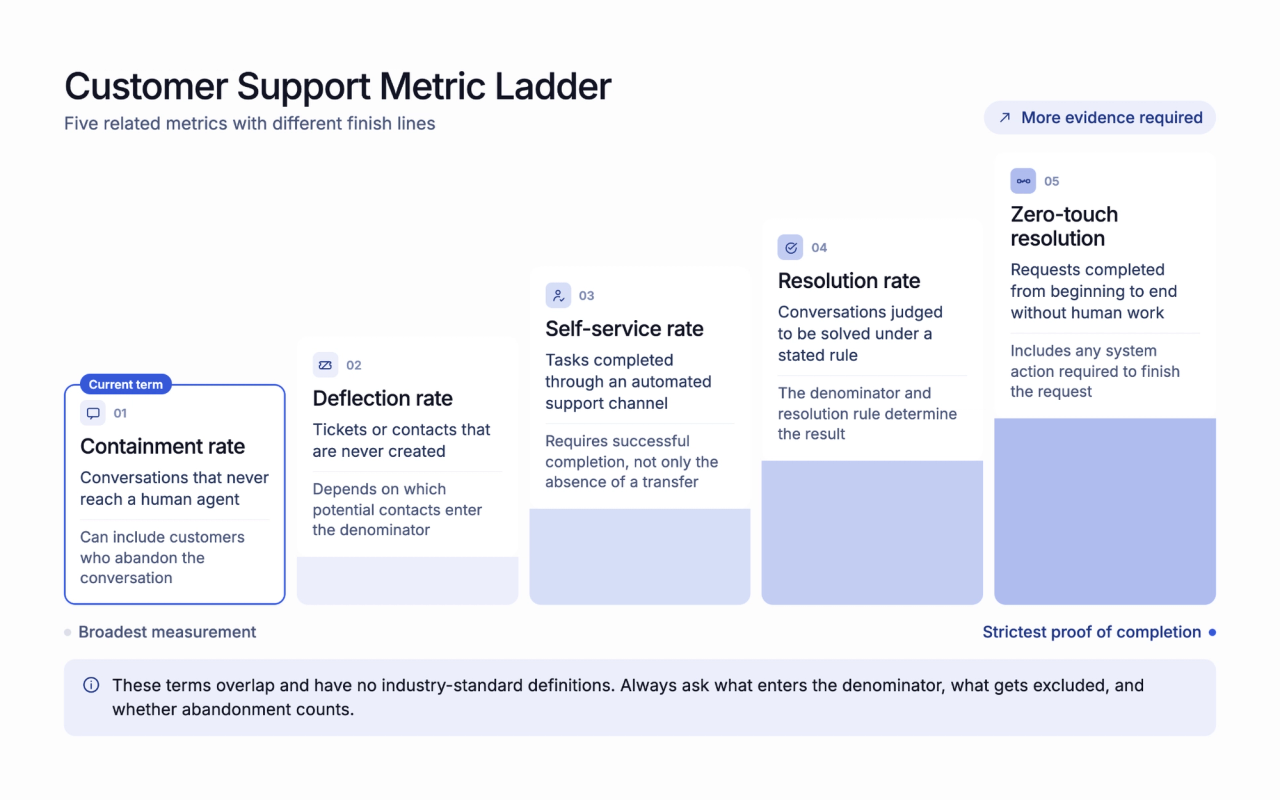
Wonderchat treats containment as the broadest and most easily inflated member of the resolution metric family.
For a deeper comparison of these finish lines, see the guide to AI ticket deflection tools and measurement.
Frequently Asked Questions
What is containment rate?
Containment rate is the percentage of eligible automated support conversations that end without transfer to a human agent, including customers who abandon the conversation without receiving an answer.
How is containment rate different from resolution rate?
Containment rate asks whether a human entered the conversation, while resolution rate asks whether the customer’s problem was solved. A conversation can be contained but unresolved when the customer leaves, gives up, or returns through another channel.
What is a good containment rate?
Helpshift places advanced conversational AI at 70% to 90%, but lists 40% to 55% as the cross-industry average. Treat those ranges as directional because a good containment rate must also keep repeat contact, abandonment, and customer satisfaction stable.
