


03/09/2026
Resolution Rate
Resolution rate is a customer service metric measuring the percentage of tickets or inquiries fully resolved within a defined period. For AI support, its meaning depends on which conversations enter the denominator and which outcomes the system accepts as resolved.
The Denominator Problem
Resolution rate \= resolved conversations ÷ measured conversations × 100
The phrase “measured conversations” controls the result because a vendor may calculate resolution rate as:
- Resolved conversations divided by all conversations.
- Resolved conversations divided only by conversations the AI agent attempted.
- Resolved conversations divided by conversations left after out-of-scope topics are excluded.
- Conversations without a human escalation divided by all conversations.
- Customer-confirmed resolutions divided by all conversations.
If an AI agent resolves 50 of 100 conversations, the all-conversation rate is 50%. Excluding 20 out-of-scope conversations raises it to 62.5%, while counting only 60 attempted conversations produces 83.3%, even though the agent still resolved the same 50 requests.
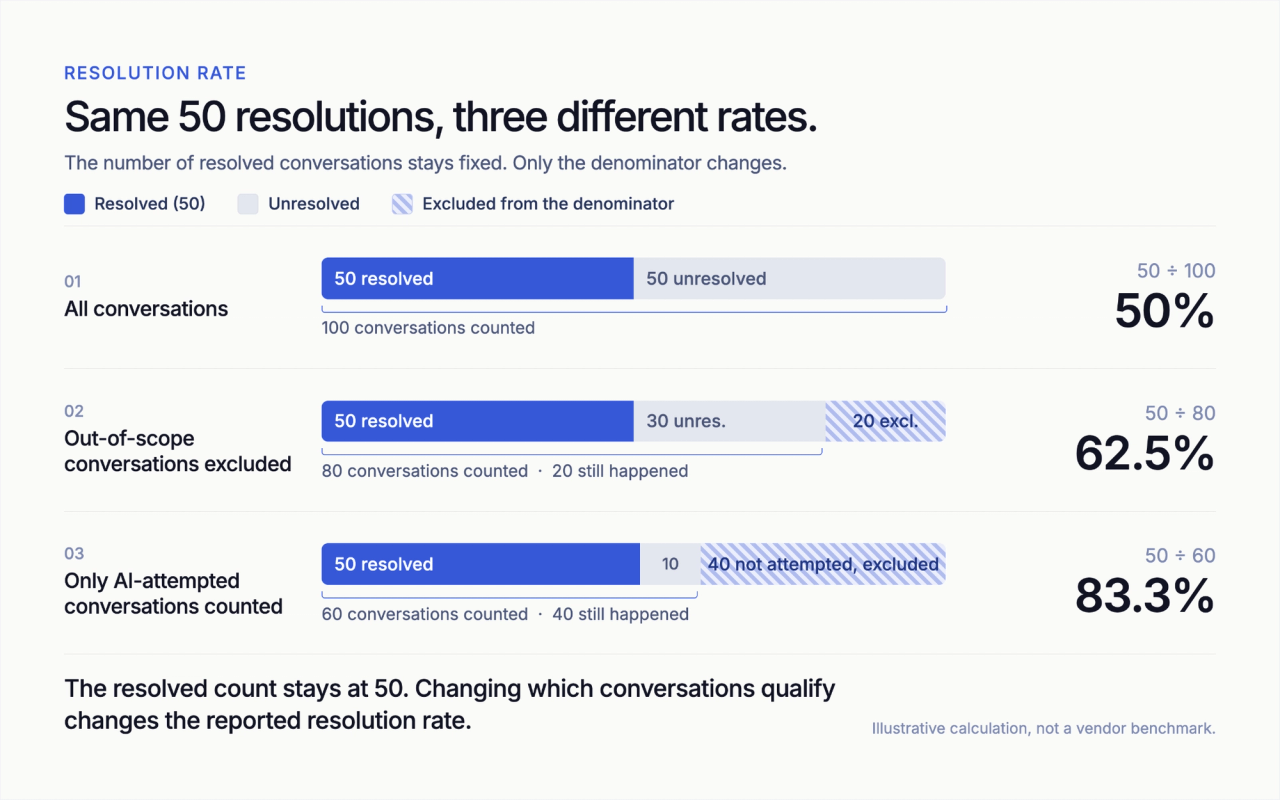
*Caption: The same 50 resolved conversations produce rates of 50%, 62.5%, or 83.3%, depending on which conversations enter the denominator.*
A usable resolution rate therefore states the numerator, denominator, exclusions, measurement period, resolution rule, and repeat-contact window.
The Market Benchmark
An eesel AI benchmark published in June 2026 reported median tier-one deflection of 41.2% and a top-quartile rate of 58.7%. Those figures provide market context, not a universal AI resolution target, because deflection measures whether work reached a person rather than whether the request was solved.
Fin, formerly Intercom, shows how a denominator can move a reported rate. After a June 2026 reporting update excluded conversations in which Fin had no opportunity to answer, its number of resolutions and Automation Rate stayed unchanged while its Resolution Rate increased.
Salesforce signed a definitive agreement to acquire Fin on June 15, 2026, and the transaction remains pending.
Five Questions to Ask a Vendor
- What counts as resolved? Confirm whether the rule requires customer approval, no further reply, no human escalation, a completed action, or an automated classifier.
- Which conversations enter the denominator? Ask whether it includes every conversation, only eligible contacts, or only requests the AI agent attempted.
- What gets excluded? Record how the vendor treats out-of-scope topics, immediate human requests, abandoned sessions, spam, failed workflows, and usage limits.
- Can a resolution be reversed? Check whether a reopened conversation or repeat contact removes the original resolution and how long that review window lasts.
- Who audits the result? Request the dashboard formula, a conversation-level export, and a sample showing confirmed, assumed, rejected, and escalated outcomes.
Wonderchat asks buyers to demand a published denominator from every vendor, including Wonderchat.
Resolution Rate and Neighboring Metrics
- Resolution rate measures the share of requests identified as completed under a stated rule.
- Containment measures whether automation kept control of the conversation, even when the outcome remains unclear.
- Ticket deflection measures whether a request avoided a human queue or ticket.
- Self-service rate measures how often customers complete a task through an unassisted support path.
Frequently Asked Questions
What is resolution rate in AI customer service?
AI resolution rate is the percentage of measured support conversations an AI agent completes under a defined success rule. The published rate should identify the denominator, exclusions, measurement period, and whether resolution requires customer confirmation, inactivity, a completed action, or another test.
How is resolution rate calculated?
Resolution rate is calculated as resolved conversations divided by measured conversations, multiplied by 100. For 50 resolved conversations out of 100 measured conversations, the rate is 50%. The calculation is incomplete until the vendor explains which conversations enter or leave the denominator.
What is a good AI resolution rate?
There is no universal good AI resolution rate because vendors use different denominators. An eesel AI benchmark reported median tier-one deflection of 41.2% and top-quartile performance of 58.7% in June 2026. Treat these as context, not resolution targets, because the success rules differ.
