


29/10/2026
CSAT vs NPS
CSAT (customer satisfaction score) measures how satisfied a customer is with a specific interaction or product. NPS (Net Promoter Score) measures how likely a customer is to recommend the company, on a 0 to 10 scale.
How do CSAT and NPS differ?
The two scores come from different questions, so they move for different reasons.
- The question: CSAT asks "How satisfied were you with this conversation?" and NPS asks "How likely are you to recommend us to a friend or colleague?"
- Scale: CSAT uses a short scale, such as 1 to 5 or thumbs up and down, and NPS uses 0 to 10.
- When it's asked: CSAT comes right after a conversation or purchase, and NPS every few months, or after a milestone.
- Result: CSAT is a percent from 0 to 100, and NPS is a score from minus 100 to 100.
- What moves it: CSAT moves with the reply, its speed, and whether it was right. NPS moves with product, price, onboarding, and support together.
Asked after a support conversation, CSAT rates that conversation, so a support team sees the effect of its own work within days.
How are CSAT and NPS calculated?
CSAT divides the positive answers by all valid answers, and NPS subtracts the share of detractors from the share of promoters.
CSAT = positive valid responses ÷ all valid responses × 100
A positive response is a 4 or 5 on a 1 to 5 scale, or a thumbs up.
NPS = percent promoters minus percent detractors
Bain & Company's NPS method sorts answers into promoters (9 to 10), passives (7 or 8), and detractors (0 to 6). Passives count in the total but in neither group. Because NPS is one percentage minus another, it is written as a number, such as +10, not as a percent.
Count responses, not conversations, since a customer who skips the survey isn't in either score. Recalculate NPS from the counts when combining teams, since an average of team scores ignores team size.
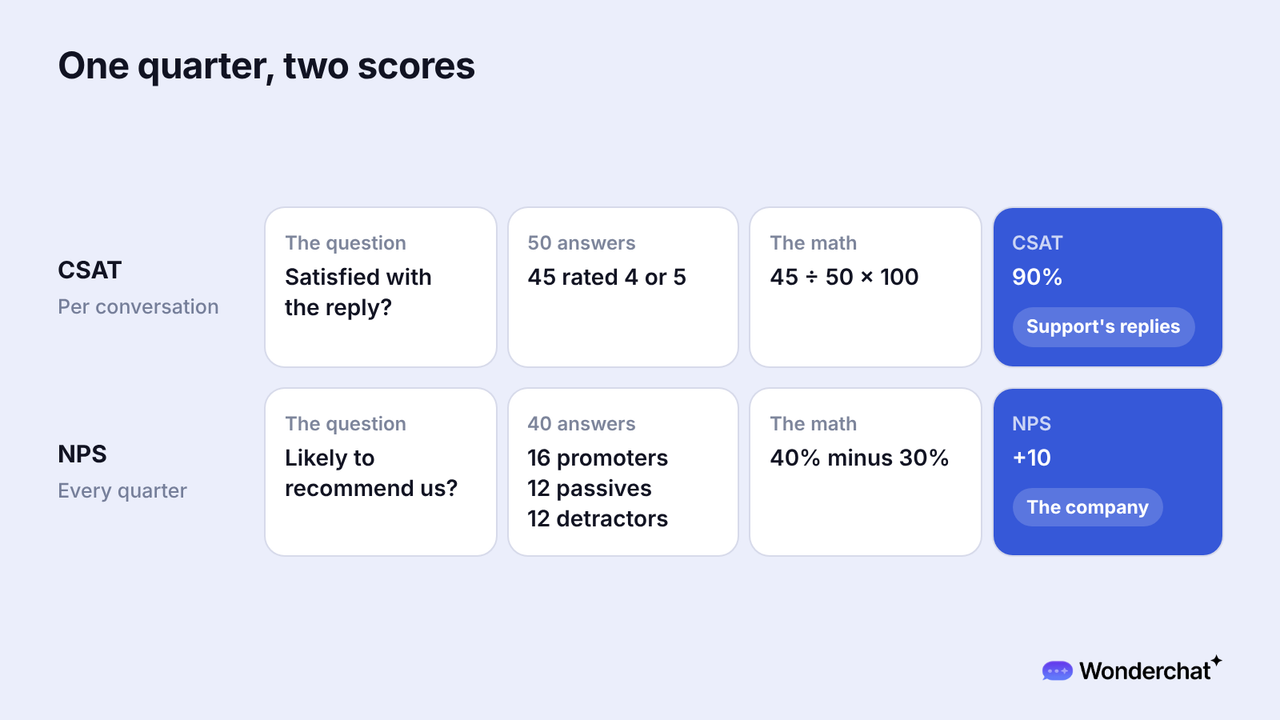
For example, 45 positive answers out of 50 give a CSAT of 90%, while 16 promoters, 12 passives, and 12 detractors out of 40 NPS answers give an NPS of +10.
Which score should a support team report?
Report CSAT, because the reply is the part a support team controls. Read NPS for context, since a drop after a price change or an outage says more about the company than about the inbox.
A detractor who names a slow reply or a wrong answer still points to a fix support can make.
Why can't a support team own NPS alone?
Making NPS a support KPI holds support answerable for things it doesn't control, and hides whether the replies themselves are getting better.
HBR's 2021 article on Net Promoter 3.0, by NPS creator Fred Reichheld, Darci Darnell, and Maureen Burns, says that as NPS spread, it "started to be gamed and misused in ways that hurt its credibility."
Neither score shows whether the customer's problem was solved, so a support report needs an outcome check such as resolution rate beside them. Across Wonderchat's customers, about 75% of evaluated conversations are resolved without a person.
Wonderchat answers from a team's own help center and shows the source on every reply.
Frequently asked questions
Can CSAT and NPS be used together?
Yes, ask CSAT after support conversations and NPS on a fixed schedule, then read them side by side. A falling NPS with a steady CSAT points to product, price, or onboarding, not to the replies.
What is a good NPS and CSAT score?
Published benchmarks rarely match your question, scale, and timing, so they make weak targets. Compare each score with your own trend, asked the same way every period.
Can you convert NPS to CSAT?
You can't. The scores come from different questions on different scales, so one can't be calculated from the other. A customer can like a reply and still not recommend the company after a price rise.
