


15/10/2026
CSAT
CSAT, or customer satisfaction score, is the percentage of valid survey responses that rate a specific experience positively. It reflects respondents' satisfaction with what the question asks, rather than proving that a support problem is solved.
How CSAT Surveys Measure Customer Satisfaction
A support survey asks customers to rate an interaction, such as a chat or phone call. A product survey asks a different question, so CSAT doesn't always measure the last exchange with a support team.
The question and timing define what the rating means. A survey after troubleshooting instructions measures the customer's reaction at that point; it doesn't confirm that the instructions work when the customer tries them.
How to Calculate CSAT and Survey Response Rate
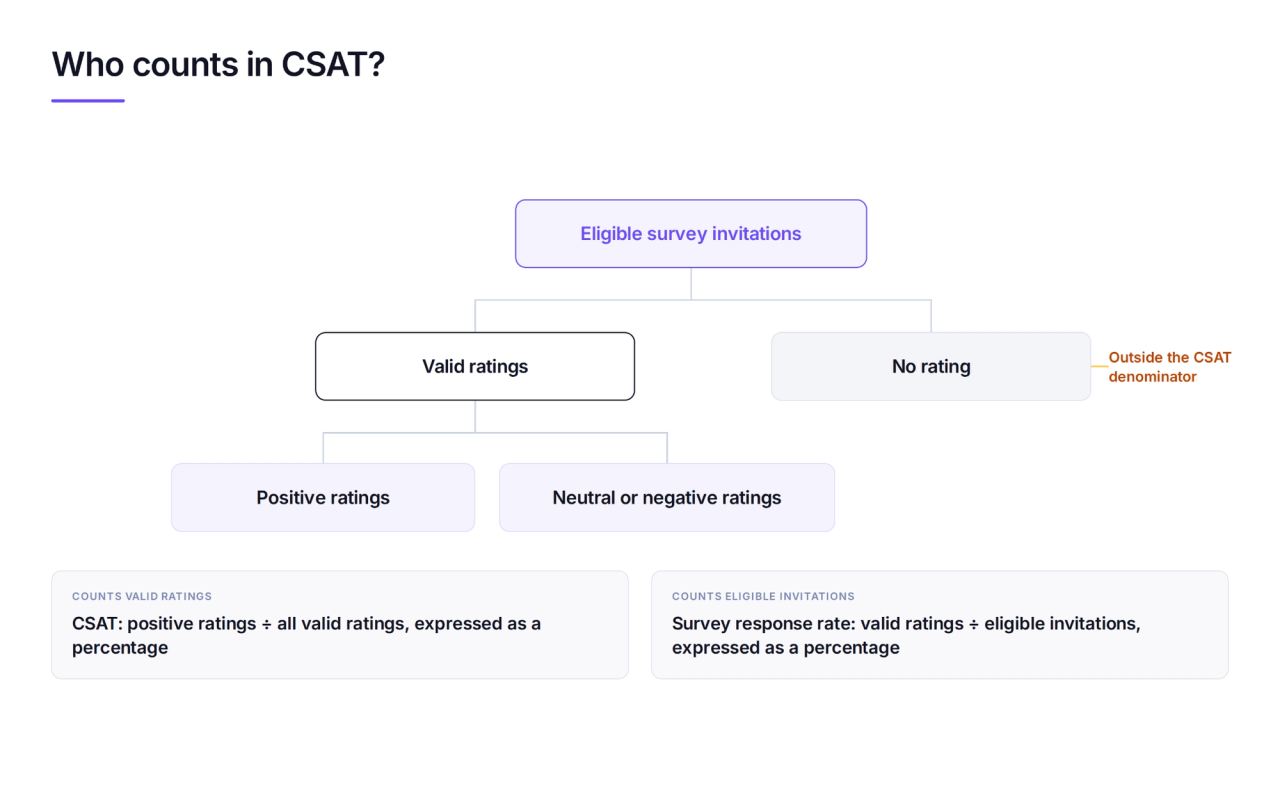
CSAT = positive valid responses ÷ all valid responses × 100.
IBM describes a common cutoff: ratings of 4 or 5 on a 5-point scale count as positive. Neutral and negative ratings stay in the denominator; unanswered surveys don't count as ratings.
For a defined group of eligible survey invitations, response rate is valid ratings received divided by invitations, expressed as a percentage. Its denominator includes invited customers who don't answer, while the CSAT denominator doesn't.
A comparable report states:
- Question and scale: The experience being rated and the available answers.
- Positive cutoff: Which ratings count as satisfied.
- Survey trigger: When and to whom the invitation is sent.
- Coverage: Valid response count, eligible invitation count, and reporting period.
Why CSAT Doesn't Represent Every Customer
Customers with strongly positive or negative experiences may be more willing to respond, leaving other experiences underrepresented. A change in invitation timing or channel can also change who answers without improving support.
AAPOR cautions that response rate alone doesn't establish survey accuracy. Teams can compare invitations and responses for billing questions, technical faults, and escalated requests to check which groups are missing from the reported score.
A report that surveys only closed chats excludes customers still waiting for help. That score describes the selected group, so it shouldn't stand in for the quality of the whole support operation.
Why CSAT Doesn't Prove Resolution
A resolution rate asks whether requests are solved, while CSAT records satisfaction with the stated experience. Comparing AI ticket deflection tools needs both measures: a polite answer can leave a problem open, and a correct answer can leave a customer dissatisfied.
Wonderchat publishes the method behind the number. Its documented Satisfaction metric averages scored conversations, using customer feedback first and AI scoring otherwise; that isn't the survey-response percentage defined here.
Its cleared support and QA observation identifies a source-quality failure: The failure seen most often is not invention. It is retrieval pulling an archived policy and answering from it correctly.
For an AI support agent that answers from documentation, checking whether the policy applies remains separate from collecting a satisfaction rating. A citation doesn't settle the outcome.
For a dedicated survey program, Qualtrics' CSAT solution is a better fit than an answer agent alone because it provides survey templates and response analysis.
Reporting first contact resolution alongside CSAT separates requests solved in one interaction from customers’ satisfaction with that interaction.
Frequently Asked Questions
What is a good CSAT score?
A good CSAT score meets a target based on comparable surveys. A billing-chat result shouldn't be judged against a product-purchase survey. Benchmarks need matching questions, scales, positive cutoffs, survey timing, and customer groups; an average rating isn't a positive-response percentage.
CSAT or NPS, which measures support?
CSAT is the more direct measure when the question names the support interaction. NPS asks about willingness to recommend a business or product, reflecting a broader relationship. Neither measure proves resolution, so a support report needs a separate outcome check.
Do unanswered surveys count against CSAT?
No. Unanswered surveys aren't positive or negative ratings and stay outside the CSAT denominator. They affect response coverage, which belongs beside the score. If no valid ratings arrive, percentage CSAT can't be calculated; it isn't a zero score.
