


14/10/2026
First Contact Resolution
First contact resolution (FCR) is the share of support requests solved during the first interaction, without another contact about the same issue. The rate depends on which requests count and how long the team checks for repeat contact.
How First Contact Resolution Works
A first contact can be a phone call, chat session, or email exchange under the team's stated rules. Several messages within a chat don't automatically make it a failed first contact; the question is whether the issue needs another interaction.
A resolution rate can count work completed after follow-up, while FCR requires completion on the initial contact. Teams also need a rule for transfers during the same session, rather than silently treating them as successes or failures.
How to Calculate First Contact Resolution
FCR = requests resolved on first contact with no related repeat contact ÷ eligible initial requests × 100.
For this issue-based method, the denominator counts the initial contact for each distinct issue, including unresolved eligible requests. Repeat contacts attach to that issue rather than becoming additional first contacts; multiplying by 100 expresses the share as a percentage.
The reported rate needs these rules beside it:
- Resolution evidence: Customer confirmation or a completed outcome, not just a closed status.
- Repeat-contact window: A fixed period, checked before the result is finalized.
- Channel coverage: Chat, email, phone, and included self-service routes.
- Eligibility: Excluded request types and the treatment of transfers and callbacks.
Comparisons need the same rules. A team that excludes problems requiring engineering work measures a different population from a team that includes them.
Why Closed Tickets Can Inflate FCR
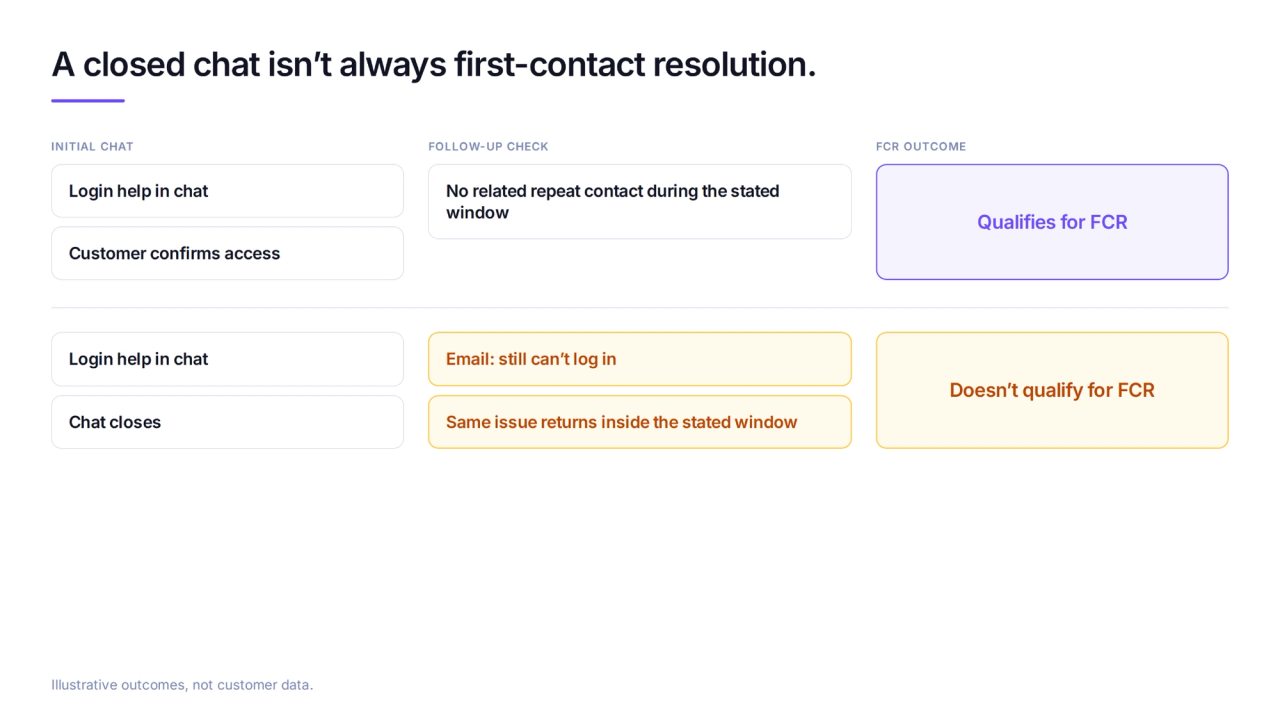
Consider a customer receiving login instructions in chat, then emailing because access still fails. Closing the chat doesn't make it first-contact resolution if the same unresolved issue returns within the stated window.
A system that treats the email as a fresh request can report an apparent success for the chat. It needs to link the customer and issue across channels, while distinguishing a new problem from a continuation of the original one.
First Contact Resolution vs Deflection Rate
Deflection rate tracks requests kept from a human queue, although some providers require resolution too. FCR asks whether the issue is solved on the first interaction, and either a person or automation can qualify.
An abandoned automated chat can avoid a queue without solving anything. Comparing AI ticket deflection tools therefore requires their resolution and repeat-contact rules, not matching headline percentages.
How to Check AI Resolutions for Repeat Contact
Wonderchat publishes the method behind the number. Its support and QA observations identify a recurring failure:
The failure seen most often is not invention. It is retrieval pulling an archived policy and answering from it correctly.
An AI support agent that answers from documentation still needs an outcome check when a source is outdated. The reviewer checks whether the instructions work and whether the customer returns, rather than accepting the citation or silence as proof of resolution.
Frequently Asked Questions
What is a good FCR rate?
There isn't a universal target. For external phone-support benchmarking, SQM Group's customer-survey method is a better fit than chatbot logs alone because it checks resolution and further contacts. Comparisons still need matching channels, request types, and measurement rules.
How is FCR different from deflection rate?
FCR measures issues solved on the first interaction without related repeat contact. Deflection rate measures avoidance of a human queue under a stated definition. FCR can include human work, and deflection doesn't necessarily prove that the issue is solved.
Does FCR include self-service resolutions?
It can, if the report includes self-service among eligible first contacts and verifies the outcome. A help-center visit or an automated chat ending isn't enough; the issue must be solved without a related repeat contact during the stated window.
