


30/10/2026
Voice of the customer
Voice of the customer (VoC) is what customers say they want, expect, and dislike, captured in their own words and used to guide product and service decisions. Support conversations and complaints are among its sources.
Where does voice of the customer data come from?
Voice of the customer data comes from anywhere customers say what they want. ASQ, the quality-management body, lists "Customer complaints" and "User support forums or help lines" among 11 ways to gather it.
- Asked for: interviews and surveys.
- Offered: reviews, social posts, and feature requests.
- Struggled with: support conversations and complaints.
- Missing: questions nobody could answer.
How does a voice of the customer program work?
A program turns one period of feedback into a few owned changes in four steps.
- Collect: gather one period's conversations, reviews, and survey comments, so the counts compare period to period.
- Group: sort them by the underlying need, not the wording, since one need arrives in different phrasings.
- Count: tally each theme and rank the themes, so the biggest need gets fixed first.
- Hand over: give the top themes to someone who can fix them, with an owner and a date, because a theme nobody owns stays a report.
How do you measure voice of the customer?
No single VoC score is standard, because each team picks its own sources and themes, so the KPIs to track show whether feedback turns into change.
Theme share = feedback about a theme ÷ all feedback in the period
Closed-loop rate = themes with a shipped change ÷ themes raised in the period
A shipped change is a new help article, a product fix, or a policy update. When a theme is closed, its share should fall in the next period.
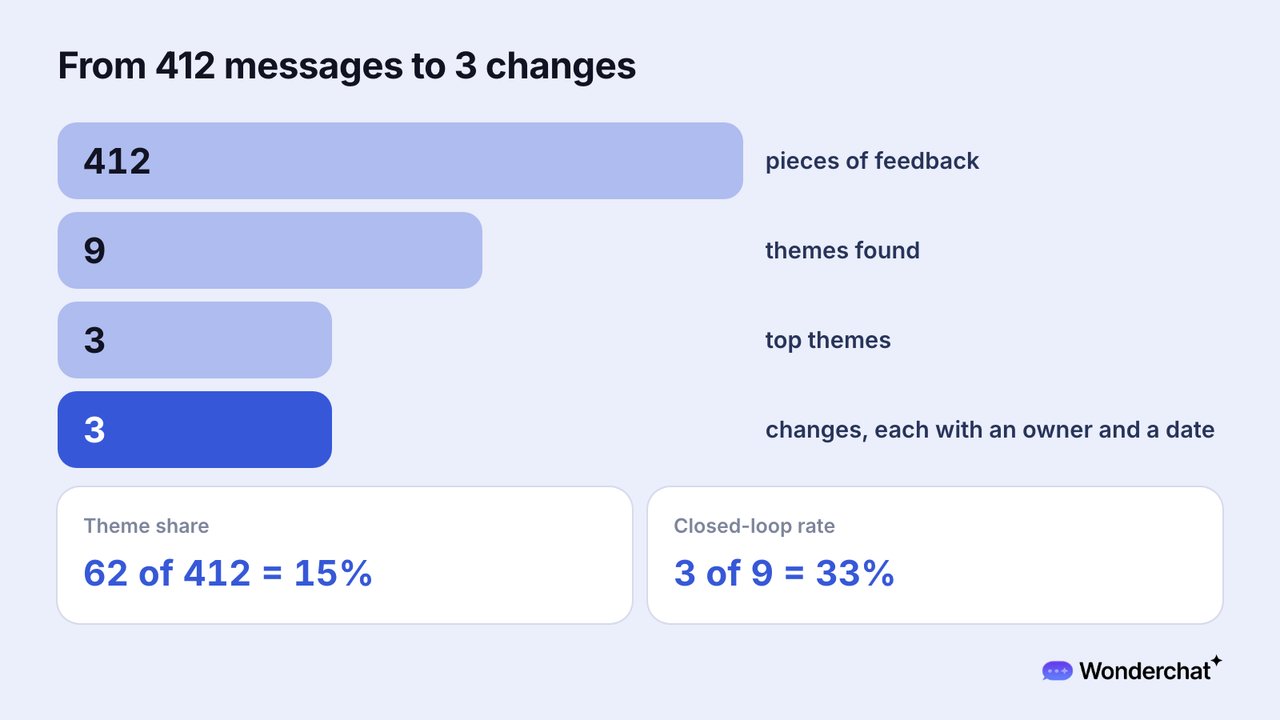
For example, one month brings 412 pieces of feedback that group into 9 themes. The top theme holds 62 of them, a 15% theme share, and once 3 owned changes ship, the closed-loop rate is 3 of 9, or 33%.
Why do unanswered questions matter for VoC?
The questions nobody could answer show what the docs are missing, and every team already has them, research budget or not. In Wonderchat's study of 5,848,078 conversations (March 2023 to August 2026), 58.5% of a random sample of 5,000 unresolved conversations asked for an answer that was never documented anywhere the agent could reach.
Collecting is the easy part. As Ian Golding, a customer experience specialist who contributed to that study, puts it, "A customer might ask the same unanswered question hundreds of times, but unless there is a mechanism that turns that signal into an action, with an owner and a date, it stays an insight rather than an improvement."
Wonderchat answers from a team's own help center and shows the source on every reply.
Is voice of the customer only surveys?
No, surveys hear from customers who answer surveys, while support hears from the ones who are stuck. ASQ's list puts surveys next to complaints, help lines, reviews, and warranty claims, so a survey-only program hears one kind of customer.
Frequently asked questions
What is meant by voice of the customer?
Voice of the customer means what customers say they want, expect, and dislike, in their own words. Teams collect it from surveys and support conversations, then use it to decide what to fix or build.
How do you collect voice of the customer data?
Pull one period of support conversations, reviews, and survey comments into one list, and group them by need. Include the questions nobody could answer, because they show what customers want that the docs don't cover.
What are examples of voice of the customer?
Examples include a support question about exporting invoices that keeps coming back, a review that names a confusing setup step, and a survey comment asking for a feature. Each one becomes useful once it's grouped by need and handed to an owner.
