


19/10/2026
Ticket Triage
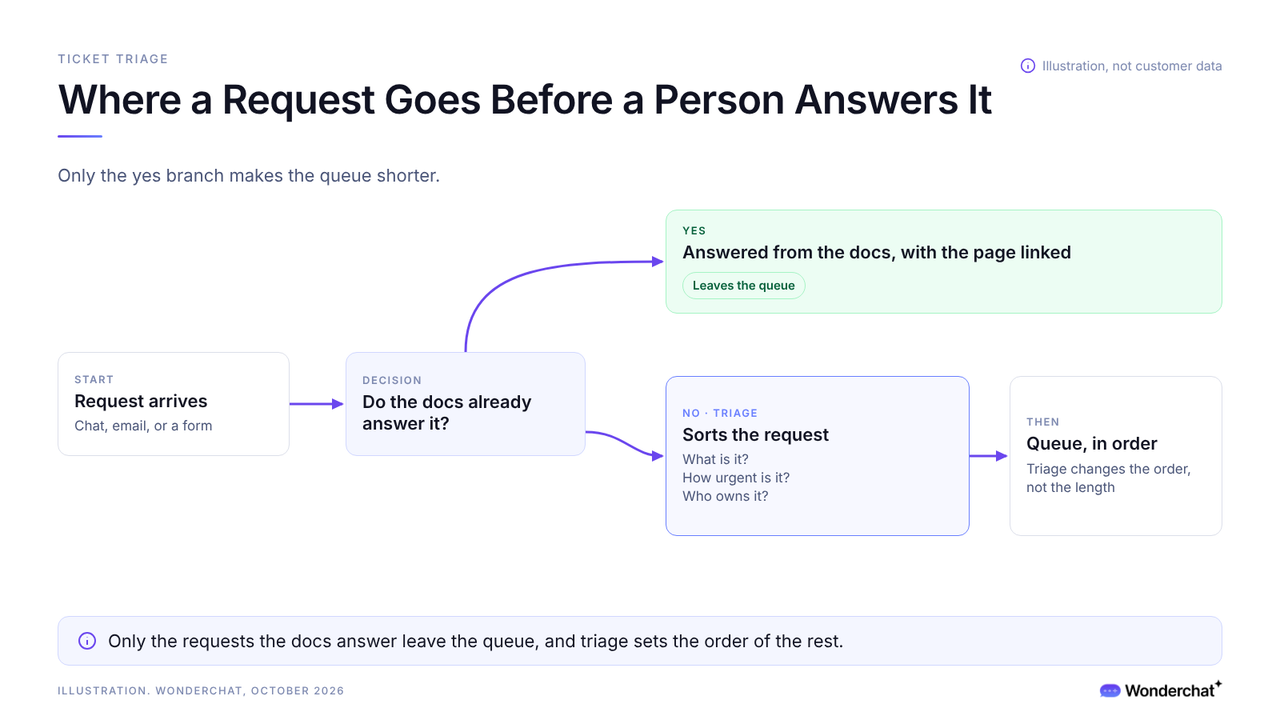
Ticket triage is sorting new support requests by what each one asks, how urgent it is, and who should take it, before anyone works on them. Triage sets the order of work but doesn't answer anything.
How Ticket Triage Works
Each new support ticket gets the same few labels, set by a person, a rule, or AI.
- Intent or topic: what the customer wants, such as a refund or a login fix.
- Urgency: how soon it needs an answer.
- Sentiment and language: how the customer feels and which language they wrote in.
- Owner: the person or group that takes it.
Zendesk's intelligent triage classifies new tickets "by topic, sentiment, language" with AI. Gorgias uses 24 intents and 3 sentiments and leaves a field blank when the AI can't assign one confidently.
AI triage that learns from history needs history. Freshdesk recommends a minimum of 2,000 past tickets for its Auto Triage.
Ticket Triage vs Ticket Routing
Triage decides what a request is, how urgent it is, and often who should own it. Routing moves it there.
Zendesk draws the line sharper. Intelligent triage classifies the ticket, and omnichannel routing, skills-based routing, or triggers then assign it based on those classifications.
Ticket Triage for a Small Support Team
In a team of two or three, who takes a ticket is often already known. The questions that matter are what it is, how urgent it is, and whether the docs already answer it.
In Fin, formerly Intercom, acquired by Salesforce in September 2026, AI-detected attributes such as the topic "can only be detected after a Fin block runs," so the AI agent runs before triage can route on them.
Triage changes the order of the queue, not its length.
Wonderchat customer Jortt, a Dutch accounting platform, resolves about 92% of its roughly 30,000 monthly inquiries without a person. Wonderchat answers from a team's own help center and shows the source on every reply. Triage matters for the person who still has to answer.
How to Check Your Ticket Triage
Run four checks on the last 20 new tickets.
- Owner. Note when each arrived and when it first got an owner. The check passes when none sat unowned past your own target.
- Bounce. Count how many people or groups each ticket passed through. The check passes when every ticket with more than one owner has a note saying why.
- Same label. Have two teammates label 10 of them without comparing. The check passes when the labels match on all 10.
- Docs first. Search the help center for each ticket's answer. The check passes at zero tickets; the docs already answered in full.
Checks 1 to 3 test the sorting. Check 4 tests to see whether the queue should have been shorter.
Frequently Asked Questions
Can AI triage support tickets?
Yes. Zendesk, Freshdesk, Gorgias, and Fin all use AI to read a request and fill in fields such as intent, sentiment, language, or priority. A person still sets the rules. Gorgias leaves a field blank when the AI is unsure, and Freshdesk can wait for an agent to accept.
What does it mean to triage a request?
To triage a request means deciding what happens to it before anyone works on it, including what kind of request it is, how soon it needs an answer, and who takes it. Help Scout notes the term is borrowed from the medical field.
Does ticket triage reduce ticket volume?
No. Triage sorts the tickets that arrive, so the queue gets better ordered, not shorter. Volume drops when fewer questions need a person, for example, when the help center answers them before a ticket exists or a product fix removes the cause.
