


08/10/2026
Help Desk vs Service Desk
A help desk focuses on incidents: something broke, fix it. A service desk is the ITIL contact point for incidents and service requests within wider IT service management. The distinction describes operating scope, not a guaranteed product feature.
The Difference Is Scope, Not Status
A help desk restores service when a user reports a fault, access problem, or other incident. Its work usually centers on recording the issue, assigning it, communicating progress, and closing it after service returns.
An ITIL service desk is the main contact point between a service provider and its users. It receives incidents and service requests, keeps users informed, and connects them with the right service-management process, but it doesn't personally perform every ITIL practice.
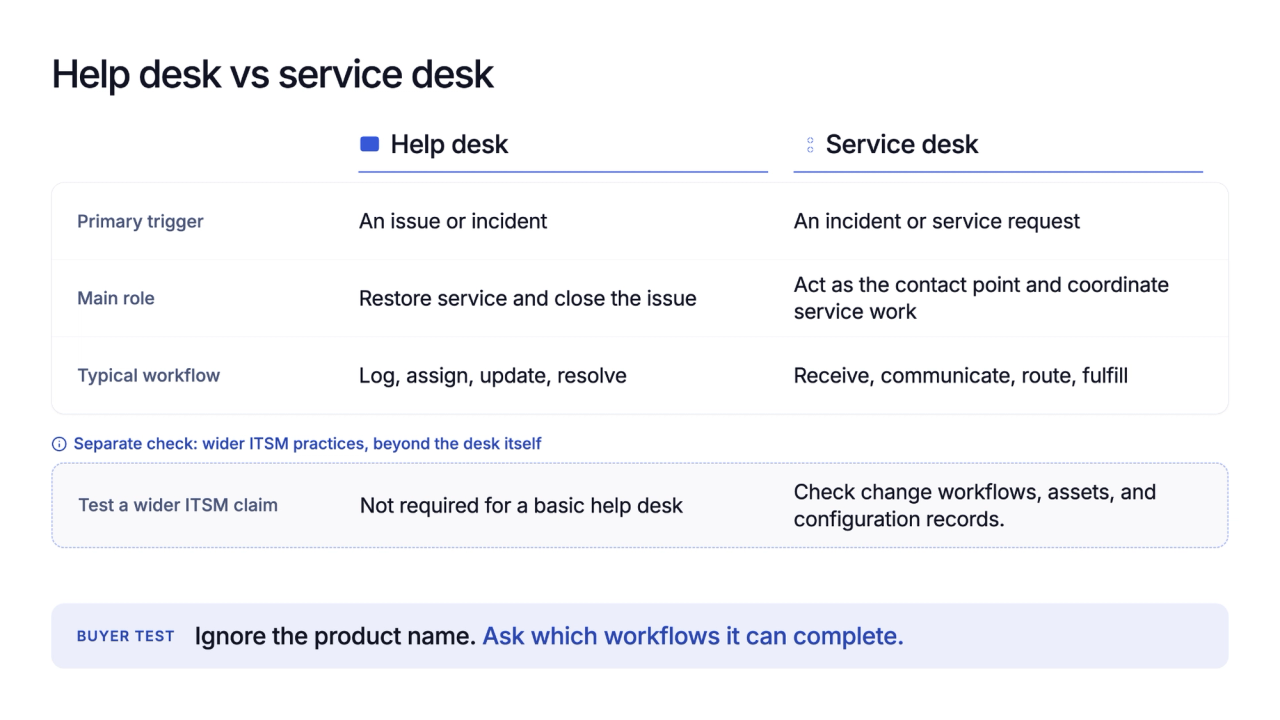
That boundary matters because change enablement, asset management, and configuration management belong to wider IT service management. Calling a product a service desk doesn't prove that it can approve a change, track an asset, or show how systems depend on one another.
How to Test What a Vendor Is Selling
Buyers often read “service desk” as a higher tier of help desk software. In practice, vendors use both labels loosely, so the product should be tested through the work it can complete.
- Incident handling: Can it log, route, track, and close something that broke?
- Service requests: Can it offer standard requests, collect approvals, and follow a defined fulfillment path?
- Wider ITSM controls: Can it manage planned changes and connect tickets with assets or configuration records?
If the product only receives and routes issues, it is functioning as a help desk regardless of the label on its website. If internal IT needs formal change approval, asset lifecycle tracking, or a configuration database, Freshservice documents those wider ITSM controls and is a stronger fit than a simple customer support queue.
An AI support layer can answer from documentation and pass an unresolved request into either operation without becoming the help desk or service desk itself. Wonderchat publishes the method behind the number.
Which One Does a Team Need?
A small customer support team usually needs a shared inbox or help desk because its main job is resolving customer questions and incidents.
Teams comparing help desk tools for SaaS support should judge routing, ownership, response tracking, integrations, and reporting rather than paying for IT processes they won't use.
An internal IT team needs a service desk approach when it handles repeatable employee requests and coordinates work across broader service-management practices.
Choose the narrower system that covers the real workflow, then add wider ITSM controls only when the team can name the change, asset, or service process that requires them.
Frequently Asked Questions
Is a service desk only for IT?
No. Service-management workflows can also support departments such as HR, facilities, finance, and legal. The deciding factor is whether the team delivers managed internal services, not the department’s name.
Which does a small support team need?
Most small customer support teams need a shared inbox or help desk. A service desk approach becomes useful when the team manages standard service requests or coordinates formal change and asset processes.
Does ITIL require a service desk?
No. ITIL is adaptable guidance rather than a fixed implementation checklist. Service desk is one ITIL management practice, and an organization selects and applies practices according to the services it manages.
