


29/10/2026
Resolution rate vs deflection rate
Deflection rate is the share of support conversations that end without reaching a person. Resolution rate is the share in which the customer's problem is solved without a person, so a conversation can be deflected without being resolved.
What does each rate count?
Deflection rate counts where a conversation ended, while resolution rate counts how it ended.
- What it counts: deflection counts conversations that ended without a person, and resolution counts those where the problem was solved without a person.
- What it includes: customers who gave up count toward deflection but never toward resolution, which includes only conversations judged solved.
- What it needs: a rule for "solved" and a waiting window, which resolution needs and deflection doesn't.
A customer who closes the chat in frustration still counts as deflected.
How do you calculate deflection rate and resolution rate?
Divide the conversations that ended without a person by all conversations for deflection, and the conversations judged solved by the conversations evaluated for resolution.
Deflection rate = conversations closed without a person ÷ all conversations × 100
Resolution rate = conversations judged resolved ÷ conversations evaluated × 100
The resolution formula only means something with its finish line. Fin, formerly Intercom (Salesforce completed the acquisition in September 2026), counts a resolution, one of the two outcomes it charges for, when the customer "confirms the answer was satisfactory" or "exits the conversation without requesting further assistance," and 24 hours of silence after Fin's last answer counts as an assumed resolution.
A shorter waiting window, a looser idea of solved, or a denominator that leaves out hard conversations all raise the rate.
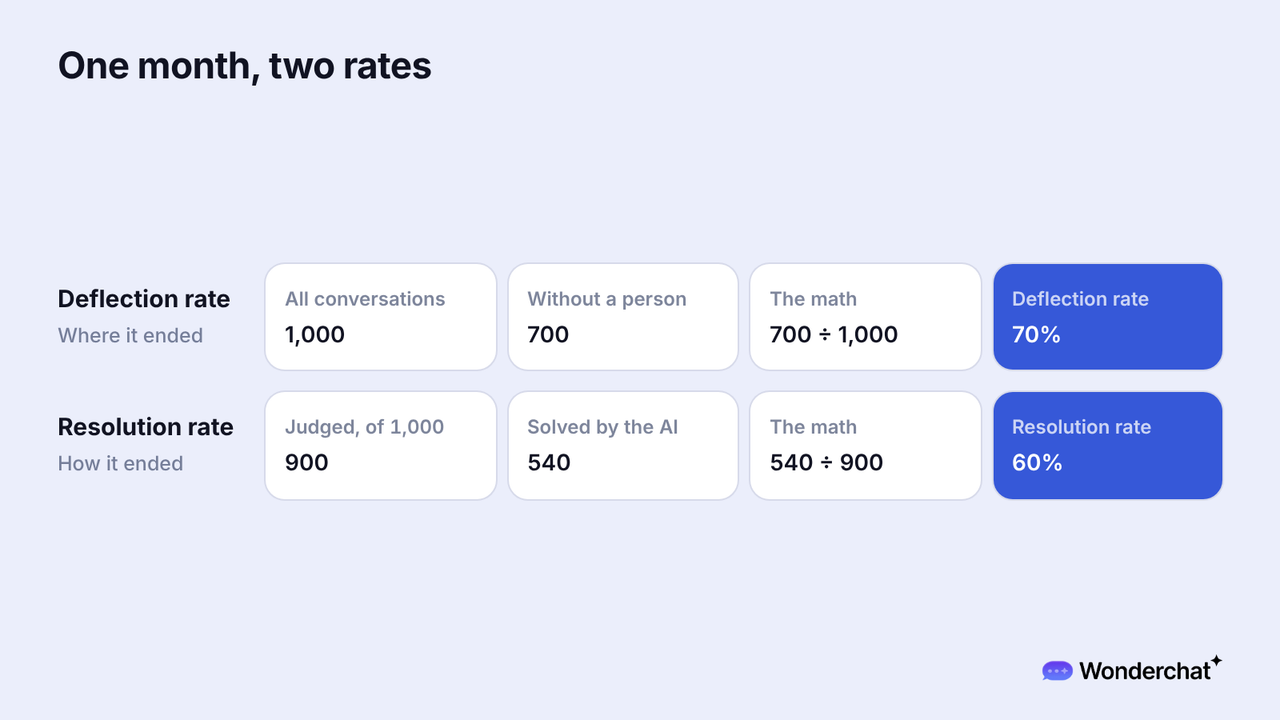
For example, in a month of 1,000 conversations, 700 end without a person, for a 70% deflection rate. If 100 of those 700 can't be judged, 900 conversations are evaluated, and 540 solved without a person give a 60% resolution rate.
What should you ask before comparing two tools' rates?
Ask which rate it is and how it was counted, because two tools can quote the same number and mean different things.
A deflection rate describes a tool's routing, while a resolution rate with its method describes what happened to the customers.
Why can a high deflection rate hide customers who gave up?
Deflection counts exits, not outcomes. Abandoned chats, article views, and customers who switched to email can all count as deflected, so the number rises while the queue doesn't shrink.
For its own rate, Wonderchat counts resolutions, about 75% of evaluated conversations resolved without a person. Wonderchat answers from a team's own help center and shows the source on every reply.
Frequently asked questions
What is a good deflection rate?
No standard exists, because tools count deflection in different ways and a high rate can include customers who gave up. Read it next to the resolution rate for the same conversations, and treat a wide gap between the two as a sign of abandonment worth investigating.
Which rate should you track for an AI agent?
Track resolution rate, with its finish line and waiting window written down, because it counts problems solved. Deflection rate shows only how many conversations never reached a person, so it helps with staffing plans more than with quality checks.
Can deflection rate be higher than resolution rate?
Yes, because deflection counts every conversation that ended without a person, including customers who gave up, while resolution counts only those judged solved. The same month can show a 70% deflection rate and a 60% resolution rate.
