


29/10/2026
AI guardrails
AI guardrails are rules and checks that keep an AI system inside set limits. In customer support, they decide what the AI may answer, which sources it may use, and when it must hand the conversation to a person.
How do AI guardrails work in customer support?
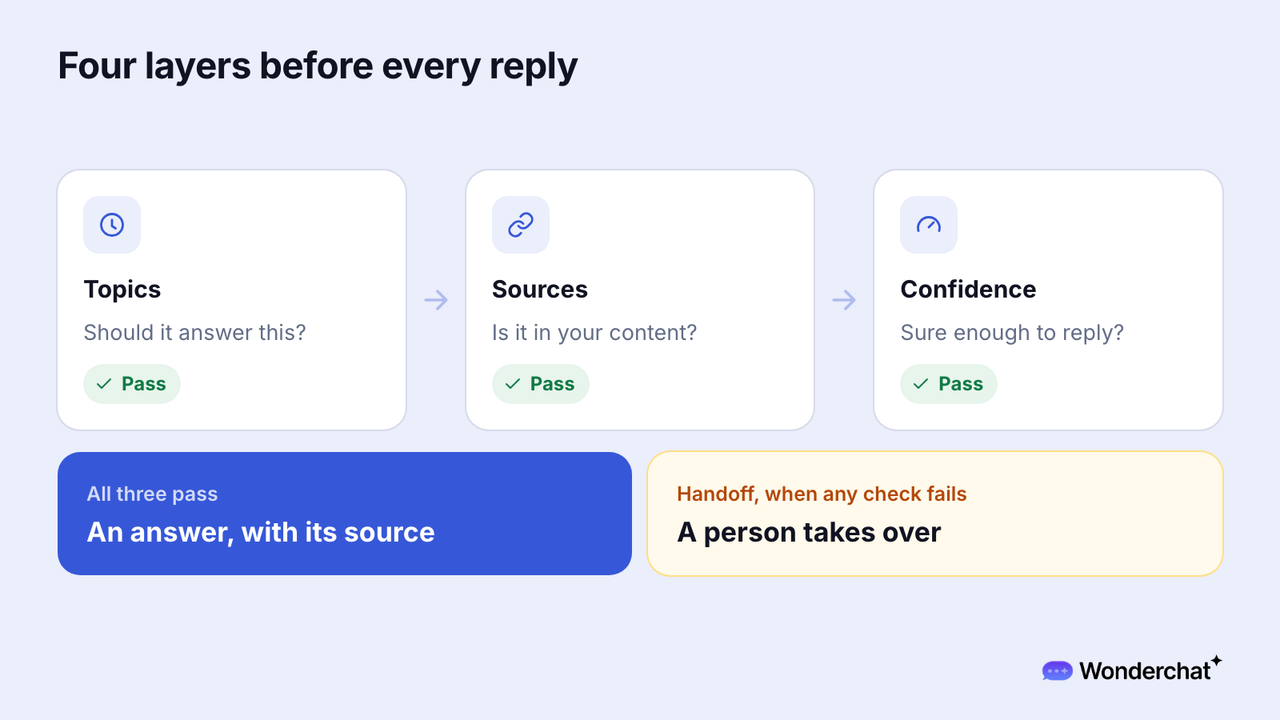
An AI agent that only answers questions needs four layers of guardrails, three checks before a reply goes out and a handoff when one fails.
- Topics: the kinds of question it may answer at all.
- Sources: the documents it may answer from, and nothing else.
- Confidence: a check that stops a reply it isn't sure of.
- Handoff: the rule that passes the conversation to a person.
NVIDIA's NeMo Guardrails library applies them "at multiple stages of the LLM interaction," including retrieval rails that "filter and validate retrieved knowledge (documents and chunks)" before the model answers.
For example, a customer asks whether a refund covers shipping, and no page mentions shipping. With no page that mentions shipping, the sources check fails, so the customer goes to a person with the full conversation attached instead of getting a guessed answer.
How do you test an AI agent's guardrails?
Test each layer with real questions before launch and again after big content changes, since no single metric scores guardrails.
- Confidence and handoff: ask 10 questions your docs don't cover. Each reply should say it can't find the answer and offer a person. These are the questions a guessed answer gets wrong.
- Sources: ask 10 questions your docs do cover. Each reply should show a source, and that page should contain the answer. A source without the answer means the reply went past its page.
- Topics: ask for legal advice, or tell it to ignore its instructions. The agent should stay in scope or hand over. An agent that follows a stray instruction can say things no page supports.
Why do guardrails matter before an AI agent talks to customers?
Guardrails are the practical answer to "will it make things up?" A founder can check each layer before the agent answers a single customer.
Security guidance points the same way. OWASP's entry on LLM misinformation recommends retrieving "relevant and verified information" and adding "human oversight and fact-checking processes, especially for critical or sensitive information."
Where does the strongest guardrail sit?
The strongest guardrail is the source of the answers, more than any filter added at the end. An agent grounded in your docs, with a confidence threshold and a handoff, needs fewer rules than a general model told to be careful.
Grounding also moves the risk to the docs. The failure Wonderchat's support team sees most often is retrieval pulling an archived policy and answering from it correctly.
Removing old pages is a guardrail too. Wonderchat answers from a team's own help center and shows the source on every reply.
Frequently asked questions
What are examples of AI guardrails?
Examples are a list of topics the AI may answer, a rule to answer only from connected documents, a check that stops low-confidence replies, and a rule that hands the conversation to a person. Agents that take actions also limit which actions they may take.
What guardrails does an AI support agent need?
At minimum, an AI support agent should answer only from your content, show the source, say when it can't find an answer, and hand over to a person with the conversation attached. Test each one with questions your docs do and don't cover.
Can guardrails stop AI hallucinations?
No, they reduce hallucinations but don't remove them. Anthropic's guidance says its techniques "significantly reduce hallucinations" but "don't eliminate them entirely," so reviewing real answers still matters.
