


26/09/2026
Knowledge Base
A knowledge base is a structured collection of articles, policies, guides, and other information that people can search when they need an answer. It can support customers, employees, human agents, and AI systems, although its value still depends on clear organization, current content, and reliable ownership.
Types of Knowledge Bases
AI knowledge bases index approved content so an AI agent can retrieve passages and form a direct answer.
- External knowledge bases contain public help articles, product guides, policies, and troubleshooting steps for customers.
- Internal knowledge bases store procedures, training material, company policies, and technical guidance for employees.
- AI-powered knowledge bases index approved content so an AI agent can retrieve passages and form a direct answer.
- Hybrid knowledge bases use the same controlled source collection for self-service, human support, and AI responses, while access rules determine what each audience can see.
The same source can support traditional search and an AI knowledge base chatbot, but each interface handles the information differently.
How a Knowledge Base Agent Works
A knowledge base agent answers a question from your existing documentation instead of returning a list of articles. Search gives you documents and leaves the reading to the customer. An agent gives the answer, with the source it comes from.
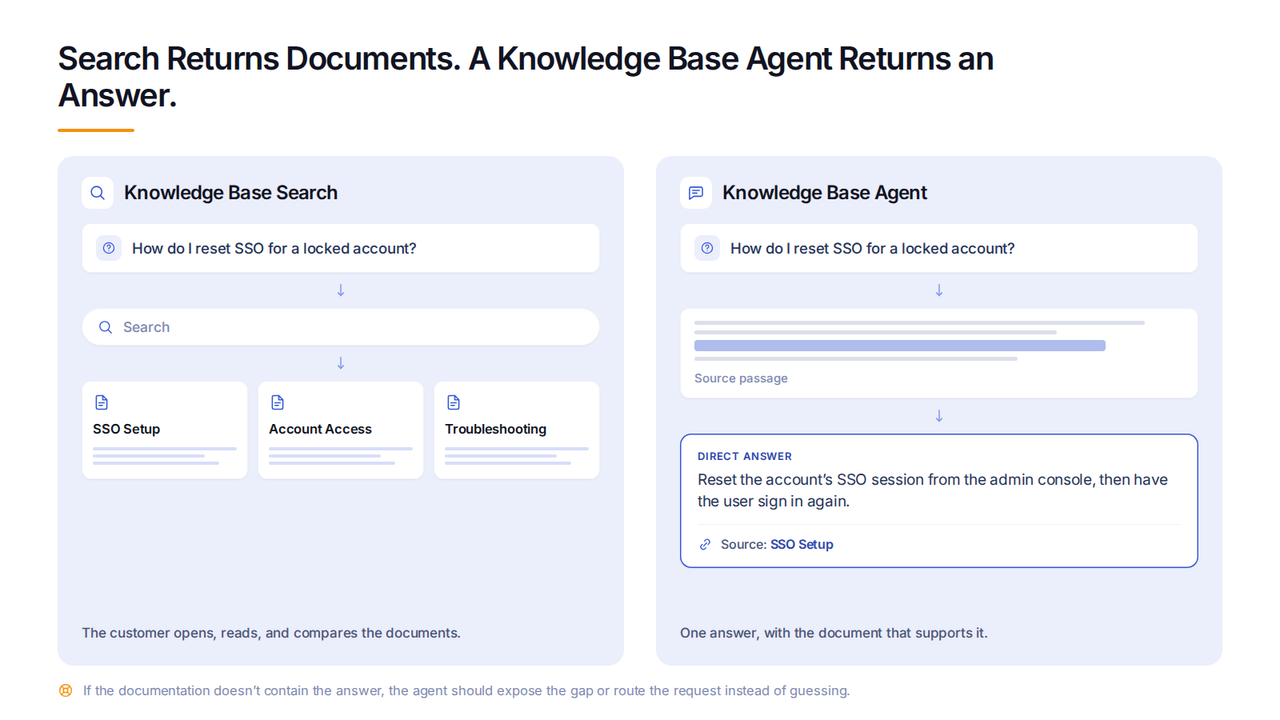
The mechanism separates finding information from writing the response.
- Prepare the content. The system indexes approved pages, files, and help-center articles, then divides them into searchable passages.
- Retrieve evidence. When a question arrives, retrieval ranks the passages most likely to contain the answer.
- Answer or stop. The agent writes from the retrieved text, while grounding limits what it should claim and an AI citation shows the supporting source.
If the documentation doesn't contain the answer, the agent can't create reliable company knowledge from the model alone. It should expose the gap, ask for clarification, or move the request to another support path.
How to Test a Knowledge Base
Search clicks show whether people open content, but they don't show whether the information answers the question. A useful evaluation checks the query, retrieved passage, final response, and customer outcome together.
- Ask a narrow question with one documented answer and confirm that the result matches the current source.
- Ask about an undocumented policy and check that the agent doesn't attach an unrelated article or invent an answer.
- Place an archived policy beside its replacement and confirm that the current version controls the response.
Common Confusion
A knowledge base isn’t the same thing as a knowledge base agent. The knowledge base is the source collection, while an AI agent that answers from your knowledge base retrieves from that collection and produces a response.
An FAQ is usually a short list of common questions, while a knowledge base holds deeper, organized content across many topics. A database mainly stores structured records for software to query, while a knowledge base contains information that people or AI systems can interpret.
Wonderchat turns a knowledge base into answers, not search results.
Frequently Asked Questions
What is a knowledge base in customer service?
It is a collection of support articles, policies, and troubleshooting guidance that customers, support agents, or AI systems use to answer service questions consistently.
What is an AI knowledge base?
An AI knowledge base makes approved content available for semantic retrieval, allowing an AI agent to find relevant passages and form an answer from them.
How do you build a knowledge base?
Start with repeated customer or employee questions, assign a content owner, write one clear answer per article, organize related pages, and set a review schedule for updates.
What is the difference between a knowledge base and a wiki?
A wiki usually allows broad collaborative editing, while a knowledge base normally follows defined templates, ownership rules, and review steps so published guidance remains consistent.
