


17/09/2026
Average Handling Time
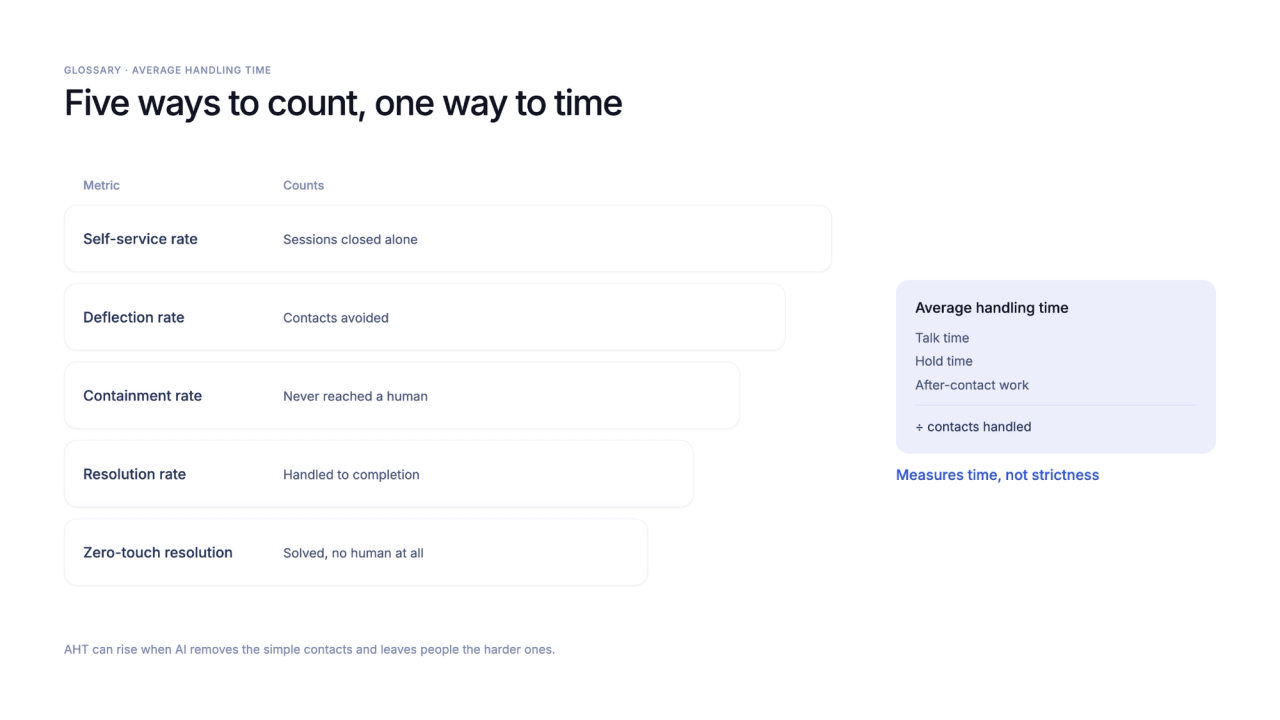
Average handling time is the mean time to complete one contact: talk time, hold time, and after-contact work divided by contacts handled. Deploying AI usually raises it, because the easy contacts leave the human queue and the hard ones remain.
Also called average handle time, AHT measures the active work connected to an interaction rather than the full time from opening a case to final resolution. It can be tracked for phone calls, live chats, emails, or other channels, although each channel needs a consistent definition.
How to Calculate Average Handling Time
The standard AHT formula combines every measured handling component for a defined period, then divides that total by the number of contacts agents handled during the same period.
AHT = (total talk time + total hold time + total after-contact work) ÷ contacts handled
Talk time covers direct conversation with the customer, hold time covers pauses during the contact, and after-contact work covers notes, updates, follow-up tasks, or closing codes completed afterward. For chat or email, teams may replace talk time with active handling time, but they should not mix definitions across channels.
Suppose a team records 500 minutes of talk time, 100 minutes on hold, and 150 minutes of after-contact work across 100 handled contacts. Its AHT is 750 divided by 100, or 7.5 minutes.
The denominator should contain handled contacts, not unique customers, incoming demand, or every ticket opened. Abandoned contacts and automated conversations should remain outside human AHT unless the reporting method clearly defines and labels another population.
Why Human AHT Can Rise After AI Starts Resolving Contacts
An AI agent can shorten some human interactions by gathering details, finding information, or preparing a summary before an agent responds. However, self-service also changes which contacts reach the human queue, and that change can move AHT in the opposite direction.
Consider a queue with 50 simple contacts taking two minutes each and 50 complex contacts taking ten minutes each. Before automation, human AHT is six minutes across 100 contacts. If AI resolves 40 of the simple contacts, people handle the remaining ten simple and 50 complex contacts, producing an AHT of about 8.7 minutes.
The human AHT increased, but human handling fell from 600 minutes to 520 minutes while the team still served all 100 customers. That increase reflects a harder mix of work rather than weaker performance, which is why a quarterly review should not judge an AI deployment from blended AHT alone.
What to Measure Alongside AHT After Automation
Support leaders need measures that reveal whether the whole operation became more efficient, even when the remaining human contacts take longer.
- Total handled volume should include contacts completed by AI and people, with each group reported separately.
- Cost per resolution connects the total cost of support with problems actually solved rather than contacts processed quickly.
- AHT by contact path separates human-only contacts, AI-assisted contacts, and contacts that reached a person after AI involvement.
The chatbot KPI framework provides the wider reporting context, while the guide to AI ticket deflection tools explains why avoided contacts and resolved contacts should not be treated as the same result.
Wonderchat expects handling time to rise on the human queue and says so before the first review.
Frequently Asked Questions
What is average handling time?
Average handling time is the average talk, hold, and after-contact work time required for each handled customer contact during a defined reporting period.
How is AHT calculated?
Add total talk time, hold time, and after-contact work for the same period, then divide the result by the number of contacts handled.
Does AI reduce average handling time?
Usually not on the remaining human queue, because AI often removes easier contacts first. AI may still reduce total human workload, so AHT should be reviewed with handled volume, cost per resolution, and contact complexity.
