
Quick Summary
Great customer service means customers get a correct answer the first time, the same answer on every channel, and a person who already has the context when the question needs one. This guide gives six steps to deliver it, from one source of truth for your answers to handoffs and feedback loops, and shows where an AI agent like Wonderchat fits. Visit the Wonderchat blog for more useful guides and reviews.
Wondering If You’re Delivering Great Customer Service?
You shouldn't have to wonder whether your team is delivering great customer service; you should know it.
Great service fixes the problem and leaves the customer with less effort than they expected. If your team can’t consistently reach this level, customers slip away.
This Wonderchat guide defines what great service looks like and gives six steps to deliver it consistently.
Why Trust This Guide?
Wonderchat builds an AI customer service agent for small teams: it answers from your own help center and docs and shows the source on every reply.
For example, Jortt's AI agent resolves about 92% of roughly 30,000 monthly inquiries without a person.

What Constitutes Great Customer Service?
Great customer service solves the problem correctly the first time, and the customer doesn't have to chase it. Do that consistently and customers stay.
Customer service excellence is built on these essential elements:
Empathy: Acknowledge the customer’s situation quickly. Show you understand their needs without lengthy delays.
Precision: Provide effective, lasting solutions immediately. Never settle for temporary fixes.
Personalization: Tailor the interaction based on the customer’s history. Every customer should feel known and valued.
Consistency: Deliver the same high-quality, reliable support across every channel, every time.
Timeliness: Respond and resolve issues with speed. Delays signal that the customer is not a priority.
Proactivity: Offer assistance or relevant information before the customer even asks, turning service into a genuine advantage.
Mastering these elements equips your team to deliver experiences that set your business apart and drive greater retention.
How Does Great Customer Service Help Your Business?
Exceptional customer service is one of the most powerful drivers of success for your business. Here’s how:
It drives customer retention and loyalty
When service is reliable and effortless, customers trust your brand and have no reason to look elsewhere. This foundation of trust translates directly into higher retention rates, ensuring customers spend more with you over time and reducing the expense of constantly acquiring new business.
It increases profitability and efficiency
World-class service means resolving issues correctly and quickly the first time. This precision cuts down on repeat contacts, lowers the operational load on your support team, and ultimately reduces your overall service costs.
It creates a competitive advantage
When products are similar, service becomes the main differentiator. Consistently superior interactions generate positive word-of-mouth and protect your reputation, positioning your brand as the reliable leader in the market.
It protects your brand reputation
In the modern market, a single negative experience can become public quickly. One bad experience can be enough for a customer to stop doing business with a company. Great service limits the damage: a complaint handled well can end as a story about how quickly you fixed it.
How to Plan and Deliver Great Customer Service as a Business
Step 1. Define and Centralize Your Knowledge Base
Great customer service starts with having a single, reliable source of truth. If your team or your AI chatbot is pulling information from multiple places, customers can get inconsistent answers, and your agents end up spending time correcting mistakes.
Your first step is to consolidate all product information, policies, and successful past resolutions into a centralized, searchable knowledge base. Tools like Notion, Confluence, Guru, or Help Scout Docs can help you structure and maintain this repository.
For example, if you’re using Notion:
Create a top-level “Knowledge Base” page.
Add subpages or databases for product information, policies, and FAQs.

Use tags, filters, and relations to connect relevant content into databases.
Enable full-text search so agents and AI chatbots can quickly find consistent answers.
No matter which platform you choose, your knowledge base must be well-organized, regularly updated, and accessible to both humans and customer service tools like CRMs and AI chatbots.
Include all relevant content, such as PDFs, videos, documentation and website links, so your team and AI agents can pull accurate, complete information for every customer interaction.
Step 2. Understand and Map the Customer Journey
It’s impossible to deliver quality service without knowing where your customers struggle. Mapping the customer journey lets you walk in their shoes, identifying every moment they seek help, from initial interest to post-purchase retention.
Key stages of the customer journey include:
Awareness: The customer becomes aware of your brand through various channels.
Consideration: They evaluate your offerings against competitors.
Decision: The customer decides to make a purchase or engage further.
Retention: Post-purchase interactions that encourage repeat business.
Advocacy: Satisfied customers recommend your brand to others.
Look closely at each touchpoint. Which channels create friction? Where do customers wait or repeat themselves? Designing great service means removing these obstacles and creating a consistent, low-effort experience across all channels.
A well-mapped journey also informs technology choices. For example, one Wonderchat agent can answer on your website chat, email, WhatsApp and Slack (WhatsApp and Slack from Starter), and hand over to a person when needed.

A mapped journey tells you where to put answers before customers have to ask for them.
Step 3. Use Technology Effectively
For a small team answering the same questions over and over, delivering great service with people alone gets hard. Introducing the right technology, like advanced AI chatbots, makes customer service faster and better.
A well-trained AI agent can handle high-volume, routine inquiries instantly, reducing wait times and freeing human agents to focus on complex or sensitive issues. When it answers from your own documentation, customers get the same answer every time, and your team can see what it said.
Where Wonderchat fits
Wonderchat is an AI customer service agent for small teams with real documentation. You point it at your website, help center and files such as PDFs, it answers from them with no code to write, and 80% of Wonderchat agents that go live do so the same day.
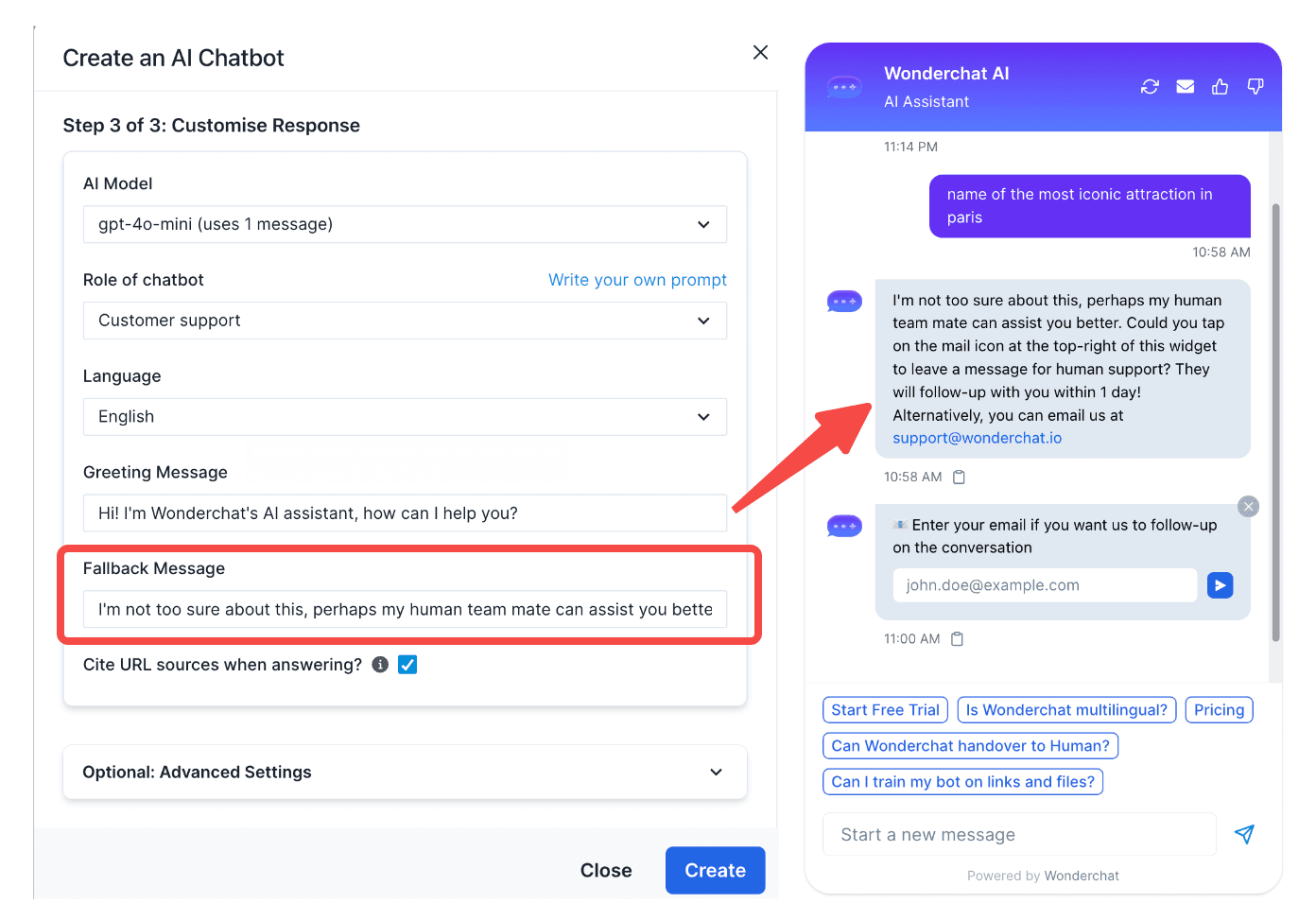
The agent can then:
Answer on website chat, email, WhatsApp, Slack and other channels, with WhatsApp and Slack from Starter.
Deliver personalized, context-aware responses in different languages that reflect your brand and customer needs.
Hand complex issues to a person with the whole conversation attached, as a ticket or through live chat on every plan.

Standardize messaging to ensure a consistent tone and style across all touchpoints.
Capture leads and track engagement, providing actionable insights to improve service and retention.
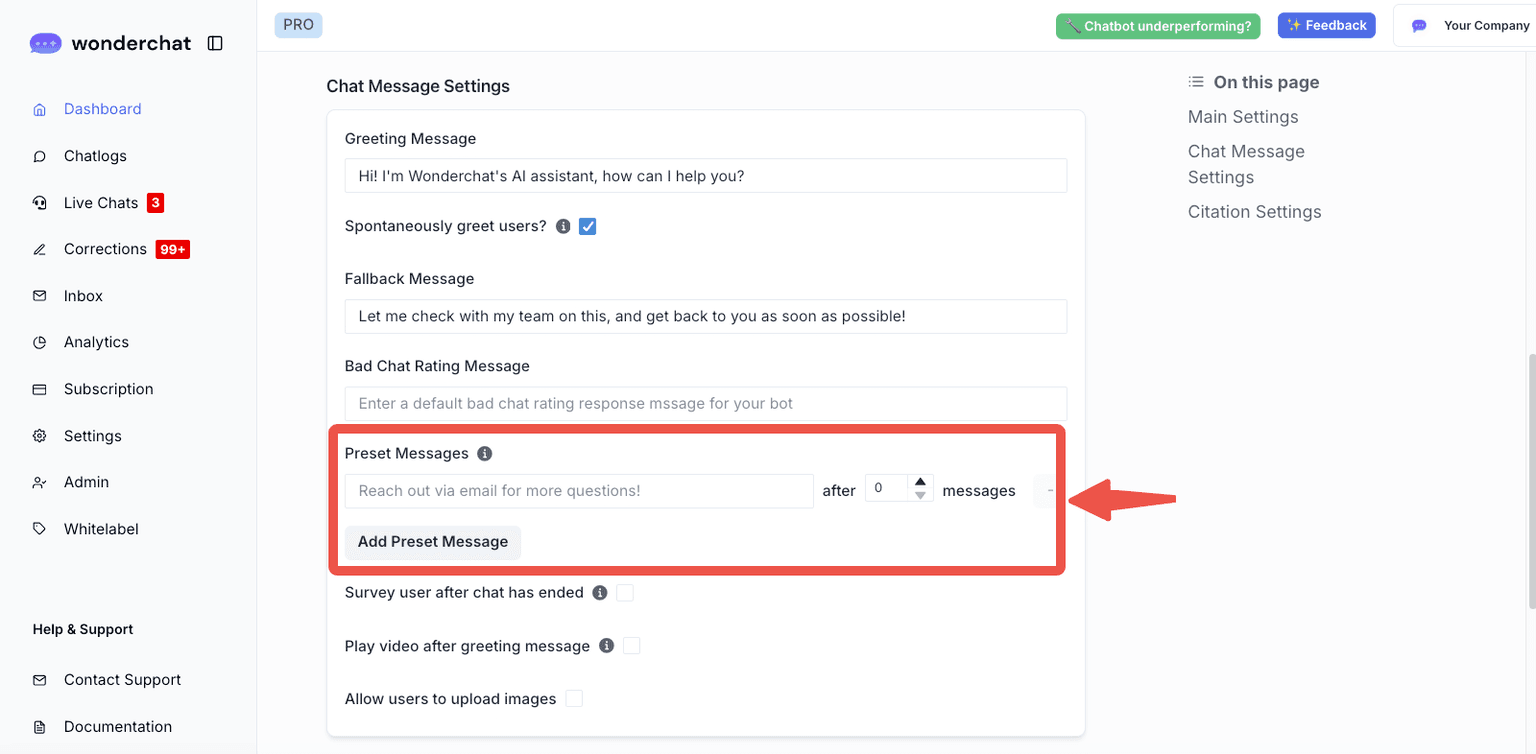
Improve as you correct it: questions it couldn't answer land in the review inbox, and once you answer one, it answers it from then on.
Integrate with other tools via Zapier to automate workflows, CRM updates, and ticketing.
Bring in teammates at $0, since seats are not billed on any plan.
Customize the chat widget to match your branding, with custom CSS on the Scale plan.
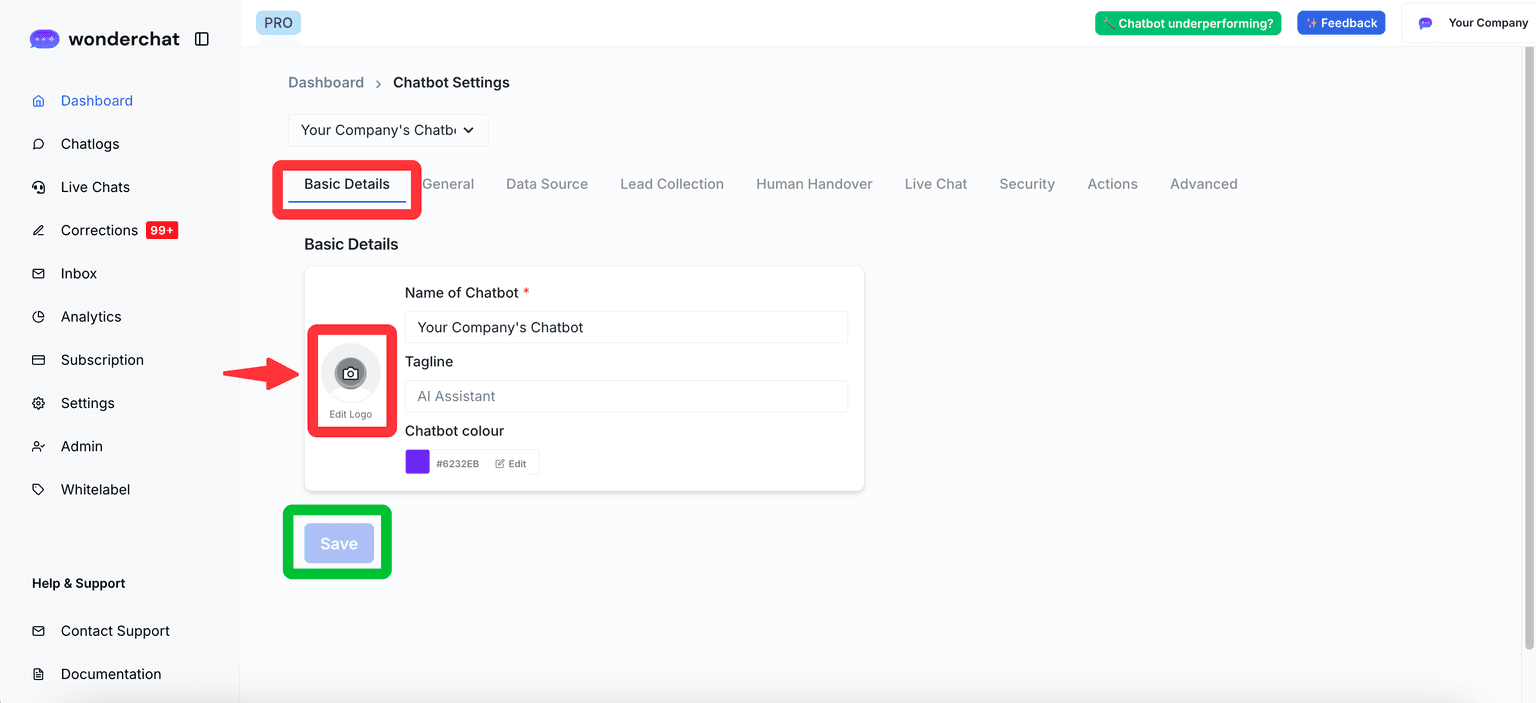
With the agent answering the routine questions, your team handles the conversations that need a person, and you can see what it answered and what it couldn't.
Step 4. Ensure Human-to-AI Transitions
Technology can change customer service, but it can't operate alone. Even the most advanced AI chatbots have limits. Some questions are too complex, emotional, or sensitive for AI to handle. Wonderchat's agent also doesn't take actions such as refunds, cancellations or account changes, so those go to a person too.
That’s why the most effective customer service setups combine AI with human agents. This ensures that when needed, conversations shift smoothly to a human, without making the customer repeat themselves or feel frustrated.
To make handoffs smooth:
Keep full context: Ensure the human agent sees the complete chat history, customer details, and sentiment cues.
Set clear triggers: Define when AI should escalate, such as repeated questions, frustration signals, or a direct request for human support.
Use one shared system: Both AI and agents should work in the same system to access up-to-date information.
Communicate with the customer: Let them know they’re being transferred and reassure them that their issue is in good hands.
In Wonderchat, the handover is built in. When no page covers a question, the agent says so, offers a person and creates a ticket with the full chat attached, with follow-up by email, on every plan.
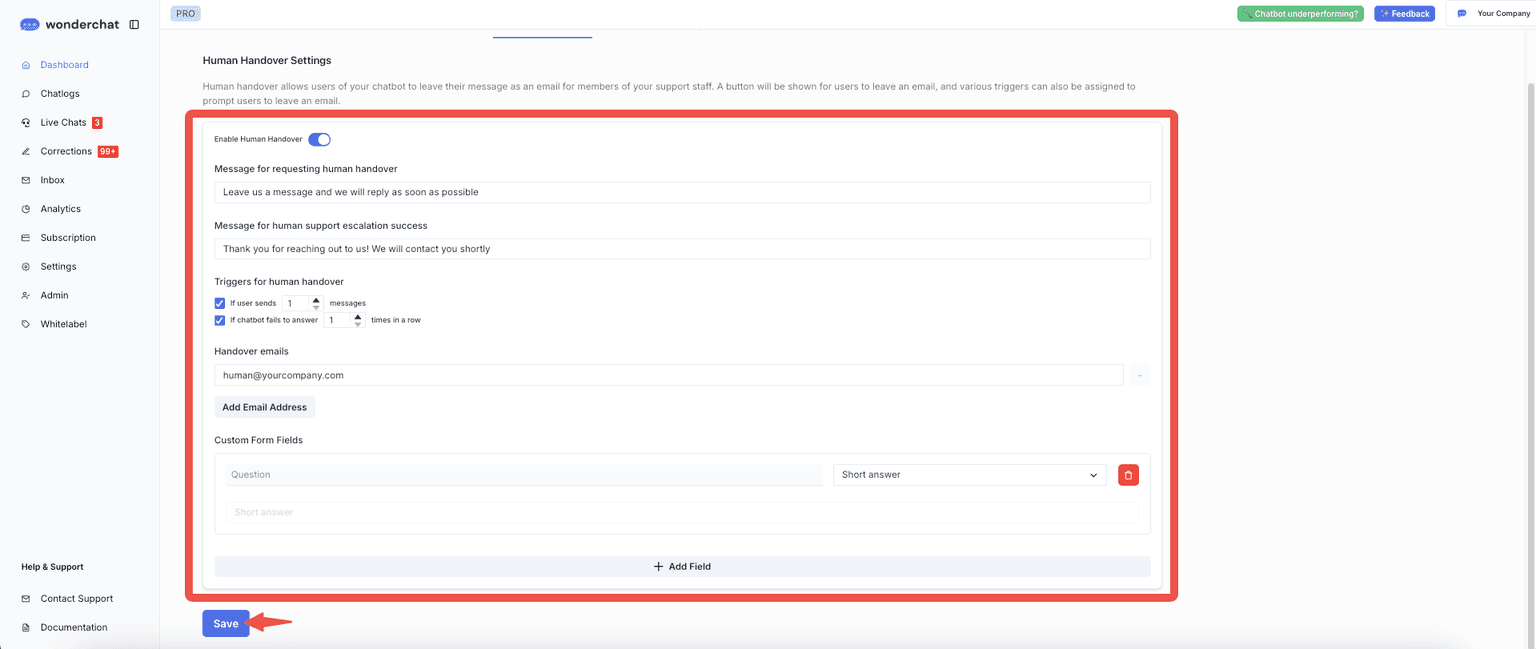
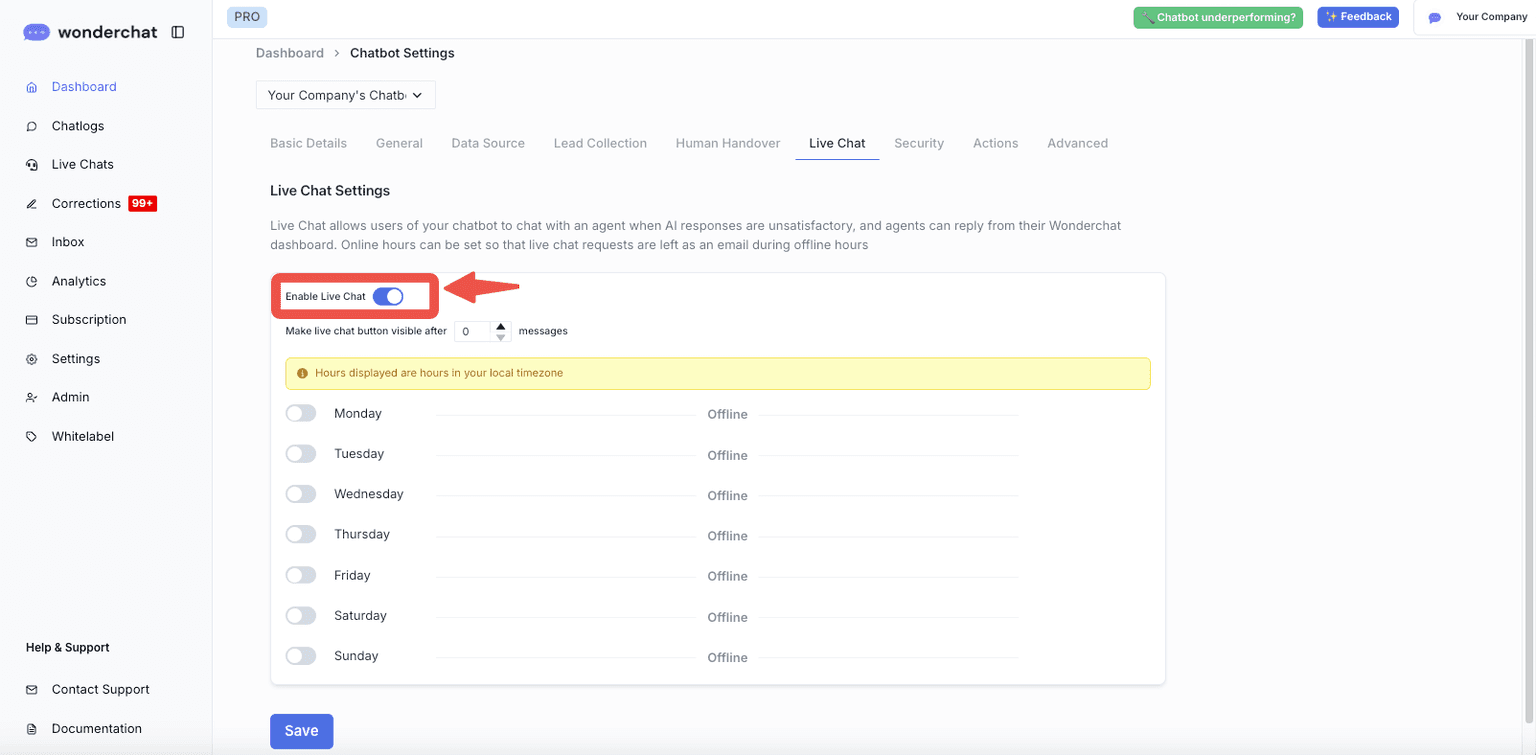
On every plan, live chat lets a teammate take over in real time with the whole conversation in front of them. Teammates can be notified by email, or by SMS and other tools through Zapier, so they can respond quickly.
The customer doesn't have to repeat themselves, and the person who takes over starts with the full context.
Step 5. Prioritize Agent Training for High-Value Interactions
Once AI handles the routine questions, the job of the people on your support team changes. You are no longer paying agents to search for simple answers; you are relying on them for empathy, critical thinking, and advanced problem-solving.
Therefore, agent training must shift from product knowledge basics to mastering these high-value skills. You should focus on:
Active listening and empathy: Train agents to really hear customers, acknowledge their feelings, and respond thoughtfully. This helps de-escalate tension and build trust.
Emotional regulation: Equip agents to stay calm and composed, even when handling frustrated or upset customers.
Scenario-based practice: Use real-life role-playing exercises so agents can practice responding to challenging situations with confidence.
Stress management: Provide tools to cope with the emotional demands of support work, helping prevent burnout and keep morale high.
That way, when a customer reaches a person, the person adds something the agent couldn't.
Step 6. Establish Real-Time Performance Metrics and Feedback Loops
You can’t improve what you don’t measure. To deliver consistently great customer service, track key metrics like First Contact Resolution (FCR), Customer Effort Score (CES), response times, and satisfaction ratings. Real-time insights help teams spot recurring issues, address problems quickly, and refine both human and AI responses.
Wonderchat makes performance tracking simple for your customer service AI agents. From the Basic plan, Wonderchat's analytics dashboard shows how the agent performs, and the review inbox lists the questions it couldn't answer. You can read the agent's conversations, see which were handed to a person, and compare channels.
Feedback loops are essential. Encourage agents to note recurring questions or gaps, then feed this information back into your knowledge base and AI training. Over time, these adjustments make support faster, more accurate, and more satisfying for customers.
Best Practices for Customer Service Excellence
Here are best practices that ensure your team operates at the highest level of professionalism and empathy:
Prioritize clarity over speed: While quick responses are important, an accurate, easily understood solution is far more valuable than a fast, confusing one. Always ensure the language is simple and the steps are explicit.
Treat feedback as a gift: Every customer complaint or negative survey response is a direct opportunity to correct a systemic issue. Do not treat negative feedback as an attack; treat it as free consultation for improving your business.
Provide self-service options: Help customers with accessible FAQs, AI chatbots, or a reliable knowledge base. This allows for instant answers to routine questions, satisfying the customer's need for speed.
Maintain complete cross-channel consistency: The answer a customer receives from the AI chatbot on your website must be identical to the answer they get from a human agent via email. Inconsistency destroys trust instantly.
Be a proactive resource: Do not wait for a problem. Use customer data to anticipate needs, whether it is an alert about a system outage or a follow-up email after a major purchase, and provide helpful information first.
Use clear, concise communication: Avoid technical jargon, explain solutions in plain language, and always confirm the customer understands the next steps before ending the interaction.
Achieve Customer Service Excellence with Wonderchat
Delivering great customer service requires moving past reactive support and implementing a cohesive strategy built on precision and consistency. By centralizing knowledge and strategically deploying conversational AI, you move from simply fixing problems to actively retaining customers.
Wonderchat is built for the answering part: one source of truth, answered the same way on every channel. Wonderchat provides a no-code AI agent that answers from your own docs with the source cited and hands the whole conversation to a person when needed. Stop letting inconsistent service cost you customers.

