


30/10/2026
Customer health score
A customer health score is a number that combines signals such as product usage, support activity, and billing to show how likely a customer is to stay or leave.
How is a customer health score calculated?
Customer-success tools such as Vitally build the score as a weighted average of signals scored on the same scale.
Health score = (each signal score × its weight, added up) ÷ the sum of the weights
- Signal score: each signal on a common scale, such as 0 to 100.
- Weight: how strongly the signal predicted churn in past accounts.
- Missing value: left out, with its weight shared by the other signals.
Gainsight's guide advises, "Use historical data to assign weights based on what predicts churn or renewal." For a blank signal, Vitally's documentation notes that Vitally "only scores the inputs that have known values," so a gap doesn't count as zero.
To check the weights, Gainsight says to "test your model often and adjust to stay aligned with customer outcomes." One way is to compare last quarter's churned accounts with the scores they had two months earlier, because a weight that didn't flag them early is the one to change.
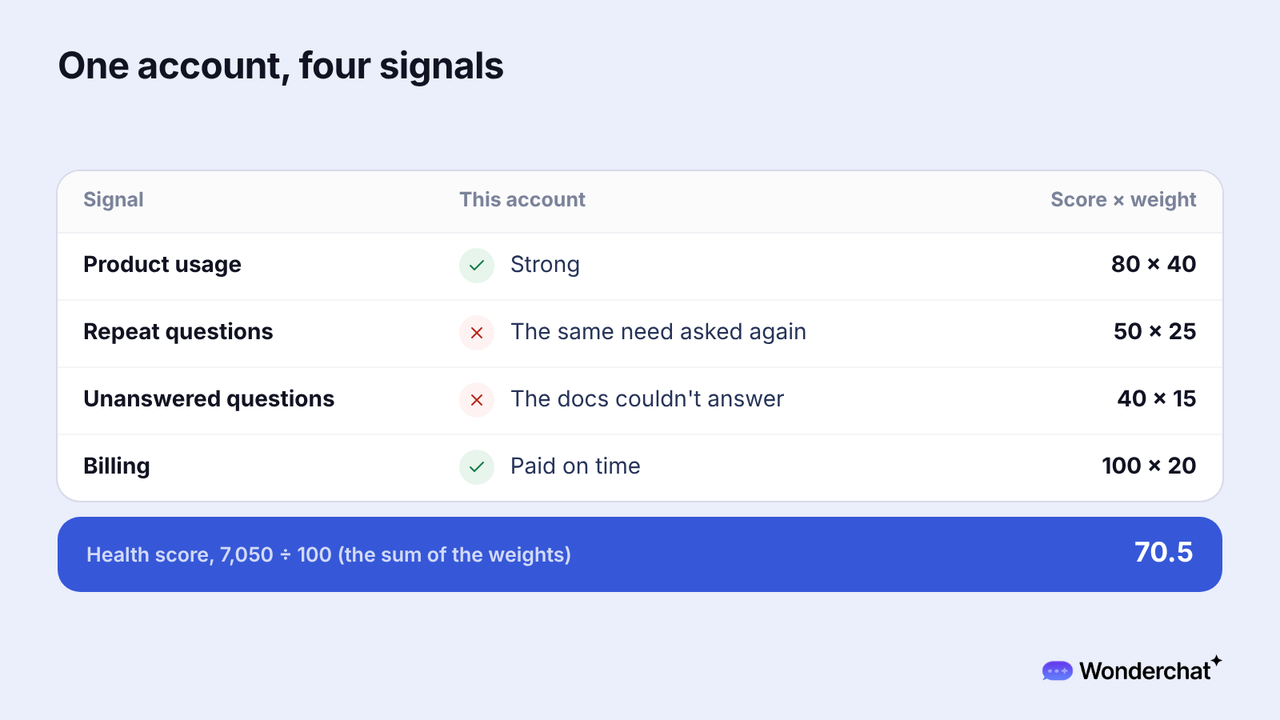
For example, an account scores 80 on usage, 50 on repeat questions, 40 on unanswered questions, and 100 on billing. With weights of 40, 25, 15, and 20, its health score is 70.5 out of 100.
Which support signals belong in a health score?
Repeat questions, unanswered questions, and the satisfaction trend belong there, because ticket count alone says little about whether an account is stuck.
- Repeat questions: the same need asked again within 30 days.
- Unanswered questions: questions the docs couldn't answer.
- Satisfaction trend: the account's CSAT over the last few months.
Why does support data matter for retention?
The questions an account keeps asking show where it's stuck, so support data is a signal in its own right.
In Wonderchat's study of 5,848,078 conversations (March 2023 to August 2026), existing customers with a problem make up 53% of the total. The AI agent resolved 60.8% of theirs in a sample of 5,000 scored conversations, against 73.6% for people deciding whether to buy, so the pages existing customers need are the ones to check first.
Wonderchat answers from a team's own help center and shows the source on every reply.
Does a high ticket count mean an unhealthy customer?
A high ticket count alone doesn't mean an unhealthy customer, because an account that uses more of the product can have more to ask. Repeat questions and unanswered ones are the signal, not raw volume.
Frequently asked questions
What metrics go into a customer health score?
A health score can combine product usage, such as logins and feature use, support signals, such as repeat and unanswered questions, and billing, such as on-time payment. Keep the signals that predicted churn in your past accounts and drop the rest.
What is a good customer health score?
No benchmark applies across teams, because each one picks its own signals, scale, and weights. Set your bands from your own history, such as the scores churned accounts had two months before they left, and review them each quarter.
How is a customer health score different from CSAT?
CSAT is a customer's rating of one interaction, while a health score combines several signals, the CSAT trend among them, into one account's churn risk. A happy rating can sit next to a falling health score when usage drops.
