


29/10/2026
Cost per ticket
Cost per ticket is the average amount a support team spends on one customer request. The number is total support cost for a period divided by the tickets handled or resolved in that period.
What goes into total support cost?
Total support cost is everything support spends in the month, wages included.
- People: pay and benefits for everyone who answers tickets, plus leads, trainers, and reviewers.
- Tools: the help desk, the AI agent, and other software.
- Space and phones: office space, equipment, and telephony.
- Outside help: outsourcing and any per-resolution fees.
- Shared time: a founder or engineer who answers tickets part of the week, at a fair share of their pay.
MetricNet's 2011 desktop support model, published by HDI, counts similar groups, from technician pay to telecom, facilities, and training. Leaving one out makes the team look cheaper than it is.
How do you calculate cost per ticket handled or resolved?
Divide total support cost for the month by the tickets handled, or by the tickets resolved for a stricter number.
Cost per ticket handled = total support cost ÷ tickets handled
Cost per ticket resolved = total support cost ÷ tickets resolved
For IT desktop support, MetricNet's Jeff Rumburg defines it as "the total monthly operating expense of desktop support divided by the monthly ticket volume."
- Tickets handled: every ticket opened in the month, solved or not.
- Tickets resolved: tickets closed with the problem solved and not reopened.
- Left out: spam, duplicates, and tickets merged into another.
Pick one version, name it, and keep it month to month, so the trend compares like with like. The gap between the two numbers is the cost of unsolved tickets, spread across the solved ones.
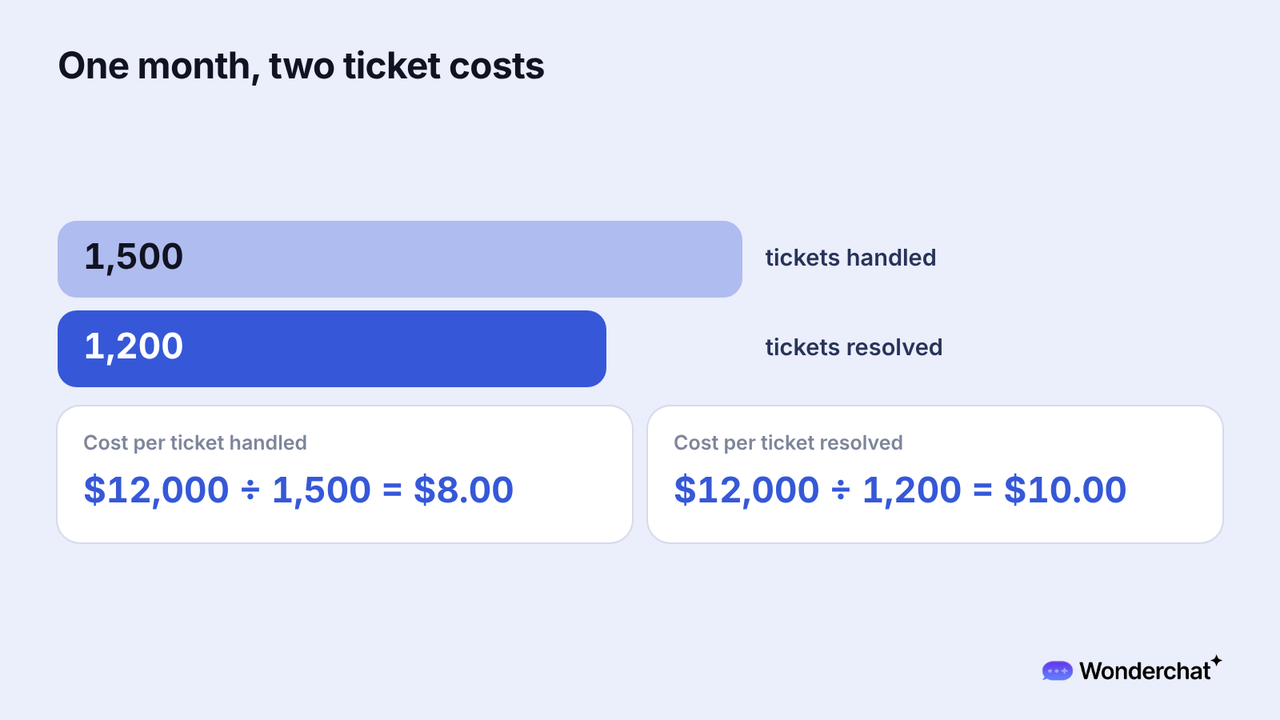
For example, a month with $12,000 of support cost, 1,500 tickets handled, and 1,200 resolved costs $8.00 per ticket handled and $10.00 per ticket resolved.
Why does cost per ticket matter for a hire or a tool?
Cost per ticket is the number a support lead shows the budget owner before asking for a hire or a tool. Splitting it by who resolved the ticket shows where the money goes, since a ticket a person resolves carries their time and one resolved without a person carries the tool's cost.
The split depends on how many questions an AI agent can settle. In Wonderchat's study of 5,848,078 conversations, the AI agent resolved 75.3% of scored conversations on its own in 2026, up from 56.7% in 2024.
When is a lower cost per ticket a bad sign?
Cost per ticket can fall while customers suffer. Closing tickets fast, or self-service that doesn't work, lowers the number and sends the same customers back with the same question.
MetricNet makes the same point, warning that "a low cost per ticket is not necessarily good, particularly if the low cost is achieved by sacrificing quality of service." Read the number next to CSAT and the reopen rate.
An AI agent that closes a ticket without solving it lowers cost per ticket on paper only. A source on each reply lets a reviewer check whether the answer was right, not only whether the ticket closed.
Wonderchat answers from a team's own help center and shows the source on every reply.
Frequently asked questions
What is cost per ticket in customer support?
Cost per ticket in customer support is the average cost of one customer request, a month of pay, tools, and outside help divided by the tickets handled or resolved.
What is a good cost per ticket?
Published benchmarks rarely fit your own team, and some measure cost per contact or IT service desks instead. Track your own number monthly with the same formula, and compare each month with the last.
Is cost per ticket the same as cost per contact?
No, cost per contact divides the same spend by every call, chat, or email, while cost per ticket divides by tickets. With several contacts per ticket, cost per contact comes out lower.
