


20/10/2026
First Response Time
First response time (FRT) is how long a customer waits between sending a request and getting the first real reply. An automatic "we got your message" doesn't count, because it confirms receipt without answering anything.
When the First Response Time Clock Starts and Stops
The clock starts when the request arrives and stops at the first reply that addresses it. In Zendesk, first reply time runs from ticket creation to the first public agent comment, and in messaging and live chat most automated or bot actions don't count.
Customers expect different speeds on chat and email, so measure each channel on its own. State business hours or calendar hours too, because one ticket can give two very different numbers.
With a 9 to 5 schedule, a request that arrives Friday at 4:50 pm and gets a reply Monday at 9:20 am waited 30 business minutes. In calendar time, the same wait is 64 hours and 30 minutes.
How to Calculate First Response Time
First response time = time of the first real reply minus the time the request arrived, per ticket
Report the median beside the average, plus the share of tickets answered within your target. One slow ticket can move the average a long way.
Hypothetical week of email tickets
- First reply times: 4, 6, 8, 10, 12, and 15 minutes, and 9 hours
- Average: 85 minutes
- Median: 10 minutes
- Answered within 1 hour: 6 of 7, or 86%
Gorgias reports the median for the same reason, "so a few unusually slow tickets don't skew the number."
Why First Response Time Matters
The first reply is the first part of support a customer feels. It shows them someone saw the request, and it sets what they expect from the rest of the wait.
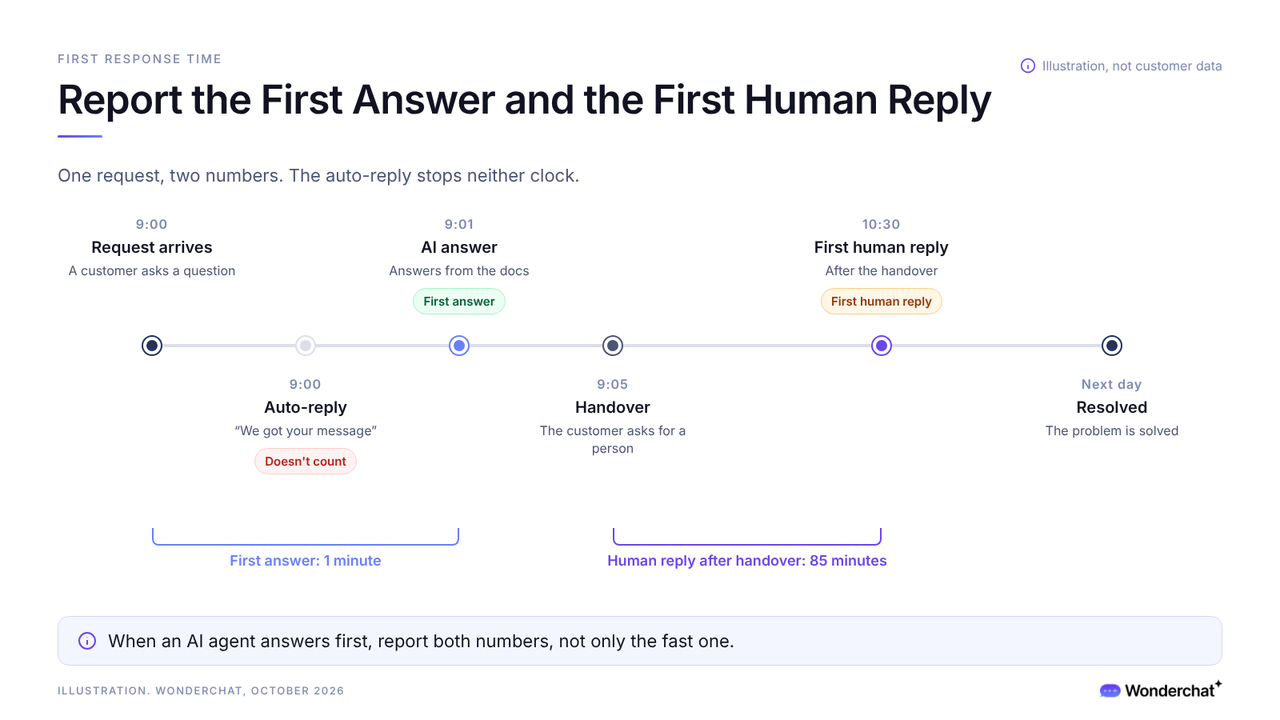
First Response Time vs an Instant Reply That Doesn't Answer
A fast first reply isn't a resolution. An instant AI reply only counts when it answers the question, and an agent that can't find the answer should hand over quickly, or the fast clock is cosmetic.
Wonderchat answers from a team's own help center and shows the source on every reply. It resolves about 75% of evaluated conversations without a person, and when no page covers a question, it says it can't find that, doesn't guess, and offers a person.
Help desks don't agree on AI replies. Zendesk leaves most bot actions out of messaging first reply time, while Gorgias reports the AI agent's first reply and the first human reply after a handover as two separate medians.
A team with an AI agent should report two numbers.
- The time to the first answer, from the agent or a person
- The time from a handover to the first human reply
Track both next to average resolution time, because a fast first answer says nothing about when the problem is solved.
Frequently Asked Questions
What is a good first response time?
A good first response time depends on the channel, so set each target from your own median. For email, a Toister Performance Solutions survey of more than 3,200 people in March 2020 found that a reply within an hour met the expectations of 88% of the consumers surveyed.
Does an automated reply count as a first response?
No. An acknowledgment like "we got your message" confirms receipt but doesn't answer. Tools differ at the edges, since Zendesk messaging counts legacy autoreplies that recommend articles, and Gorgias scores an autoresponder's first response as a fixed 60 seconds in one report, so check what yours counts.
Does an AI agent's answer count as a first response?
Only when it answers the question. Many help desks leave bot replies out by default, so report the first answer from the agent or a person and the first human reply after a handover as two numbers.
