


26/09/2026
Multi-Channel Deployment
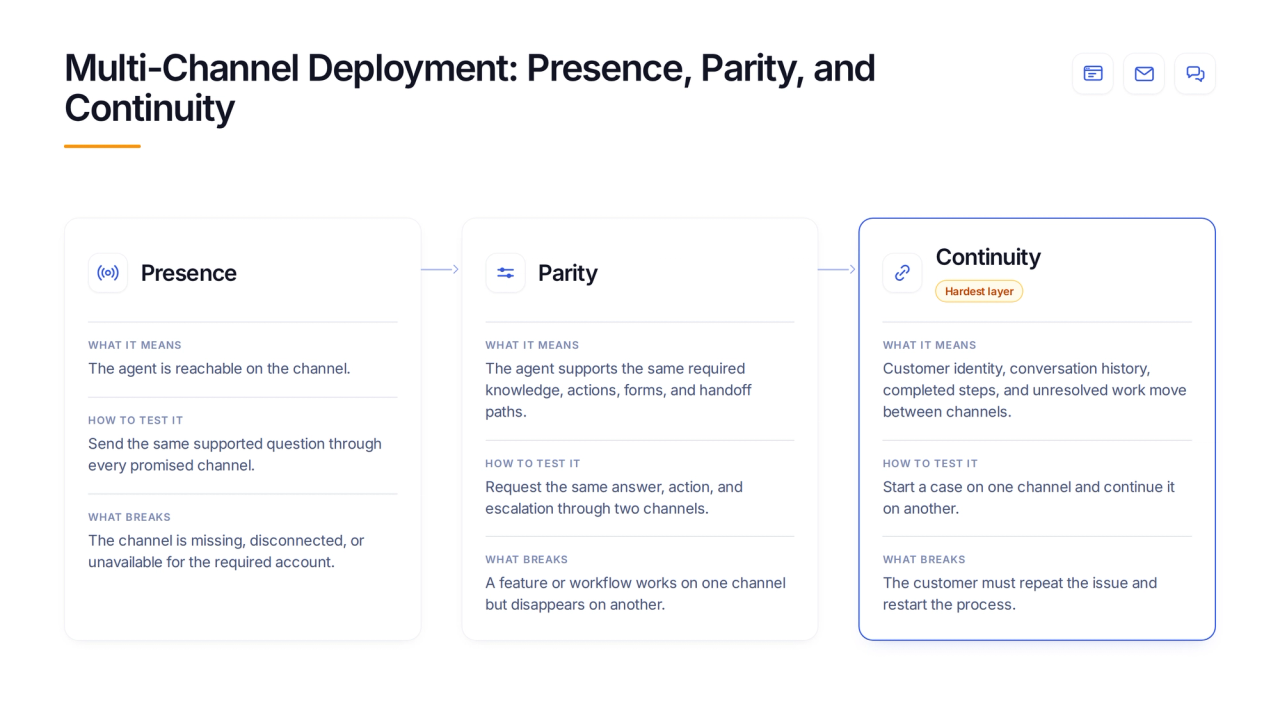
Multi-channel deployment means running the same AI agent across web, email, WhatsApp, and other support channels. It requires three separate checks: presence, parity, and continuity. Channel count measures only the first.
Multi-Channel vs Omnichannel Customer Service
Multi-channel customer service gives customers several ways to contact a business, although each channel may keep its own tools, history, and rules. An agent can therefore be present in several places while giving different answers or completing different actions in each one.
Omnichannel customer service connects those channels so identity, conversation history, and case progress can follow the customer. A deployment approaches omnichannel only when parity and continuity work alongside presence.
3 Parts of Multi-Channel Deployment
A useful assessment separates the deployment into three parts because each one can succeed or fail without the others.
- Presence means the agent is available on the channel. A customer can reach it through the promised entry point, but a channel logo doesn’t prove the connection is active for the required account or region.
- Parity means the agent can perform the same required work there. It should use the same approved knowledge and support the actions, forms, citations, and escalation paths needed on that channel.
- Continuity means the next channel recognizes the existing conversation. The platform must connect customer identity, prior messages, completed steps, and unresolved work, or the channel change begins a separate conversation.
Wonderchat defines multi-channel by continuity, not by channel count.
Wonderchat’s AI support agent can run on a website and connect to WhatsApp through a dedicated business number, while current WhatsApp documentation says human agents cannot reply directly on that connected number, showing why presence should not be treated as parity.
Where Multi-Channel Support Breaks
Consider a customer who begins a return in website chat, receives several troubleshooting steps, and later continues through a messaging app. If the second channel cannot connect the customer’s identity and earlier messages, the agent asks for the order number and problem again, even though both channels are available.
A shared knowledge base may keep the policy consistent, but it doesn’t automatically transfer the conversation or unlock the same actions everywhere. Continuity needs a link between channel histories, while parity depends on the workflows each channel supports.
How to Test a Multi-Channel Deployment
A product trial should test the channels as one customer journey, not as separate demonstrations.
- Test presence: Send a supported question through every promised channel and confirm that the intended agent answers from the approved source.
- Test parity: Request the same answer, action, and human escalation on two channels, then record any step that disappears or changes.
- Test continuity: Start a case on one channel and continue it on another, then confirm that the second channel receives the identity, messages, completed steps, and unresolved request.
Passing the first test proves channel coverage, but it doesn’t prove equal service or preserved progress when the customer moves.
Frequently Asked Questions
What is multi-channel deployment?
Multi-channel deployment makes one AI agent available through several customer contact channels. A complete assessment checks presence, capability parity, and conversation continuity on each one.
What is the difference between multi-channel and omnichannel?
Multi-channel support offers several contact channels, which may operate separately. Omnichannel support connects them so identity, conversation history, and case progress can move between channels.
Does a conversation carry across channels?
Only when the platform links the customer’s identity and conversation state across those channels. A shared knowledge base can keep answers consistent, but it doesn’t automatically transfer messages or completed steps.
