


29/10/2026
Proactive customer service
Proactive customer service means giving customers an answer before they have to ask, such as telling them about a known problem, showing the right help article at the right moment, or fixing an issue before they report it.
How does proactive customer service work?
Each proactive step starts from a question customers already ask.
- Known-issue notices: a banner or status note while a bug is being fixed.
- Help at the right moment: the article for a task, shown on the screen where people get stuck.
- Follow-ups after a fix: a short note to the customers who reported the problem.
- Answers written in advance: a help page for every question that came in more than once last month.
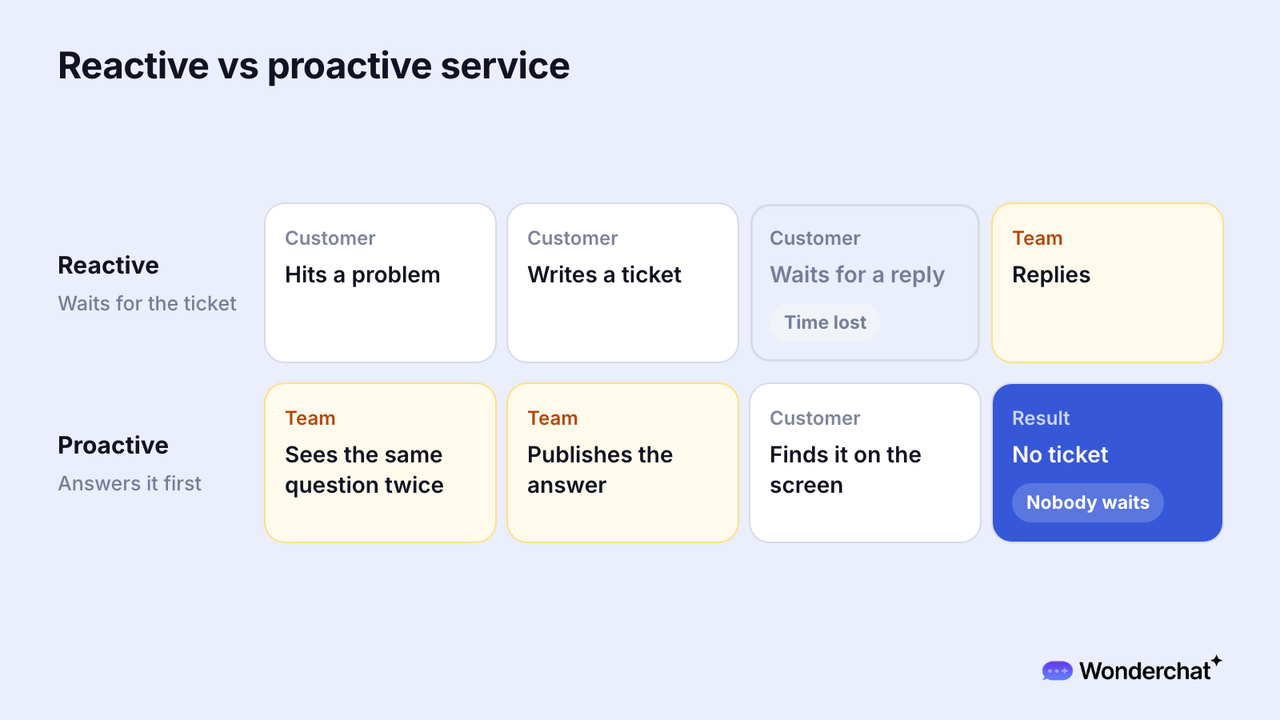
For example, a team sees the same question about exporting invoices come in twice in one week. The team publishes the answer as a help article on the billing screen, so the next customer who gets stuck finds it there, and no ticket is written.
How do you measure proactive support?
Measure the contact rate on one topic before and after the notice or article goes up.
Contact rate on a topic = contacts about the topic ÷ active customers in the period
Compare two similar periods, so a busy month doesn't hide the change. Count contacts that only check whether the notice is real separately, since they're a cost of the notice.
Those contacts add up. In a Gartner survey of more than 4,800 customers in late 2021, 24% of B2B customers followed up after proactive outreach only to confirm it wasn't a scam.
Why does proactive service start with the docs?
A team can only answer early if the answer is written down, so proactive service is a docs job more than a tools job. The self-service rate shows whether the written answers work.
In Wonderchat's study of 5,848,078 conversations, 84 businesses that added missing documentation went from 75.4% to 80.8% resolution in three months, a tendency, not a promise, since 57% improved and 23% got worse. Wonderchat answers from a team's own help center and shows the source on every reply.
When does proactive outreach create more tickets?
Outreach creates more tickets when it raises questions it doesn't answer. The same Gartner survey found that 66% of B2C and 82% of B2B customers contacted the company after receiving proactive outreach, and Eric Keller, a senior research director at Gartner, warned that "proactive outreach that raises unanswered questions erodes the benefits for customers."
Outbound marketing doesn't count, because proactive work starts with the questions customers already ask.
Each notice should say what happens next and what the customer needs to do, so it doesn't raise new questions.
Frequently asked questions
What is proactive customer service?
Proactive customer service means answering a customer's question before they have to ask it. Examples include notices about known problems, help articles shown at the right moment, and fixes made before anyone reports the issue.
What are examples of proactive customer service?
Examples are a notice about a known bug, a help article shown on the screen where users get stuck, a follow-up after a fix, and a status page during an outage. Each one answers a question before the customer asks it.
What is the difference between reactive and proactive customer service?
Reactive service waits for the customer to ask, then answers. Proactive service answers first, with a notice or a help article placed where the question comes up, so the customer doesn't need to ask.
