


16/10/2026
Canned Response
A canned response is a prewritten reply a support agent selects, checks, and sends to answer a recurring request. It saves retyping; the person still decides whether the wording fits the customer's situation.
How Canned Responses Work in Customer Support
An agent reads the request, inserts a saved reply from a library, fills in relevant details, and checks the message before sending it. The reply can become part of a support ticket, but it doesn't decide whether that ticket is resolved.
A password-reset template can explain the normal process, while a customer who loses access to both their password and recovery email needs another route. Reusing the normal instructions doesn't address that missing recovery option, even when the wording is correct.
Canned Responses vs AI Answers and Deflection
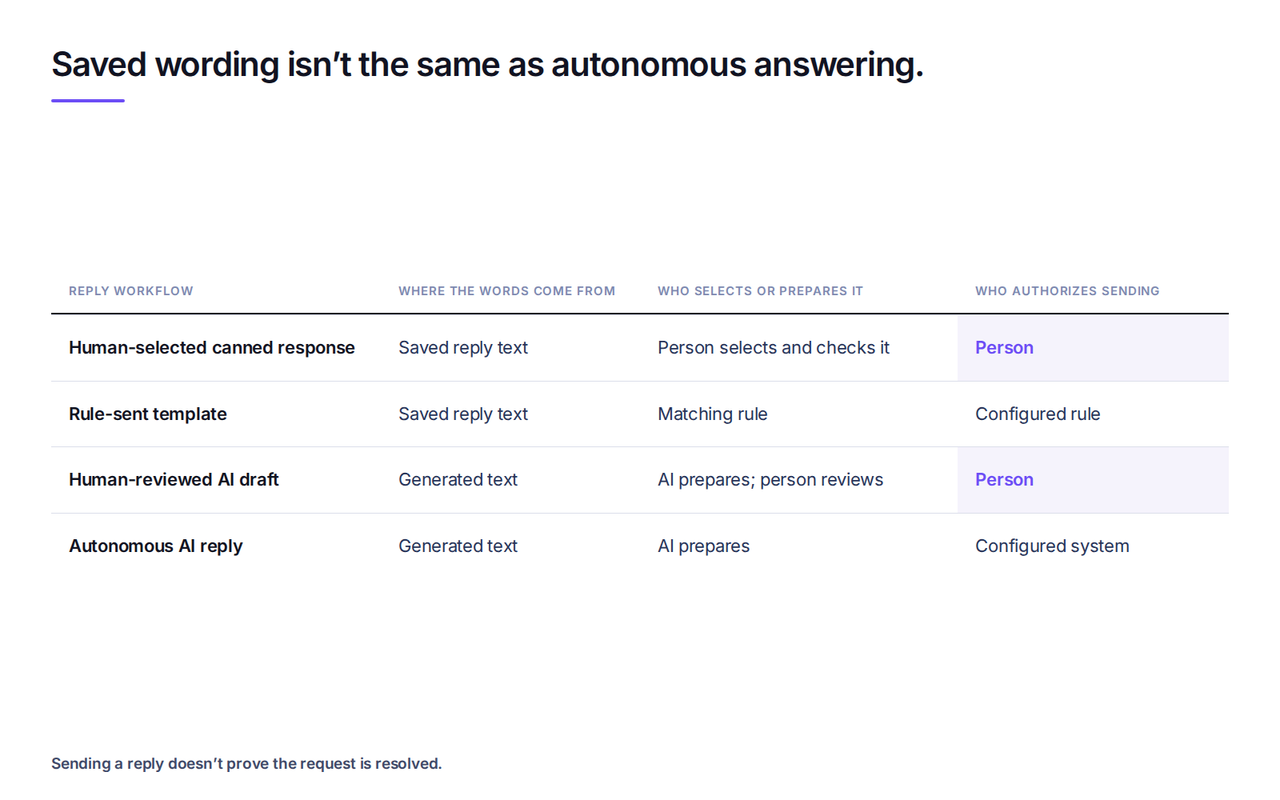
A human-selected reply still involves a person, so it doesn't demonstrate deflection rate, which concerns contacts kept away from a human queue. Template sends measure reuse, not avoided human work; counting both as the same outcome obscures that boundary.
The distinction depends on the workflow, not just the text. A rule can send saved wording automatically, while an AI-generated draft can require human approval; neither a template nor an AI label proves resolution. Buyers comparing AI ticket deflection tools need to separate reply generation, human involvement, and the customer's outcome.
When Canned Responses Fit Better Than Generated Replies
For a team that requires fixed wording and human review, Help Scout's saved replies fit better than autonomously generated answers. Templates suit approved instructions that remain stable, while exceptions still need someone to check which conditions apply.
Wonderchat publishes the method behind the number. Its support and QA observations identify a recurring failure: retrieval selects an archived policy and answers from it correctly. That risk also applies to an AI support agent that answers from documentation, so replacing templates doesn't remove source checks.
How to Measure Canned Response Use and Editing
Template-use rate = human replies using a template ÷ all human replies × 100.
The reporting period and unit need to stay consistent: count sent replies, not template insertions or whole conversations. For AI customer support, record human-approved drafts separately from replies sent without human approval.
An editing audit can add another check:
- Compare the inserted template with the final sent reply after routine name and account fields are filled.
- Calculate character edit distance, then take the median within each template.
- Review whether edits correct instructions, add missing conditions, or only personalize the wording.
Stanford's information-retrieval text defines edit distance through character insertions, deletions, and replacements. Frequent substantial edits warrant a review of template fit, but the distance isn't an accuracy score: adding “not” can reverse an instruction with little editing.
Frequently Asked Questions
Are canned responses the same as macros?
A canned response is reusable reply text. A macro can include that text and other actions, such as changing ticket fields, tags, or assignment. The terms overlap when a macro inserts a reply, but they aren't always interchangeable.
Do canned responses count as automation?
A human-selected canned response assists the agent rather than replacing human judgment. A rule-sent template automates sending, but delivery alone doesn't prove resolution or deflection. Reports need to distinguish reusable text, automatic actions, and requests handled without a person.
When should a canned response be replaced by an AI answer?
An AI answer becomes worth testing when requests vary beyond stable templates and current documentation covers those variations. The test needs to check relevant sources, unsupported questions, and human approval. Replacing templates without fixing outdated content can reproduce the same wrong instructions.
