


20/10/2026
Chatbot Fallback Message
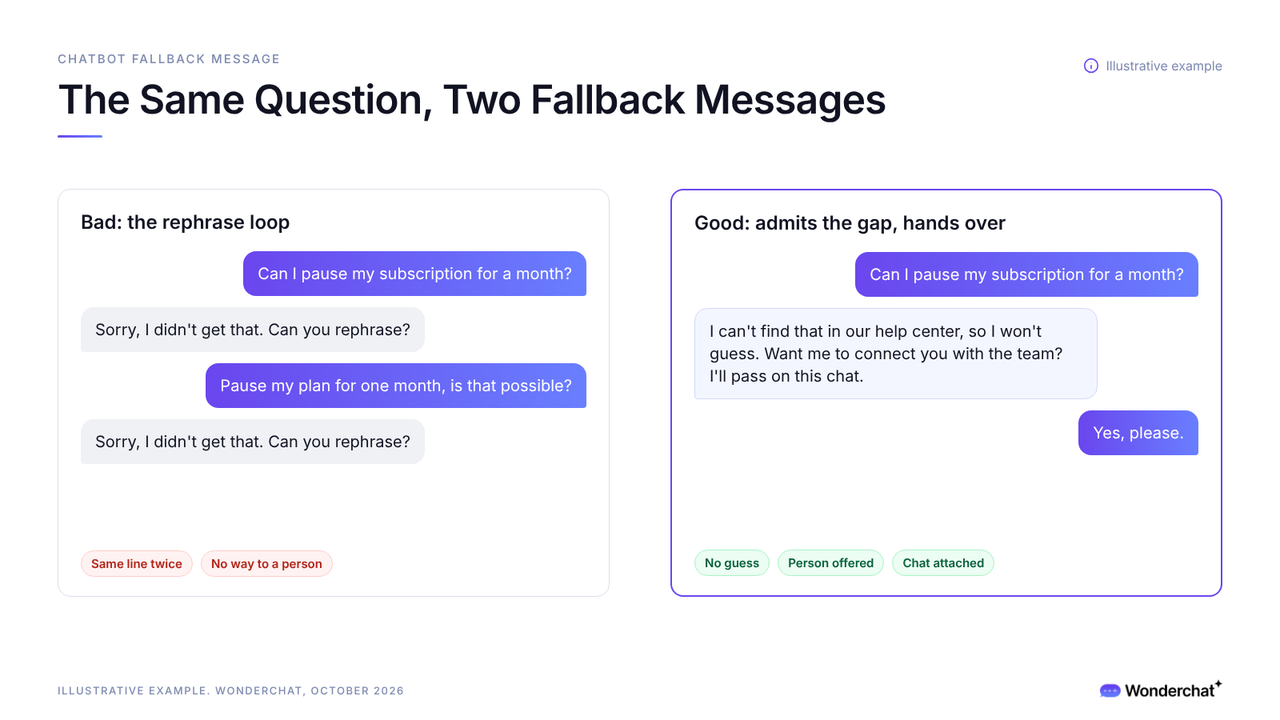
A chatbot fallback message is what a chatbot says when it can't answer, because it didn't understand the message or because no content covers it. The good ones admit the gap, don't guess, and offer a person.
What Triggers a Chatbot Fallback Message
Older chatbots fall back when they can't match a message to an intent. In Dialogflow, the default fallback intent fires when the input matches no other intent, and Rasa predicts its fallback when every intent scores below a set confidence threshold.
AI agents that answer from your content need a second trigger, for questions they understand but no page answers. Zendesk's AI agent tells the customer it can't answer when no relevant knowledge is found, and Rasa now keeps a separate default reply for each case.
After the message comes the handover. IBM's agent builder, for example, can escalate to a person on a direct request or a low confidence score, and the conversation should travel with it so the customer doesn't start again. Escalation and handoff cover that step.
How to Test Your Chatbot's Fallback Message
Run three checks, one condition at a time.
- Missing knowledge. Ask a plausible question your docs don't cover, such as a policy you've never written down. The bot passes if it says it can't find the answer and invents no policy, price, or date.
- Missing intent. Send a vague or off-topic message. The bot passes if it asks you to rephrase once, then offers options or a person instead of repeating itself.
- Handover. Ask for a person, or get two answers wrong in a row. The bot passes if it offers a person and the conversation reaches your inbox with the chat attached.
To track misses over time, count the fallback rate the way Dimension Labs defines it.
Fallback rate = messages that triggered a fallback ÷ all customer messages
Some vendors count per conversation instead, so compare like with like.
The number alone won't show what to fix, so read the questions behind it. When Wonderchat read every promise on twelve competitor homepages on 10 September 2026, none of the twelve promised to show the questions it couldn't answer.
Why the Fallback Message Decides Whether Customers Trust the Bot
The fallback is the moment a customer learns what the chatbot does when it doesn't know. An honest miss with a quick path to a person keeps the conversation going, while a rephrase loop sends the customer to email with the same question.
Fallback Message vs a Confident Wrong Answer
Most advice treats the fallback as the failure to fix. The more dangerous failure is the confident wrong answer, because it never triggers a fallback at all.
A chatbot that answers from an outdated page, or fills a gap with a plausible guess, sounds as sure as one that's right. OpenAI's research puts it plainly, "errors are worse than abstentions."
So the goal isn't the lowest possible fallback rate. A rate near zero can mean the bot guesses instead of admitting gaps, and a confidence threshold decides where that line falls.
Wonderchat answers from a team's own help center and shows the source on every reply.
Frequently Asked Questions
What does fallback mean in AI?
In a chatbot, a fallback is the response it gives when it can't handle a message. Outside chatbots, the word also means switching to a backup model or system when the first one fails, which is a different thing.
What should a chatbot fallback message say?
A fallback message should say plainly that the chatbot can't find or understand the answer, avoid guessing, and give one clear next step, usually a person. For example, "I can't find that in our help center. Want me to connect you with the team?"
What is a good fallback rate?
Published targets such as "under 5%" are starting points, not benchmarks, as Dimension Labs says of its own. Track your rate weekly, counted the same way, since a very low rate can hide confident wrong answers.
