


21/10/2026
Ticket Volume
Ticket volume, also called customer inquiry volume, is the number of support requests a team receives in a set period, across every channel. It measures how much work arrives, not how much of it needed a person.
What Counts Toward Ticket Volume
Every request a customer opens counts, whatever the channel, from email and chat to phone, social messages, and contact forms. Count each request once, even when the same customer writes by email and then by chat about the same problem.
Help desks agree on the core and differ at the edges. Zendesk leaves deleted tickets out, Freshdesk counts only the primary ticket after a merge, and Gorgias excludes merged, trashed, and spam tickets.
A reopened ticket isn't new volume. Metabase's metric guide calls a reopen "continued work on an existing ticket, not a new arrival."
How to Calculate Ticket Volume
Ticket volume = support requests created in the period, across all channels, each counted once
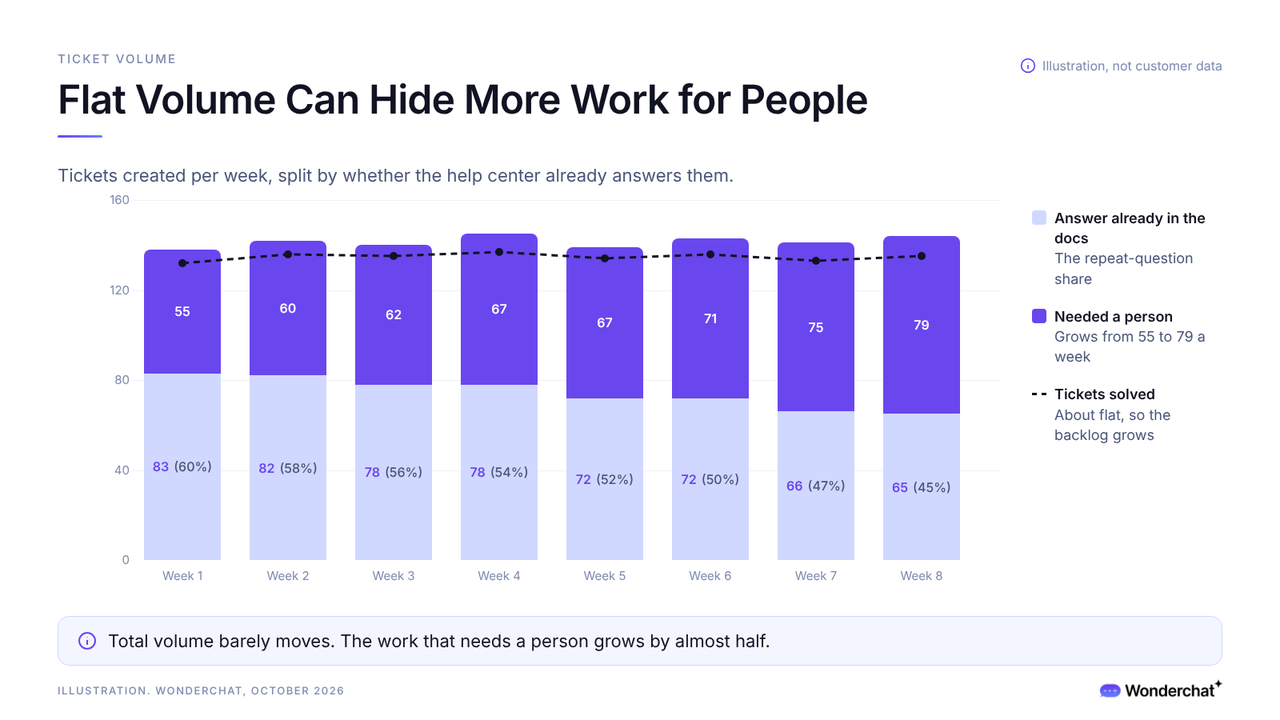
Read it next to the tickets solved in the same period. When created stays above solved week after week, the backlog grows.
To compare months while the business grows, divide by active customers or orders. The result is the contact rate, and Gorgias gives the same formula, tickets ÷ orders or customers.
Hypothetical month
- Requests logged across email, chat, and forms: 610
- Spam and merged duplicates: 40
- Ticket volume: 570
- Tickets solved in the same month: 540, so the backlog grows by 30
- Contact rate (570 ÷ 1,200 active customers): About 48 per 100 customers
- Tickets the help center already answers: 342, a repeat-question share of 60%
Repeat-question share is a label this entry uses for the share of tickets whose answer already exists in your help center or docs. The label doesn't mean a repeat contact, where one customer writes again about the same issue.
Why Ticket Volume Is Important for a Small Team
For a small team, ticket volume raises the staffing question, whether to hire another person or answer the repeat questions from your own content first.
Jortt, a Dutch accounting platform and Wonderchat customer, resolves about 92% of roughly 30,000 monthly inquiries without a person. Its inquiry count and the share that needs a person are very different numbers.
Why Total Ticket Volume Is the Wrong Number to Manage
A queue makes volume visible, but it doesn't reduce it. When most tickets are the same few questions asked again; the total volume is the wrong number to manage.
The number to manage is the repeat-question share, because those tickets already have an answer. Answer them from your docs, and the tickets left are the ones a person needs to see.
A falling count can mislead too. When an AI agent answers without opening a ticket, created tickets drop while customer demand stays the same, so track questions answered and tickets created side by side.
Wonderchat answers from a team's own help center and shows the source on every reply.
Frequently Asked Questions
What is the ticket volume formula?
Ticket volume is the number of support requests created in a period, across all channels, with each request counted once. Leave out spam and merged duplicates. Divide it by active customers or orders to get the contact rate.
What is a good ticket volume per customer?
There's no universal benchmark, because it depends on what you divide by. In Gorgias data from March 2026 for ecommerce brands at the $10M GMV band, tickets per 100 orders ranged from 19 to 46 by vertical. Outside ecommerce, track your own contact rate weekly.
How do you reduce ticket volume without hiding problems?
Answer the repeat questions from your own docs, and keep a clear path to a person. Then review the questions your docs couldn't answer, and write those pages. Volume that falls because customers gave up isn't progress.
