


29/10/2026
Tier 1 support
Tier 1 support is the first level where a person answers a customer. Tier 1 agents resolve common questions that have a known answer and pass anything they can't solve to tier 2, with the conversation attached.
What are tier 0, tier 1, tier 2, and tier 3 support?
Support tiers sort questions by who can answer them, with self-service at tier 0 and engineering at tier 3. Zendesk notes that L1, L2, and L3 "are different ways of saying tier 1, 2, and 3 support."
- Tier 0: self-service, such as a help center or a chatbot, for questions a customer can look up alone.
- Tier 1: the first person a customer reaches, for questions with a known answer and account basics.
- Tier 2: a person with deeper product knowledge or account access, for problems beyond the documented steps.
- Tier 3: experts or engineering, for bugs and code-level issues.
In a team of three, the same person can cover tiers 1, 2, and 3.
Is tier 1 support just the easy questions?
No, because difficulty is the wrong test. Zendesk describes tier 1 agents as trained to handle "simple and frequently asked customer inquiries," yet a hard question with a written answer can be solved at tier 1, and a simple question with no written answer still needs a person.
Findability is where self-service breaks most often. In a Gartner survey of 5,728 customers, conducted in December 2023, only 14% of service issues were fully resolved in self-service, and the most common failure, in 43% of cases, was not finding content relevant to the issue.
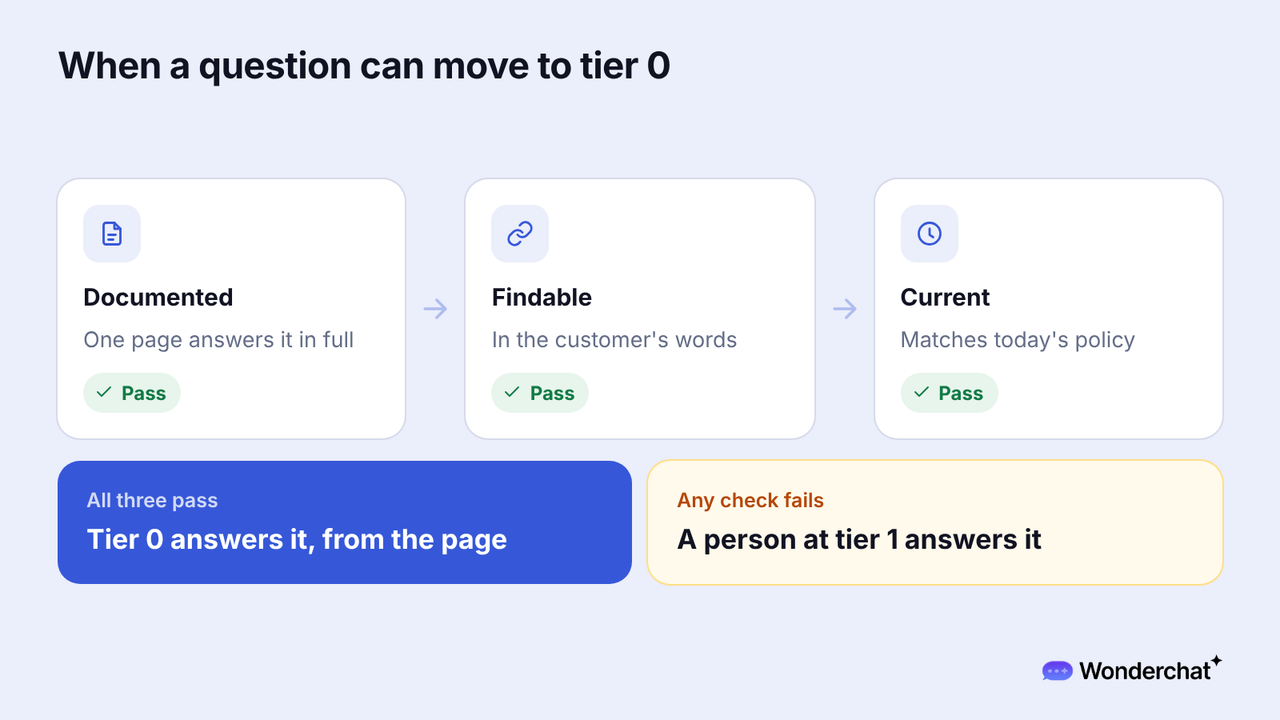
What decides tier 1 is whether a known answer exists. Once that answer is documented, easy to find, and current, the question can move down to tier 0.
For example, "How do I add a second billing contact?" moves to tier 0 once one current help center page answers it in full and customers can find it in their own words. Until then, a person at tier 1 retypes the answer.
Wonderchat resolves about 75% of evaluated conversations without a person, and when no page covers a question, it says it can't find that and doesn't guess.
Wonderchat answers from a team's own help center and shows the source on every reply.
How do you tell which questions belong in tier 1?
Run three checks, plus a handoff check, on the last 20 conversations a person answered.
- Documented: search the help center for each answer. Count it only if one page answers it in full, since half an answer still ends with a person.
- Findable: search again in the customer's own words. The right page should show in the first results, because not finding content was the failure Gartner counted most.
- Current: open each page and compare it with today's policy or product, because an outdated page still answers, just wrongly.
- Passed with context: open 10 conversations sent to tier 2. Tier 2 should be able to act without asking the customer to repeat anything, since a customer who repeats the problem waits twice.
To count how much tier 1 resolves, count conversations closed without going to tier 2, and define "closed" once. MetricNet calls this first-level resolution, which isn't first contact resolution, the share solved on the first contact.
Published tier 1 targets run from HDI's 2018 range of 40% to 60% to TechTarget's 70% to 80%, and neither page cites a study, so set the target from your own baseline.
Frequently asked questions
What is the difference between tier 1 and tier 2 support?
Tier 1 is the first person a customer reaches, and it answers questions that have a known answer. Tier 2 takes what tier 1 passes on, such as problems that need deeper product knowledge, account access, or troubleshooting beyond the documented steps.
What does a tier 1 support agent do?
A tier 1 agent answers questions that already have a written answer, such as account basics and how-to steps, and passes the rest to tier 2 with the conversation attached.
Can an AI agent handle tier 1 support?
An AI agent that answers from the help center can take the questions the docs already cover and pass the rest to a person. Labels differ, since Zendesk puts chatbots at tier 0, while Decagon says AI agents can now do tier 1 work.
