


13/11/2026
Ticket Backlog
A ticket backlog is the number of support tickets still unsolved at a given moment. Teams count it two ways, every unsolved ticket or only those past their target time.
Where does a ticket backlog come from?
Tickets come in, which is ticket volume, and get solved. The backlog is the level between the two:
End-of-day backlog = start-of-day backlog plus tickets created minus tickets solved
Zendesk reports it as the unsolved tickets at the end of each day, and new, open, pending, and on-hold tickets all count. HDI's 2020 metric-of-the-month article sorts age into bands of under 10 days, 10 to 30 days, and over 30 days.
The level rises when created stays above solved, when the same questions keep arriving, when ticket routing leaves tickets with no owner, and when pending tickets wait on customers who never reply.
How do you measure a ticket backlog?
Four numbers cover it:
- Backlog: unsolved tickets at a set time each day
- Daily change: tickets created minus tickets solved
- Share of daily volume: backlog ÷ average tickets per day, which in HDI's 2020 example is 10 ÷ 200 = 5%
- Aged backlog: unsolved tickets older than the team's target time
What counts is every ticket not yet solved or closed, with spam and duplicates merged out.
Closing old tickets in bulk is the trap Metabase lists for this metric. The chart looks better, and the customers behind those tickets leave without an answer.
Why a growing backlog shows up before slow replies
The backlog moves before reply times do. A positive created-minus-solved gap today becomes tomorrow's late replies, before average resolution time or satisfaction scores show it.
If the gap is a few tickets a day and some of them ask what the docs already answer, fix the inflow before adding a person. Compare AI agents for tier 1 support on how much of that inflow each one answers.
Why does a cleared backlog come back?
Backlog definitions count tickets at one moment. That snapshot hides the daily gap between what arrives and what gets closed, and the gap is what refills a cleared backlog.
A push to clear the backlog lowers the count once. InvGate makes the same point about recurring incidents, which refill the queue after it has been cleared.
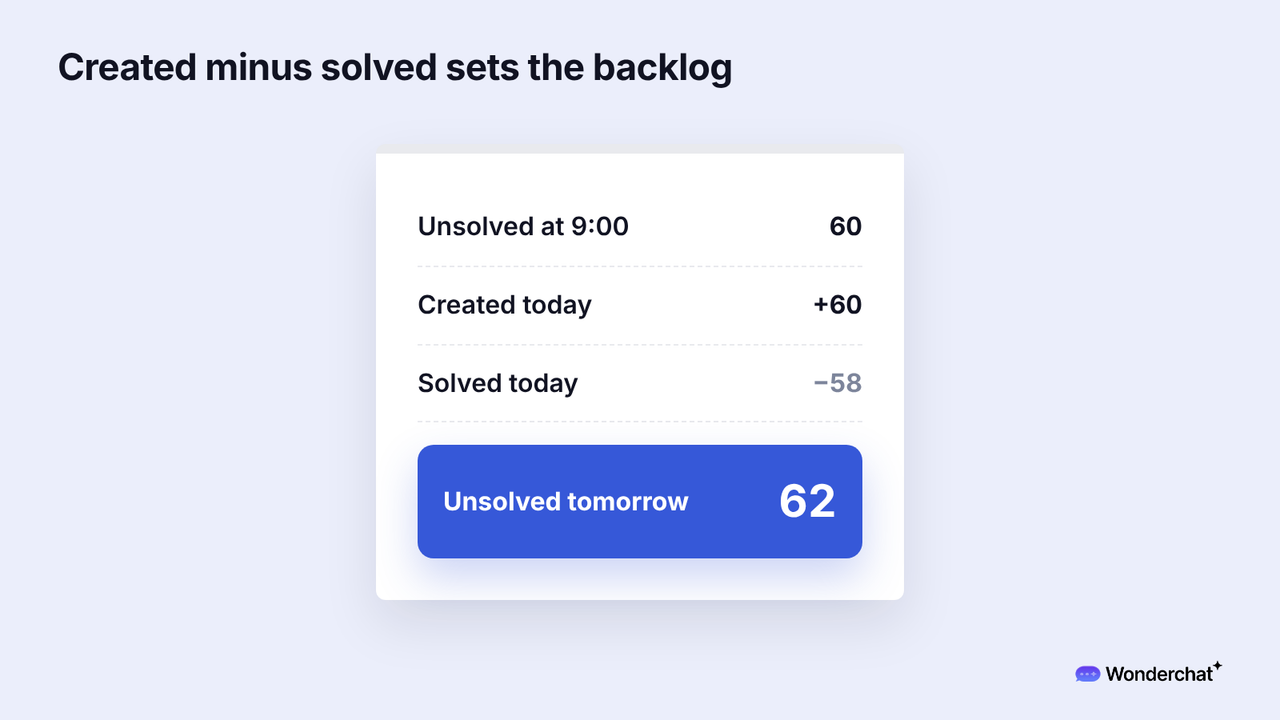
For example, 60 tickets in and 58 solved a day grows the backlog by 2 a day, so a push that solves 40 extra is refilled in 20 working days. If 10 of the 60 daily questions are answered from the help center before they become tickets, the backlog falls by 8 a day.
The lever that lasts without hiring is fewer tickets coming in, from questions the help center answers, or should. Wonderchat answers from a team's own help center and shows the source on every reply.
In Wonderchat, a team approves a question and its answer once as a correction. The AI agent uses it the next time a customer asks the same thing or something with the same meaning.
In Wonderchat's study of 5,848,078 conversations between March 2023 and August 2026, 84 businesses that added missing documentation went from 75.4% to 80.8% of conversations resolved in three months, +5.4 points on average, while 57% improved and 23% got worse.
Frequently asked questions
What is the difference between ticket backlog and ticket volume?
Ticket volume counts the tickets that arrive in a period. The backlog counts the ones still unsolved at a moment.
Do pending tickets count as backlog?
In Zendesk's backlog they do. Pending is an unsolved status there. Report pending tickets on a separate line. They wait on the customer's reply, and the team can't solve them alone.
Is a ticket backlog a bad thing?
A small, steady backlog is normal. Tickets that arrive late in the day wait until morning. A backlog that grows or ages week after week needs fewer tickets coming in or more hours solving them.
