


20/11/2026
Customer Effort Score
Customer effort score (CES) measures how easy it was for a customer to get an issue handled. It comes from one survey question after an interaction, such as a rating of how easy the company made it.
CEB introduced it in a Harvard Business Review article, as IBM recounts.
How does a customer effort score survey work?
The survey follows an interaction, such as a closed ticket or a chat, with one question in one of three forms:
- Agree or disagree: "The company made it easy for me to handle my issue." Salesforce calls this version the most common, on a scale such as 1 to 5 or 1 to 7, where higher means easier
- Effort rating: a scale such as 1 to 5 that runs very easy to very difficult, where a low number can mean easy
- Faces or numbers: a row of emoji or a plain numeric scale
Qualtrics lists switching channels, repeating information, generic answers, and being transferred as the moments that create effort.
Writing in a second language adds effort too. In Wonderchat's study of 5,848,078 conversations between March 2023 and August 2026, English was 38% of conversations and German 20%, in a sample of 40,000 messages.
CSAT asks how the customer felt, and first contact resolution counts contacts. CES asks how hard the customer had to work.
How do you calculate customer effort score?
Name the scale and its direction with every number:
- Average CES = sum of scores ÷ number of responses
- Share easy = responses at the easy end ÷ all responses × 100
- Net CES = % positive minus % negative, neutral answers left out, the formula Zendesk uses for emoji scales
For example, 80 responses on a 7-point agree scale split 52 at 5 to 7, 16 at 4, and 12 at 1 to 3. Share easy is 52 ÷ 80 = 65%, and net CES is 65% minus 15%, or 50 points.
Track repeat contacts on the same issue within seven days and the messages a customer sent before a person took over. Neither needs a survey.
Why does customer effort matter?
Effort predicts what a customer does next better than how they felt. CEB's research, as Qualtrics quotes it, found that 96% of customers with a high-effort service interaction become more disloyal, against 9% after a low-effort one.
Zendesk reports Gartner's finding that a low-effort interaction costs 37% less. For the team, every repeat contact is another ticket about the same problem.
CES sits beside the customer service KPIs.
Where does most customer effort happen?
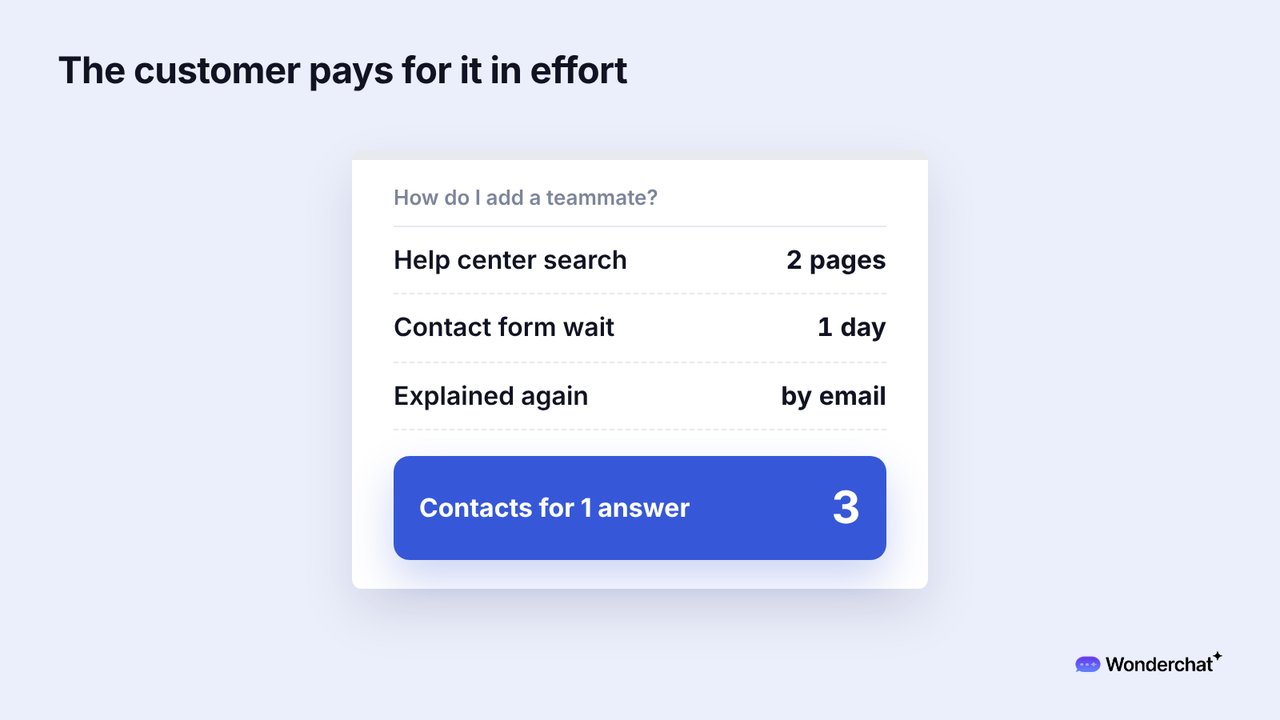
A CES survey sent after a ticket closes hears only from customers who reached a person and stayed to the end. Effort also builds earlier, while the customer searches the help center, waits for a reply, or explains the problem again on a second channel.
An answer from the docs at the moment of the question removes the search and the wait.
Wonderchat answers from a team's own help center and shows the source on every reply. When it can't answer, its AI agent says so and hands over with the full chat attached, so the customer doesn't explain the problem twice.
The same AI agent adds effort when it loops or hides the way to a person. Send the survey after AI-handled conversations as well as after closed tickets.
Frequently asked questions
What is a good customer effort score?
Zendesk says no industry standard exists. IBM suggests the top 20% of whatever scale you use, such as 4 or higher on 1 to 5.
Is a higher or lower customer effort score better?
It depends on the scale. On an agree scale, higher means easier. On an effort scale that starts at very easy, a lower number can mean easier.
What is the difference between CES and CSAT?
CSAT asks how satisfied the customer was, and CES asks how hard it was to get the issue handled. A customer can rate a friendly teammate highly after five contacts.
